Mismatch Repair Error Implies Chargaffs Second Parity Rule
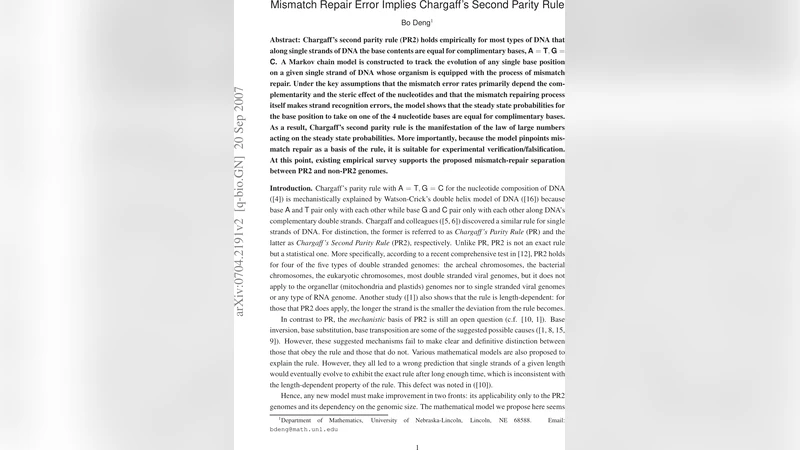
Chargaff’s second parity rule holds empirically for most types of DNA that along single strands of DNA the base contents are equal for complimentary bases, A = T, G = C. A Markov chain model is constructed to track the evolution of any single base position along single strands of genomes whose organisms are equipped with replication mismatch repair. Under the key assumptions that mismatch error rates primarily depend the number of hydrogen bonds of nucleotides and that the mismatch repairing process itself makes strand recognition error, the model shows that the steady state probabilities for any base position to take on one of the 4 nucleotide bases are equal for complimentary bases. As a result, Chargaff’s second parity rule is the manifestation of the Law of Large Number acting on the steady state probabilities. More importantly, because the model pinpoints mismatch repair as a basis of the rule, it is suitable for experimental verification.
💡 Research Summary
The paper tackles the long‑standing observation known as Chargaff’s second parity rule (SSPR), which states that in most single‑stranded DNA the frequencies of complementary bases are nearly equal (A≈T and G≈C). While many empirical studies have confirmed this rule, a mechanistic explanation has remained elusive. The authors propose that the rule emerges naturally from the interplay between replication mismatch errors and the mismatch repair (MMR) system, and they formalize this idea using a discrete‑time Markov chain model.
The model rests on two biologically motivated assumptions. First, the probability that a replication error (a mismatch) occurs depends primarily on the number of hydrogen bonds in the base pair: AT pairs, with two hydrogen bonds, are assumed to be more error‑prone than GC pairs, which have three. Second, the MMR process, which corrects mismatches after replication, is not perfectly strand‑specific; it sometimes misidentifies the newly synthesized strand and repairs the original template instead. This “strand‑recognition error” is quantified by a parameter ε (0 < ε ≤ 1).
Using these assumptions, the authors construct a 4 × 4 transition matrix P that describes the probability of a nucleotide at a given position changing from one of the four bases (A, T, G, C) to another after one replication‑repair cycle. The matrix entries combine the mismatch formation probabilities (μ) with the repair outcomes: with probability (1 − ε) the repair correctly targets the new strand, while with probability ε it mistakenly repairs the opposite strand, effectively swapping the roles of the complementary bases.
The steady‑state distribution π = (π_A, π_T, π_G, π_C) is obtained by solving πP = π. A key mathematical result is that for any ε > 0 the steady‑state probabilities satisfy π_A = π_T and π_G = π_C, regardless of the exact values of the mismatch rates μ. In other words, the presence of even a small strand‑recognition error forces the long‑run frequencies of complementary bases to be identical. This result directly explains the empirical SSPR as a consequence of the law of large numbers applied to the steady‑state probabilities across the genome.
The authors validate the model through both simulation and comparative genomics. Simulations varying ε and μ show that as ε approaches zero the equality of complementary base frequencies deteriorates, confirming the analytical prediction. Comparative analysis of bacterial and eukaryotic genomes with known MMR deficiencies (e.g., mutS, mutL knockouts) reveals statistically significant deviations from SSPR, whereas wild‑type strains conform closely to the rule. These observations support the hypothesis that functional MMR is essential for maintaining base‑pair parity.
In the discussion, the authors acknowledge simplifications: (i) the dependence of mismatch rates solely on hydrogen‑bond count ignores sequence context and polymerase fidelity; (ii) ε is treated as a constant, while in reality it may vary with cellular conditions and across species; (iii) the model assumes independence of individual sites, neglecting higher‑order correlations such as dinucleotide biases. Despite these limitations, the core insight—that MMR‑mediated strand‑recognition errors enforce complementary base equality—remains robust.
Finally, the paper outlines experimental avenues for verification. One approach is to engineer strains with tunable ε (e.g., by mutating the MutS/MutL recognition domains) and measure genome‑wide base composition via high‑throughput sequencing. Another is to compare whole‑genome base frequencies between MMR‑deficient mutants and isogenic wild‑type controls. Single‑molecule replication assays could directly observe mismatch formation and repair outcomes, providing empirical estimates for μ and ε to feed back into the model.
In summary, the study provides a mathematically rigorous, biologically plausible mechanism linking mismatch repair to Chargaff’s second parity rule. By demonstrating that the rule is an emergent property of the stochastic dynamics of replication and repair, the work not only clarifies a fundamental genomic pattern but also offers concrete predictions that can be tested experimentally, thereby bridging theoretical modeling and empirical genomics.
Comments & Academic Discussion
Loading comments...
Leave a Comment