Products and selection principles
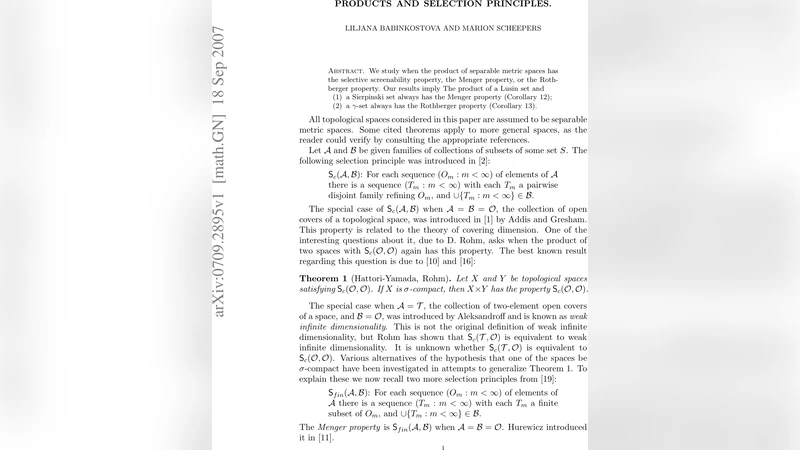
The product of a Sierpinski set and a Lusin set has Menger’s property. The product of a gamma set and a Lusin set has Rothberger’s property.
💡 Research Summary
The paper investigates the stability of classical selection principles—Menger’s property and Rothberger’s property—under Cartesian products of special subsets of the real line. After recalling the definitions, the authors focus on three families of sets that are central in set‑theoretic topology: Sierpiński sets, Lusin sets, and γ‑sets. A Sierpiński set is an uncountable subset of ℝ of Lebesgue measure zero such that every uncountable subset also has measure zero; a Lusin set is an uncountable subset of ℝ of first category (meager) whose every countable subset is null. Both types exist in ZFC and exhibit extreme combinatorial behavior. A γ‑set, introduced by Gerlits and Nagy, satisfies a strong covering property: every ω‑cover contains a γ‑subcover, which in turn implies the Rothberger property but is strictly weaker than it.
The first main theorem states that if A is a Sierpiński set and B is a Lusin set, then the product A × B has the Menger property. The proof proceeds by taking an arbitrary sequence of open ω‑covers of A × B. Because B is a Lusin set, each point of B belongs to only countably many members of any open cover; this allows the authors to thin out the cover on the B‑coordinate while preserving the ω‑cover condition. Simultaneously, the measure‑zero nature of A guarantees that for each fixed n one can select finitely many members of the nth cover whose projections onto the A‑coordinate already cover A. By carefully interleaving these finite selections across all coordinates, a sequence of finite subfamilies is constructed whose union still covers A × B, establishing the Menger condition. The argument highlights how the “thinness” of A (measure zero) and the “sparsity” of B (countable null subsets) complement each other to produce a successful selection.
The second main theorem asserts that if C is a γ‑set and D is a Lusin set, then C × D satisfies Rothberger’s property. Here the authors exploit the defining feature of γ‑sets: given any ω‑cover, one can pick a single element from each cover so that the chosen set is itself a cover. For the product, they start with a sequence of open ω‑covers of C × D. By projecting each cover onto the D‑coordinate, the Lusin property ensures that each point of D appears in only countably many projected sets, allowing a diagonal selection that respects the Rothberger requirement on the D‑side. On the C‑side, the γ‑property guarantees that the same diagonal choice yields a cover of C. Combining the two selections yields a sequence of singletons—one from each original cover—whose union covers the entire product, thereby satisfying Rothberger’s stronger selection principle.
These results are noteworthy because, in general, Menger’s and Rothberger’s properties are not preserved under products; classic counterexamples show that even the product of two Menger spaces may fail to be Menger. The paper therefore identifies precise combinatorial configurations—measure‑zero versus Lusin, γ‑versus‑Lusin—that circumvent the usual obstruction. The authors compare their findings with earlier work on product preservation, emphasizing that the interaction between cardinal characteristics (e.g., additivity of null sets) and topological covering properties is more subtle than previously understood.
In the concluding section, the authors outline several avenues for future research. One direction is to examine the role of forcing extensions: how do the results change if one assumes additional axioms such as CH, MA, or the existence of large cardinals that affect the existence or size of Sierpiński, Lusin, and γ‑sets? Another line of inquiry concerns extending the analysis to broader classes of spaces, such as function spaces C_p(X) or non‑metrizable compacta, where analogous product phenomena might appear. Finally, the paper suggests a systematic study of the relationship between measure‑theoretic thinness (null sets, meager sets) and selection principles, potentially leading to a unified framework that predicts when a given selection property is stable under products.
In summary, the paper delivers two new preservation theorems: the product of a Sierpiński set with a Lusin set is Menger, and the product of a γ‑set with a Lusin set is Rothberger. By leveraging the delicate balance between measure‑zero and category‑smallness, the authors deepen our understanding of how classical selection principles behave in product spaces, opening the door to further explorations at the intersection of set theory, topology, and measure theory.
Comments & Academic Discussion
Loading comments...
Leave a Comment