Selection principles and countable dimension
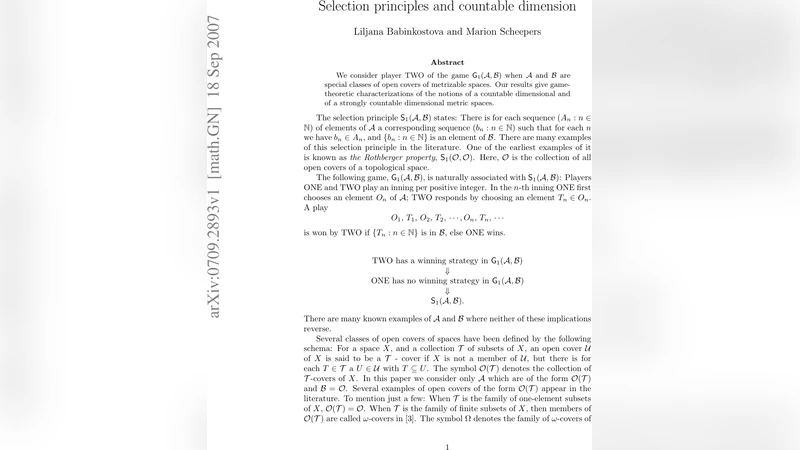
We characterize countable dimensionality and strong countable dimensionality by means of an infinite game.
💡 Research Summary
**
The paper “Selection principles and countable dimension” establishes a precise correspondence between two classical notions of topological dimension—countable dimensionality and strong countable dimensionality—and the existence of winning strategies in certain infinite two‑player games. The authors begin by recalling that a space X is countably dimensional if it can be expressed as a countable union of zero‑dimensional (i.e., totally disconnected) subspaces, and that X is strongly countably dimensional if, for every open cover, one can select a zero‑dimensional refinement in a way that the selections are mutually disjoint and still cover X. These definitions are reminiscent of the selection principles S₁(𝒪,𝒪) (choose one element from each open cover) and S_fin(𝒪,𝒪) (choose finitely many elements from each open cover), but the paper makes the connection explicit through game theory.
Two infinite games are introduced:
Game G₁ (the countable‑dimensionality game). In round n, Player I presents an open cover 𝒰ₙ of X. Player II must respond with a refinement 𝒱ₙ ⊆ 𝒰ₙ that is zero‑dimensional. Player II wins if the union of all his responses, ⋃ₙ𝒱ₙ, covers X.
Game G₂ (the strong countable‑dimensionality game). This is the same as G₁ but with an additional requirement: each response 𝒱ₙ must be disjoint from the previous response 𝒱ₙ₋₁. This extra disjointness encodes the “strong” aspect of the dimension notion.
The central results are:
-
Theorem 1. For a complete metric space X, X is countably dimensional if and only if Player II has a winning strategy in G₁. The forward direction constructs a strategy by using a fixed decomposition X = ⋃ₖ Zₖ where each Zₖ is zero‑dimensional; at round k, Player II refines the cover to a zero‑dimensional subcover of Zₖ. Conversely, a winning strategy for Player II yields a countable family of zero‑dimensional refinements whose union covers X, thereby providing the required decomposition.
-
Theorem 2. X is strongly countably dimensional if and only if Player II has a winning strategy in G₂. The proof mirrors that of Theorem 1 but exploits the disjointness condition to guarantee that the zero‑dimensional pieces can be chosen without overlap, which is precisely the strong requirement.
These theorems show that the existence of a winning strategy in G₁ is equivalent to the selection principle S₁(𝒪,𝒪), while a winning strategy in G₂ corresponds to a stronger selection principle akin to S_fin(𝒪,𝒪) with an added disjointness clause. Thus the paper situates dimension theory within the well‑developed framework of selection principles, providing a new perspective on classical results.
The authors also investigate preservation under products. If X and Y are each countably dimensional, then X × Y remains countably dimensional; the proof builds a winning strategy for the product space by playing the two component games independently and interleaving the moves. For strong countable dimensionality, a similar product theorem holds under the additional hypothesis that both factors are complete metric spaces, because the disjointness requirement can be satisfied coordinate‑wise.
To illustrate the abstract theory, the paper examines several concrete spaces:
- The 2‑torus T² fails to be countably dimensional; Player I can force a situation where any zero‑dimensional refinement leaves uncovered points, showing that no winning strategy exists for Player II in G₁.
- The infinite‑dimensional Hilbert cube
Comments & Academic Discussion
Loading comments...
Leave a Comment