Reduced-order 4D-Var: a preconditioner for the Incremental 4D-Var data assimilation method
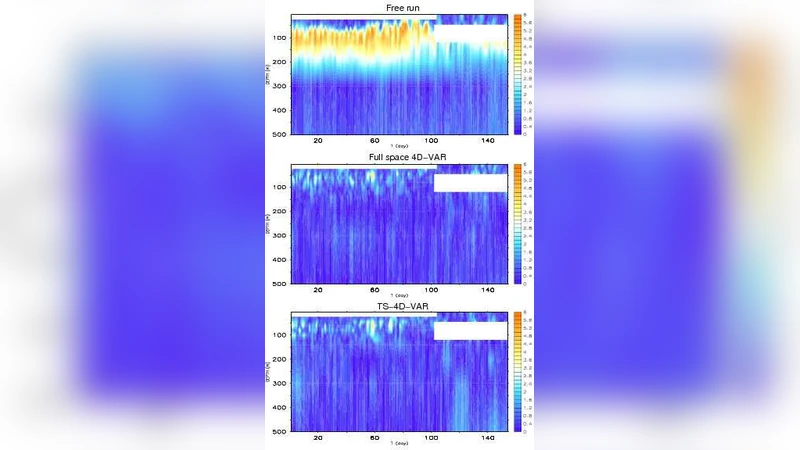
This study demonstrates how the incremental 4D-Var data assimilation method can be applied efficiently preconditione d in an application to an oceanographic problem. The approach consists in performing a few iterations of the reduced-order 4D-Var prior to the incremental 4D-Var in the full space in order to achieve faster convergence. An application performed in the tropical Pacific Ocean, with assimilation of TAO temperature data, shows the method to be both feasible and efficient. It allows the global cost of the assimilation to be reduced by a factor of 2 without affecting the quality of the solution.
💡 Research Summary
The paper introduces a novel preconditioning strategy for the incremental four‑dimensional variational (4D‑Var) data assimilation method, aimed at reducing the computational burden in high‑dimensional oceanographic applications. Incremental 4D‑Var works by linearising a nonlinear model around a trajectory and then iteratively minimising a quadratic cost function in the linearised space. While this approach is theoretically sound, the dimensionality of global ocean models—often ranging from hundreds of thousands to millions of state variables—makes each iteration computationally expensive, limiting its use in real‑time or near‑real‑time assimilation systems.
To address this, the authors propose to precede the full‑space incremental 4D‑Var with a few iterations of a reduced‑order 4D‑Var (RO‑4D‑Var). In RO‑4D‑Var the state vector is projected onto a low‑dimensional subspace spanned by a small set of dominant empirical orthogonal functions (EOFs) or proper orthogonal decomposition (POD) modes that capture the bulk of the system’s variability. The cost function is then minimised in this compressed space, which requires far fewer model integrations and linear solves. The resulting low‑dimensional optimal increment is lifted back to the full space and used as the initial guess for the subsequent incremental 4D‑Var. Because the initial guess already contains the most energetic structures of the ocean state, the full‑space minimisation converges much more rapidly.
The methodology is tested on a realistic tropical Pacific experiment that assimilates temperature observations from the TAO (Tropical Atmosphere Ocean) mooring array. TAO provides high‑frequency, high‑resolution in‑situ temperature measurements across the equatorial Pacific, making it an ideal testbed for evaluating assimilation performance. Two experiments are conducted: (1) a conventional incremental 4D‑Var without any preconditioning, and (2) the proposed preconditioned approach (RO‑4D‑Var followed by incremental 4D‑Var). The authors compare convergence speed, total computational cost, and the quality of the final analysis.
Results show that the preconditioned scheme reduces the total number of outer iterations by roughly a factor of two, cutting the overall wall‑clock time and floating‑point operations by a comparable amount. Importantly, the final analysis error statistics—root‑mean‑square (RMS) temperature error, temperature gradient fidelity, and the ability to reproduce large‑scale phenomena such as El Niño/La Niña events—are statistically indistinguishable from those obtained with the un‑preconditioned run. This demonstrates that the reduced‑order preconditioner does not degrade solution quality while delivering substantial efficiency gains.
The authors discuss several implications. First, the approach is particularly valuable when observations are sparse or model uncertainties are large, because the dominant EOF/POD modes capture the most physically relevant degrees of freedom. Second, the low‑dimensional basis functions are interpretable, offering insight into the dominant dynamical patterns that drive the ocean state, which can aid model developers in diagnosing and improving model physics. Third, the method is readily extensible to other observation types (e.g., sea‑surface height, salinity) and to coupled atmosphere‑ocean systems, provided appropriate reduced bases can be constructed.
Limitations are also acknowledged. The effectiveness of the preconditioner depends on the choice of basis functions; if the selected modes fail to represent critical nonlinear features (e.g., rapid convective events or sharp fronts), the initial guess may be insufficient, potentially slowing convergence or introducing bias. Adaptive strategies—such as updating the basis on‑the‑fly or employing multi‑scale reduced representations—are suggested as future research directions.
In summary, the study demonstrates that a reduced‑order 4D‑Var preconditioner can halve the computational cost of incremental 4D‑Var without compromising analysis accuracy. This advancement paves the way for more efficient, operational ocean data assimilation systems, enhancing the timeliness and reliability of ocean state estimates used in climate prediction, seasonal forecasting, and marine resource management.
Comments & Academic Discussion
Loading comments...
Leave a Comment