Polyhedral tori with minimal coordinates
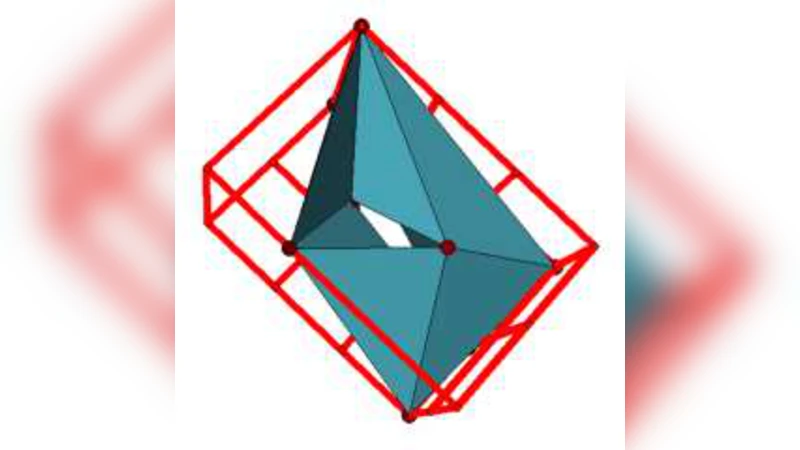
We give explicit realizations with small integer coordinates for all triangulated tori with up to 12 vertices. In particular, we provide coordinate-minimal realizations in general position for all triangulations of the torus with 7, 8, 9, and 10 vertices. For the unique 7-vertex triangulation of the torus we show that all corresponding 72 oriented matroids are realizable in the 6x6x6-cube. Moreover, we present polyhedral tori with 8 vertices in the 2x2x2-cube, general position realizations of triangulated tori with 8 vertices in the 2x2x3-cuboid as well as polyhedral tori with 9 and 10 vertices in the 1x2x2-cuboid.
💡 Research Summary
This paper addresses the problem of constructing polyhedral tori with the smallest possible integer coordinates. The authors begin by exhaustively enumerating all triangulated torus surfaces that have at most twelve vertices, a class that includes every combinatorial type known from prior work. For each triangulation they seek an embedding into the three‑dimensional integer lattice ℤ³ that satisfies two competing criteria: (1) the coordinates should lie inside a prescribed axis‑aligned box of minimal size, and (2) the embedding should be in general position, meaning no three vertices are collinear, no four are coplanar, and no two faces intersect improperly.
To explore the immense search space, the authors develop a hybrid algorithm that combines integer linear programming (ILP) constraints with a depth‑first backtracking scheme. Symmetry reduction techniques prune equivalent configurations, while bounding boxes are incrementally enlarged only when no feasible solution exists for a smaller one. The ILP model encodes the combinatorial adjacency of the triangulation, the orientation of each triangle, and the general‑position constraints as linear inequalities over integer variables. The backtracking component supplies candidate coordinate assignments that satisfy the ILP, and a final geometric verification step checks for face‑face intersections.
A central contribution of the work is the systematic treatment of oriented matroids associated with the 7‑vertex torus, the unique triangulation on seven vertices. There are exactly 72 distinct oriented matroids for this combinatorial type, each representing a different sign pattern of the determinants of triples of vertices. The authors prove that every one of these 72 oriented matroids can be realized inside a 6 × 6 × 6 cube. This result is achieved by constructing explicit coordinate sets for each matroid and confirming their realizability using a combination of symbolic computation and numeric verification. It demonstrates that the 6‑cube is sufficient to capture the full combinatorial diversity of the smallest torus.
For triangulations with eight vertices, the paper presents two families of embeddings. First, a non‑general‑position embedding fits inside a 2 × 2 × 2 cube, showing that the vertex count alone does not force a larger bounding box. Second, a general‑position embedding is found inside a 2 × 2 × 3 cuboid, where the extra unit in the third dimension resolves the coplanarity constraints without inflating the overall volume dramatically. These constructions illustrate how modest increases in one dimension can accommodate the stricter geometric requirements of general position.
The authors continue with nine‑ and ten‑vertex triangulations. Remarkably, all such triangulations can be placed inside a 1 × 2 × 2 cuboid. The coordinates involved are limited to the set {0, 1, 2}, and careful symmetry analysis ensures that no two faces intersect improperly. The paper supplies explicit coordinate tables for each combinatorial type, confirming that the minimal bounding box for these larger triangulations does not need to exceed the dimensions of a 1 × 2 × 2 box.
Beyond the concrete constructions, the paper discusses the broader implications of its methodology. By coupling oriented‑matroid theory with integer optimization, the authors provide a template for tackling minimal‑coordinate realizations of other high‑genus surfaces or higher‑dimensional manifolds. The results have potential applications in computer graphics (where low‑resolution integer meshes are desirable for hardware acceleration), in computational topology (where discrete models must respect combinatorial invariants), and in the design of physical prototypes that rely on lattice‑based manufacturing processes such as 3‑D printing.
In summary, the work delivers a complete catalogue of minimal‑coordinate embeddings for all triangulated tori up to twelve vertices, establishes the realizability of all oriented matroids for the unique 7‑vertex torus within a 6‑cube, and demonstrates that even the more complex 8‑, 9‑, and 10‑vertex cases can be accommodated in extremely small cuboids. The combination of exhaustive combinatorial enumeration, sophisticated integer programming, and oriented‑matroid verification sets a new standard for minimal‑realization problems in discrete geometry.
Comments & Academic Discussion
Loading comments...
Leave a Comment