Techniques, advances, problems and issues in numerical modelling of landslide hazard
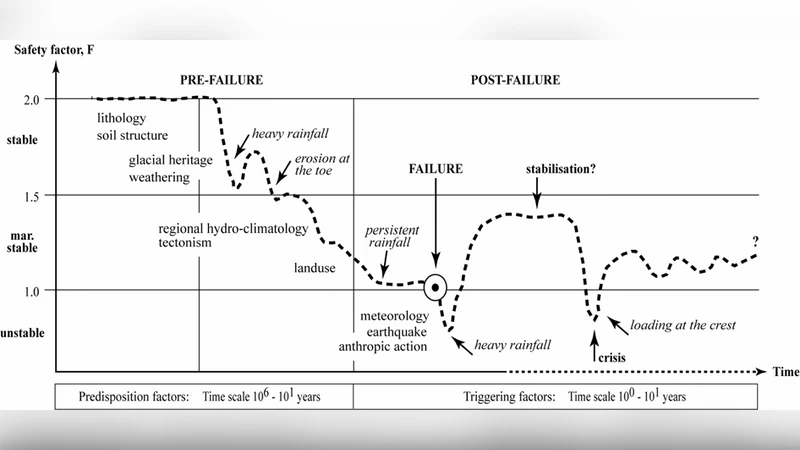
Slope movements (e.g. landslides) are dynamic systems that are complex in time and space and closely linked to both inherited and current preparatory and triggering controls. It is not yet possible to assess in all cases conditions for failure, reactivation and rapid surges and successfully simulate their transient and multi-dimensional behaviour and development, although considerable progress has been made in isolating many of the key variables and elementary mechanisms and to include them in physically-based models for landslide hazard assessments. Therefore, the objective of this paper is to review the state-of-the-art in the understanding of landslide processes and to identify some pressing challenges for the development of our modelling capabilities in the forthcoming years for hazard assessment. This paper focuses on the special nature of slope movements and the difficulties related to simulating their complex time-dependent behaviour in mathematical, physically-based models. It analyses successively the research frontiers in the recognition of first-time failures (pre-failure and failure stages), reactivation and the catastrophic transition to rapid gravitational processes (post-failure stage). Subsequently, the paper discusses avenues to transfer local knowledge on landslide activity to landslide hazard forecasts on regional scales and ends with an outline how geomorphological investigations and supporting monitoring techniques could be applied to improve the theoretical concepts and the modelling performance of physically-based landslide models at different spatial and temporal scales.
💡 Research Summary
The paper provides a comprehensive review of the current state‑of‑the‑art in physically‑based numerical modelling of landslide hazards, emphasizing the intrinsic complexity of slope movements that arise from the interaction of inherited (geological, geomorphological) and contemporaneous (hydrological, seismic, anthropogenic) controls. It begins by outlining the four conceptual stages of a landslide event—pre‑failure, failure, post‑failure, and reactivation—and identifies the key physical variables that dominate each stage, such as shear strength degradation, pore‑pressure evolution, strain‑rate dependence, and the rapid transition from quasi‑static shear to fluidised flow.
In the pre‑failure discussion, the authors examine constitutive models (Mohr‑Coulomb, Hoek‑Brown, viscoplastic rate‑dependent formulations) and highlight the difficulty of calibrating their parameters in heterogeneous field conditions. They stress the need to couple infiltration‑drainage processes (Richards equation) with thermal‑mechanical effects, because temperature‑induced changes in water viscosity and mineral expansion can significantly affect strength.
The failure stage analysis contrasts continuum approaches (finite‑element, finite‑volume) with discrete‑element methods. Continuum methods excel at representing complex boundary conditions and non‑linear material behaviour but become computationally prohibitive for large‑scale three‑dimensional simulations. Discrete‑element models capture grain‑scale interactions and the onset of granular flow, yet they struggle to enforce continuum assumptions over basin‑wide domains. Recent hybrid schemes that embed DEM zones within an FEM framework, together with GPU acceleration and adaptive mesh refinement, are presented as promising pathways to reconcile accuracy and efficiency.
Post‑failure and reactivation are treated as time‑dependent processes where residual deformation, healing of shear zones, and renewed pore‑pressure spikes can trigger secondary movements. The paper reviews time‑dependent healing laws and visco‑plastic flow models that aim to quantify the likelihood of re‑activation under new triggering events such as intense rainfall or seismic shaking.
A major portion of the review is devoted to the “scale‑transfer” problem: parameters identified at the site scale (tens of metres) cannot be directly upscaled to regional models (kilometres) without introducing bias. To address this, the authors advocate Bayesian hierarchical modelling, machine‑learning‑driven parameter space exploration, and multi‑scale frameworks that propagate uncertainty from local measurements to regional hazard maps. They illustrate how high‑resolution digital elevation models, LiDAR point clouds, and InSAR interferograms can be integrated with meteorological and hydrological time series to provide realistic initial and boundary conditions. However, they also acknowledge the challenges posed by spatial‑temporal data gaps, measurement errors, and the scarcity of long‑term monitoring records.
In the concluding section, the paper outlines a research roadmap aimed at overcoming the most pressing limitations of current models. The authors argue that existing physically‑based codes still fail to reproduce the abrupt transition from quasi‑static shear to rapid granular flow—a critical “catastrophic” phase of landslides. They propose a three‑pronged strategy: (1) development of fully coupled hydro‑thermo‑mechanical‑chemical constitutive models that capture the interplay of infiltration, drainage, heat transfer, and mineral weathering; (2) integration of high‑performance computing with data‑driven calibration techniques (e.g., Bayesian inference, deep learning) to quantify parameter uncertainty and improve predictive skill; (3) construction of hierarchical Bayesian hazard assessment platforms that can assimilate local monitoring data and upscale predictions to regional hazard forecasts.
By advancing these fronts, the authors anticipate that physically‑based landslide models will achieve higher fidelity, enabling more reliable hazard assessments, early‑warning systems, and evidence‑based land‑use planning. The paper thus serves both as a state‑of‑the‑art synthesis and a strategic guide for future research in landslide hazard modelling.
Comments & Academic Discussion
Loading comments...
Leave a Comment