Convergence of weighted averages of relaxed projections
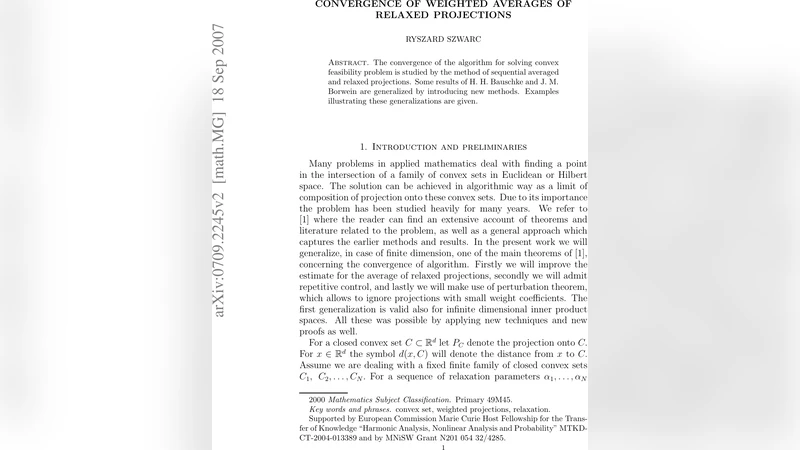
The convergence of the algorithm for solving convex feasibility problem is studied by the method of sequential averaged and relaxed projections. Some results of H. H. Bauschke and J. M. Borwein are generalized by introducing new methods. Examples illustrating these generalizations are given.
💡 Research Summary
The paper investigates the convergence properties of an algorithm designed to solve the convex feasibility problem, which seeks a point in the intersection of a finite (or, in some extensions, infinite) family of closed convex sets. Classical approaches rely on successive orthogonal projections onto each set, while the seminal work of H.H. Bauschke and J.M. Borwein introduced a framework that combines relaxation (using a scalar λ∈(0,2) to form a relaxed projection Rλ = (1‑λ)I + λP) with averaging (assigning fixed weights ωi that sum to one). Their results guarantee Fejér monotonicity and weak convergence under fairly general conditions.
The present study generalizes this framework in two significant directions. First, it allows the averaging weights to vary from iteration to iteration: at step k a weight vector ω(k) = (ω1(k),…,ωm(k)) with non‑negative components summing to one is chosen. Second, it permits each set to have its own relaxation parameter λi(k) that may also change with k, provided all λi(k) stay within the open interval (0,2). The resulting iteration can be written as
x^{k+1} = T^{k}(x^{k}) = Σ_{i=1}^{m} ωi(k)
Comments & Academic Discussion
Loading comments...
Leave a Comment