Algorithmic Semi-algebraic Geometry and Topology -- Recent Progress and Open Problems
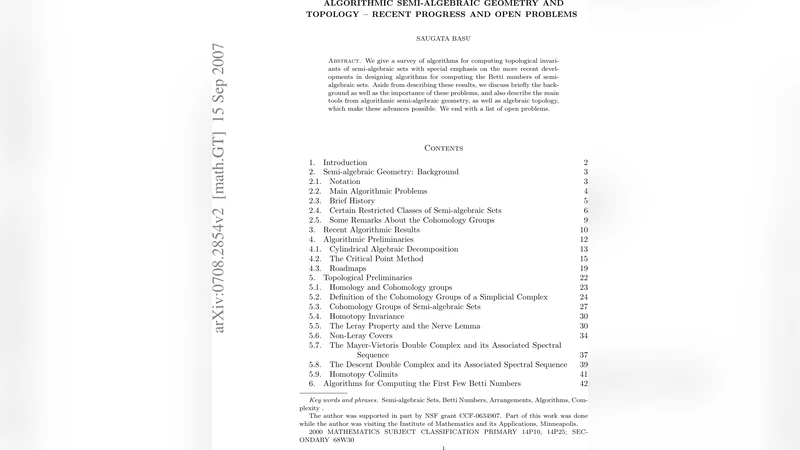
We give a survey of algorithms for computing topological invariants of semi-algebraic sets with special emphasis on the more recent developments in designing algorithms for computing the Betti numbers of semi-algebraic sets. Aside from describing these results, we discuss briefly the background as well as the importance of these problems, and also describe the main tools from algorithmic semi-algebraic geometry, as well as algebraic topology, which make these advances possible. We end with a list of open problems.
💡 Research Summary
The paper provides a comprehensive survey of algorithmic advances for computing topological invariants of semi‑algebraic sets, with a particular focus on recent progress in determining Betti numbers. It begins by outlining the significance of semi‑algebraic geometry: sets defined by polynomial equalities and inequalities over the real numbers appear in many areas such as robotics, optimization, and data analysis, and their Betti numbers encode essential information about connectivity, holes, and higher‑dimensional cycles.
Historically, the primary tool for handling these sets was Cylindrical Algebraic Decomposition (CAD), whose doubly‑exponential complexity in the number of variables makes it impractical for all but the smallest instances. The emergence of the critical‑point method and roadmap algorithms in the 1990s marked a turning point, offering single‑exponential (in the dimension) procedures for connectivity testing and path construction. These methods rely on projecting the set onto lower‑dimensional spaces, locating critical points of projection maps, and building a “roadmap” that captures the essential connectivity structure.
The core of the survey examines the last decade of breakthroughs concerning the full Betti number vector. Basu, Pollack, Roy, and collaborators introduced a divide‑and‑conquer framework combined with spectral‑sequence techniques that achieve a complexity of (sd)^{O(k)} for a semi‑algebraic set defined by s polynomial inequalities of degree at most d in k variables. The algorithm proceeds by recursively decomposing the set into simpler pieces, computing the homology of each piece, and then stitching the results together using Mayer‑Vietoris spectral sequences. Critical to the efficiency is a careful control of the geometric complexity introduced at each projection step, achieved through normal‑form transformations and certified numerical sampling that prevents error accumulation.
Beyond Betti numbers, the authors briefly discuss related invariants. The Euler characteristic can be obtained as an alternating sum of Betti numbers and often admits faster computation. Approximate methods for the fundamental group are also mentioned, though exact algorithms remain limited.
The final section lists open problems that define the frontier of the field. First, it is unknown whether the (sd)^{O(k)} bound is optimal for computing all Betti numbers; tighter upper bounds or matching lower bounds have not been established. Second, determining the full homotopy type of a semi‑algebraic set—rather than just its homology—remains an open challenge. Third, practical implementation issues such as parallelization, memory consumption, and high‑performance computing strategies need systematic study to bridge the gap between theoretical complexity and real‑world performance. Fourth, lower‑bound complexity results for Betti number computation are scarce, making it difficult to assess optimality. Finally, specialized algorithms for particular classes of semi‑algebraic sets (e.g., those arising from sparse polynomials, low‑dimensional manifolds, or specific application domains) are an important direction for future research.
In summary, the paper synthesizes the evolution from doubly‑exponential CAD‑based methods to modern single‑exponential algorithms for Betti numbers, highlights the algebraic‑topological tools that made these advances possible, and delineates a clear agenda of unresolved questions that will shape the next generation of research in algorithmic semi‑algebraic geometry and topology.