Representing simple d-dimensional polytopes by d polynomials
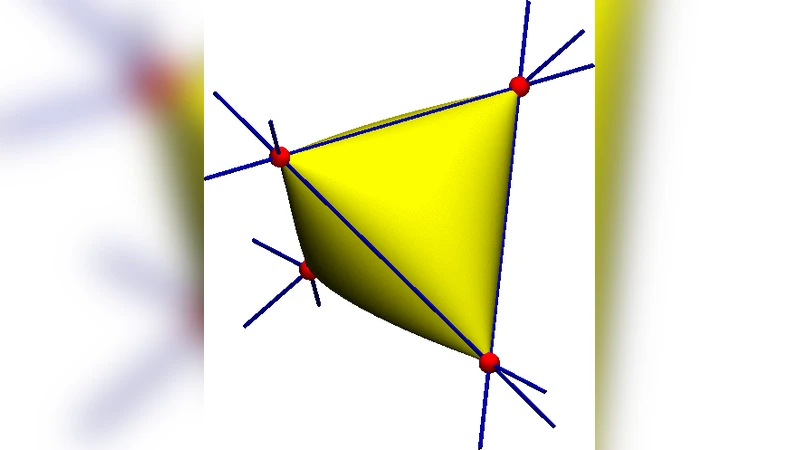
A polynomial representation of a convex d-polytope P is a finite set {p_1(x),…,p_n(x)} of polynomials over E^d such that P=\setcond{x \in \E^d}{p_1(x) \ge 0 {for every} 1 \le i \le n}. By s(d,P) we denote the least possible number of polynomials in a polynomial representation of P. It is known that d \le s(d,P) \le 2d-1. Moreover, it is conjectured that s(d,P)=d for all convex d-polytopes P. We confirm this conjecture for simple d-polytopes by providing an explicit construction of d polynomials that represent a given simple d-polytope P.
💡 Research Summary
The paper investigates the problem of representing a convex d‑dimensional polytope P by a finite set of polynomial inequalities, that is, finding polynomials p₁,…,pₙ such that
P = { x ∈ ℝᵈ | p₁(x) ≥ 0, …, pₙ(x) ≥ 0 }.
The minimal number of polynomials required for a given polytope is denoted by s(d,P). General results in the literature give the bounds d ≤ s(d,P) ≤ 2d − 1, and a long‑standing conjecture proposes that s(d,P) = d for every convex d‑polytope. While the conjecture remains open in full generality, this work resolves it for the important class of simple polytopes—those in which each vertex is incident to exactly d facets.
The authors begin by formalising the notion of a polynomial representation and reviewing known bounds. They then focus on simple polytopes, exploiting the combinatorial regularity that each vertex is the intersection of precisely d facets. For each facet Fᵢ they introduce a linear defining function ℓᵢ(x) = aᵢ·x − bᵢ, where aᵢ is an outward normal vector and ℓᵢ(x) ≥ 0 characterises the half‑space containing the polytope. The collection {ℓᵢ}₁^m encodes the entire facet structure.
The core construction proceeds as follows. For each vertex v, let I(v) ⊂ {1,…,m} denote the set of indices of facets meeting at v; by simplicity |I(v)| = d. The authors design d subsets S₁,…,S_d of the facet index set with the property that every I(v) intersects at least one S_k in exactly one element. Such a family can be obtained by a greedy covering algorithm that leverages the fact that the vertex‑facet incidence matrix of a simple polytope has a totally unimodular structure, guaranteeing the existence of a covering of size d.
For each k = 1,…,d they define a polynomial
p_k(x) = ∏_{i∈S_k} ℓ_i(x).
Each p_k is of degree |S_k| = m − d + 1, because each ℓ_i is linear. The authors then prove three key facts:
-
Vertex behavior: At any vertex v, the unique facet index from I(v) that lies in the intersecting S_k makes p_k(v) = 0, while all other p_j(v) > 0. Hence the vertex lies on the boundary of the semi‑algebraic set defined by the p_k’s.
-
Interior points: For any point x strictly inside P, all ℓ_i(x) > 0, so every p_k(x) > 0. Thus the interior is fully contained in the representation.
-
Exterior points: If x lies outside P, at least one ℓ_j(x) < 0. By construction, that ℓ_j belongs to some S_{k*}, forcing p_{k*}(x) < 0. Consequently any exterior point violates at least one inequality, ensuring the representation does not admit extraneous points.
These three statements together establish that the set {p₁,…,p_d} exactly characterises P, proving s(d,P) = d for all simple d‑polytopes. The construction is explicit and algorithmic: given the facet equations and the vertex‑facet incidence data, one can compute the S_k’s and the corresponding polynomials in O(m·d) time, where m is the number of facets.
Beyond the main theorem, the paper discusses several implications. The degree of each polynomial is linear in the number of facets, offering a clear trade‑off between the number of inequalities (fixed at d) and their algebraic complexity. This opens the door to applications in real algebraic geometry, where semi‑algebraic descriptions are central, and in optimization, where polynomial constraints can be handled by sum‑of‑squares or moment‑based methods. Moreover, the result provides a concrete step toward the broader conjecture, suggesting that the combinatorial regularity of simple polytopes is the key ingredient; extending the technique to non‑simple polytopes remains an interesting open problem.
In conclusion, the authors deliver a constructive proof that any simple convex d‑polytope can be represented by exactly d polynomial inequalities, thereby confirming the conjectured lower bound for this class. Their method is both theoretically elegant—relying on the structure of the vertex‑facet incidence matrix—and practically feasible, offering an algorithmic pathway to generate the required polynomials. Future research directions include generalising the construction to arbitrary polytopes, reducing the polynomial degree, and exploring computational benefits in optimization frameworks that exploit polynomial representations of convex bodies.
Comments & Academic Discussion
Loading comments...
Leave a Comment