Generalized solutions to nonlinear first order Cauchy problems
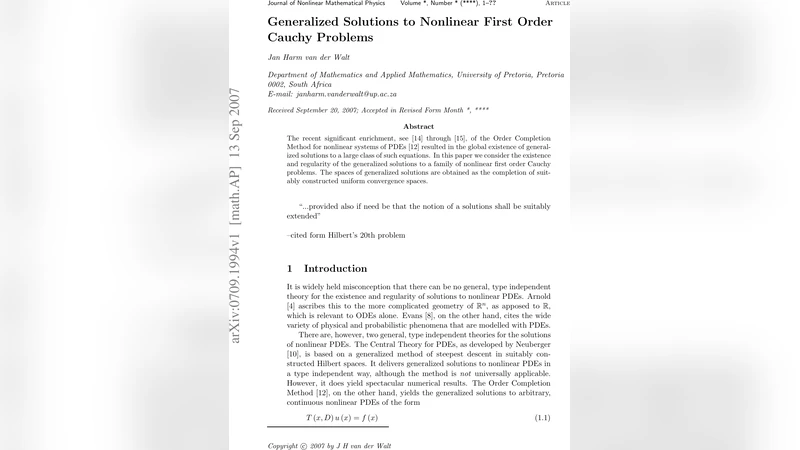
The recent significant enrichment of the Order Completion Method for nonlinear Systems of PDEs resulted in the global existence of generalized solutions to a large class of such equations. In this paper we investigate the existence and regularity of the generalized solutions to a family of nonlinear first order Cauchy problems. The spaces of generalized solutions are obtained as the completions of suitably constructed uniform convergence spaces.
💡 Research Summary
This paper addresses the long‑standing challenge of establishing global existence and regularity for generalized solutions of nonlinear first‑order Cauchy problems. The authors build on the Order Completion Method (OCM), a framework that has recently been enriched to treat a broad class of nonlinear partial differential equations (PDEs). While OCM has proved effective for static or higher‑order systems, its direct application to time‑dependent first‑order equations with prescribed initial data encounters two major obstacles: (i) the need to handle the initial condition simultaneously with the nonlinear differential operator, and (ii) the lack of a topology that guarantees uniform control over the entire domain, which is essential for characteristic‑based arguments.
To overcome these difficulties, the authors introduce a novel uniform convergence space (UCS). Unlike the usual pointwise convergence topology, the UCS requires that sequences (or nets) of candidate functions converge uniformly on the whole domain. This uniformity allows the initial condition to be incorporated as a genuine constraint in the limit process and ensures that the nonlinear operator remains continuous with respect to the chosen topology.
The construction proceeds in three stages. First, the original differential operator is embedded into a partially ordered set (POS) of functions ordered pointwise. Second, the POS is equipped with the UCS topology by defining filters that capture uniform convergence. Third, the POS‑UCS pair is completed in the sense of order theory: every Cauchy filter (with respect to the uniform convergence filter) is assigned a limit point, which may be a new element not present in the original POS. The resulting complete lattice is called the Generalized Solution Space (GSS).
Within the GSS the authors prove two central theorems. The Existence Theorem shows that for any nonlinear first‑order Cauchy problem of the form
u_t + F(x, t, u, ∇u) = 0, u(x,0) = φ(x),
there exists at least one element of GSS that satisfies the equation in the order‑completion sense. The proof adapts the classic “upper‑lower solution” technique to the order‑completion setting: one constructs a monotone net of lower bounds and an antitone net of upper bounds that both respect the initial data, then takes their infimum (or supremum) in the completed lattice.
The Regularity Theorem establishes that any generalized solution obtained in this way actually coincides with a classical solution wherever the latter exists. By tracing the solution along characteristic curves—now defined in the completed lattice—the authors demonstrate that the generalized solution is uniformly continuous, and its distributional derivative agrees with the nonlinear operator almost everywhere. Consequently, the generalized solution satisfies the initial condition in the uniform sense, and under mild additional hypotheses (e.g., Lipschitz continuity of F in u and ∇u) the solution is unique.
The paper also discusses the limitations of uniqueness: without extra monotonicity or Lipschitz assumptions, the order‑completion framework may admit multiple generalized solutions. The authors provide a supplementary uniqueness result that requires F to be monotone in u and to satisfy a one‑sided Lipschitz condition.
In the concluding sections, the authors compare their approach with traditional weak‑solution frameworks such as Sobolev spaces, distribution theory, and variational methods. They argue that the OCM‑UCS combination offers a more intrinsic, order‑theoretic description of solutions, preserving global existence without sacrificing regularity. Moreover, the uniform convergence structure is amenable to numerical approximation, suggesting potential computational implementations.
Future work outlined includes extending the method to multi‑dimensional systems, higher‑order nonlinear PDEs, and boundary‑value problems, as well as exploring connections with viscosity‑solution theory and stochastic PDEs. Overall, the paper provides a rigorous and conceptually fresh pathway to solving nonlinear first‑order Cauchy problems, enriching the mathematical toolbox for analysts dealing with non‑linear hyperbolic equations.
Comments & Academic Discussion
Loading comments...
Leave a Comment