Spatial variation of total column ozone on a global scale
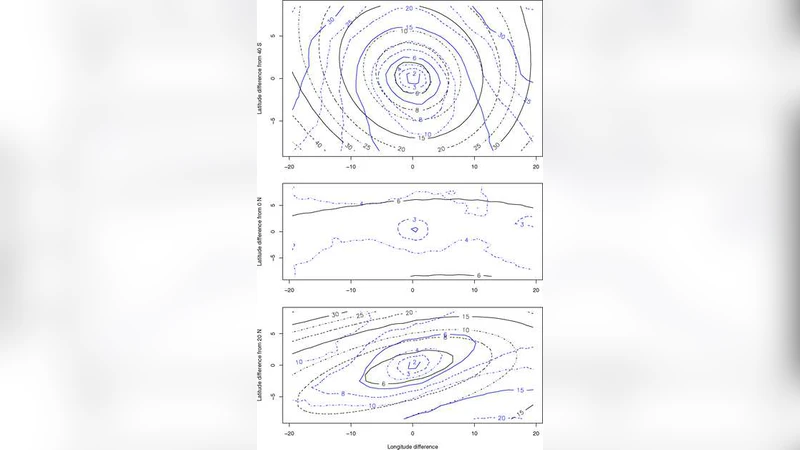
The spatial dependence of total column ozone varies strongly with latitude, so that homogeneous models (invariant to all rotations) are clearly unsuitable. However, an assumption of axial symmetry, which means that the process model is invariant to rotations about the Earth’s axis, is much more plausible and considerably simplifies the modeling. Using TOMS (Total Ozone Mapping Spectrometer) measurements of total column ozone over a six-day period, this work investigates the modeling of axially symmetric processes on the sphere using expansions in spherical harmonics. It turns out that one can capture many of the large scale features of the spatial covariance structure using a relatively small number of terms in such an expansion, but the resulting fitted model provides a horrible fit to the data when evaluated via its likelihood because of its inability to describe accurately the process’s local behavior. Thus, there remains the challenge of developing computationally tractable models that capture both the large and small scale structure of these data.
💡 Research Summary
The paper investigates statistical modeling of total column ozone (TCO) on a global scale using a six‑day set of Total Ozone Mapping Spectrometer (TOMS) measurements. The authors begin by noting that the spatial dependence of TCO is strongly latitude‑dependent; consequently, a homogeneous (isotropic) model that is invariant to all rotations on the sphere is clearly inappropriate. Instead, they adopt the more realistic assumption of axial symmetry, meaning that the stochastic process is invariant under rotations about the Earth’s axis but may vary with latitude. This assumption dramatically reduces model complexity while still capturing the dominant north‑south gradient observed in ozone fields.
To operationalize the axial‑symmetry assumption, the authors employ an expansion of the covariance function in spherical harmonics. Because axial symmetry forces the azimuthal order m to be zero, only the zonal harmonics (m = 0) are needed, turning the problem into a one‑dimensional series in the polar angle. By truncating the series at relatively low degree (ℓ ≈ 10), they are able to reproduce the large‑scale features of the empirical covariance matrix—such as the broad high‑ozone band over the tropics and the low‑ozone regions at high latitudes—using only a modest number of parameters. This parsimonious representation is computationally attractive, especially for likelihood‑based inference on massive spherical data sets.
However, when the fitted model is evaluated via its log‑likelihood, the performance is extremely poor. The low‑order spherical harmonic expansion smooths over short‑range variability, failing to capture localized phenomena such as sharp ozone gradients near the edges of the polar vortex, regional pollution plumes, or transient cloud‑induced artifacts. As a result, the model’s ability to explain the data at small spatial scales is inadequate, even though it captures the broad, global pattern. The authors therefore conclude that while axial symmetry and low‑order spherical harmonic expansions are useful for describing large‑scale structure, they are insufficient for a full statistical description of TOMS ozone fields.
To address this gap, the paper outlines two possible research directions. The first is a hybrid approach that combines a low‑order global spherical harmonic component with a high‑resolution local model (e.g., a Gaussian Markov random field or a localized kriging scheme) that can capture fine‑scale variability without exploding computational cost. The second is to relax the strict axial‑symmetry constraint by allowing piecewise or “partial” axial symmetry—estimating separate sets of harmonic coefficients for different latitude bands or introducing latitude‑dependent parameters—thereby permitting modest longitudinal heterogeneity while retaining much of the computational advantage.
In summary, the study demonstrates that axial‑symmetric models based on spherical harmonic expansions can efficiently summarize the dominant, latitude‑driven structure of global ozone, but they fall short in representing the local, high‑frequency behavior essential for accurate likelihood‑based inference. The work highlights the ongoing challenge of constructing computationally tractable yet statistically rich models that simultaneously honor both large‑scale and small‑scale features of atmospheric remote‑sensing data.
Comments & Academic Discussion
Loading comments...
Leave a Comment