What is a metric space?
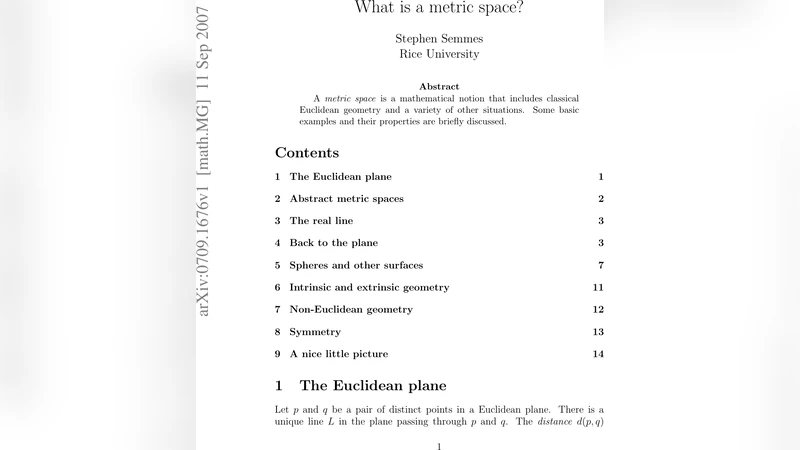
The question in the title is discussed briefly, with emphasis on a few basic examples and their properties.
💡 Research Summary
The paper opens with the seemingly simple question “What is a metric space?” and proceeds to develop a thorough answer that spans definition, canonical examples, fundamental properties, morphisms, and modern applications. A metric space is introduced as a set X equipped with a distance function d : X × X → ℝ⁺ satisfying four axioms: non‑negativity, identity of indiscernibles (d(x,y)=0 iff x=y), symmetry, and the triangle inequality. From these axioms the notion of an open ball B(x,ε) = {y ∈ X | d(x,y) < ε} is derived, and the collection of all such balls generates a natural topology on X. Thus every metric space carries an inherent topological structure, but the metric carries more refined geometric information than the topology alone.
The author then surveys several prototypical metric spaces. The real line ℝ with the Euclidean metric d(x,y)=|x−y| serves as the baseline; its open balls are ordinary open intervals, and all familiar concepts of convergence, continuity, and completeness coincide with intuition. The discrete metric d(x,y)=1 for x≠y, 0 otherwise, illustrates an extreme case where every subset is simultaneously open and closed. This space is always complete, yet it fails to be compact unless it is finite, highlighting the distinction between completeness and compactness. The Manhattan metric on ℝ², d₁((x₁,x₂),(y₁,y₂))=|x₁−y₁|+|x₂−y₂|, shows that different metrics can induce the same topology while producing dramatically different geometric shapes for balls (diamonds instead of circles).
Function spaces are examined next. On C(
Comments & Academic Discussion
Loading comments...
Leave a Comment