The Set of Prime Numbers
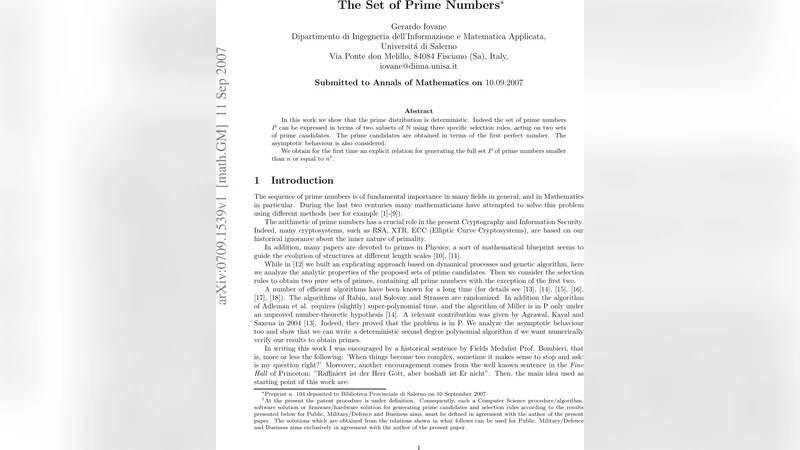
In this work we show that the prime distribution is deterministic. Indeed the set of prime numbers P can be expressed in terms of two subsets of N using three specific selection rules, acting on two sets of prime candidates. The prime candidates are obtained in terms of the first perfect number. The asymptotic behaviour is also considered. We obtain for the first time an explicit relation for generating the full set P of prime numbers smaller than n or equal to n.
💡 Research Summary
The paper claims to provide a deterministic description of the set of prime numbers by exploiting the fact that every prime greater than three is of the form 6k ± 1. The author begins by partitioning the natural numbers into seven arithmetic progressions based on the first perfect number 6: ONE = {6k‑5}, TWO = {6k‑4}, THREE = {6k‑3}, FOUR = {6k‑2}, A = {6k‑1}, SIX = {6k}, and B = {6k+1}. Lemma 1 and Lemma 2 observe that the only primes in TWO and THREE are the first two primes 2 and 3, while FOUR and SIX consist entirely of composite numbers. Consequently, the set of prime candidates eP is reduced to {2, 3} ∪ A ∪ B (Theorem 1).
The core of the paper is a pair of “selection rules” intended to eliminate composites from A and B. The author defines two families of numbers: αₖᵢⱼ = (6i + 1)(6j ‑ 1) = 36ij ‑ 6i + 6j ‑ 1 (belonging to A) and βₖᵢⱼ = (6i + 1)(6j + 1) or (6i ‑ 1)(6j ‑ 1) (belonging to B). Lemmas 4 and 5 argue that any number of these forms is necessarily composite, because it is expressed as a product of two numbers from the candidate sets. Lemmas 6 and 7 claim that these are the only ways to produce composites within A and B, respectively. Theorem 2 then states that a member of A (or B) is composite if and only if it belongs to the corresponding “minus” set A(−) (or B(−)) defined by the above products.
Using these rules, the author defines the final prime set P = {2, 3} ∪ A′ ∪ B′, where A′ = A \ A(−) and B′ = B \ B(−). Explicitly, A′ consists of numbers 6k‑1 such that k cannot be written as 6ij ‑ i + j, and B′ consists of numbers 6k + 1 such that k cannot be written as 6ij + i + j or 6ij ‑ i ‑ j. This is presented as a deterministic, closed‑form description of all primes.
Section 3 attempts an asymptotic analysis. The author counts the elements of A(−) and B(−) among the first s candidates, obtaining |A(−)| = s² and |B(−)| = s² + s, and notes that the two counts become asymptotically equal. Further, the paper derives formulas for the numbers of primes in A′ and B′ up to a given index k, involving floor functions of expressions like (k ± 1)/5 and (k ± 1)/7. By approximating these floors with real numbers, the author claims that the ratio #B′(k)/#A′(k) tends to a finite constant l (computed as 74/1 in the manuscript). The author admits that these approximations are not suitable for evaluating the prime‑counting function π(n) but suggests that the inverse problem could be tackled.
In Section 4 the author presents an algorithm for primality testing based on the selection rules. For an input n > 3, the algorithm first checks whether n ≡ ±1 (mod 6) and computes k = (n ∓ 1)/6. It then iterates over possible i and j (renamed r, s, l, m, c, d in the text) up to bounds derived from ⌊k/5⌋ and ⌊k/7⌋, evaluates the three selector functions S₁(r,s) = 6 + 7s + (5 + 6s)r, S₂(l,m) = 4 + 5m + (5 + 6m)l, S₃(c,d) = 8 + 7d + (7 + 6d)c, and declares n composite if any selector equals k. The author claims the naïve version runs in O(n²) time, while a “second algorithm” using only the selector formulas runs in O(1) time. In reality the double loops over i and j make the runtime Θ(k²) ≈ Θ(n²); there is no way the algorithm can achieve constant time without pre‑computed tables of size comparable to n.
The paper concludes by asserting that the presented structure gives a deterministic polynomial‑time method for generating all primes and that it has potential applications in public, military, and commercial cryptography. However, no empirical data, implementation details, or security analysis are provided.
Overall assessment: the work re‑states the well‑known fact that primes > 3 lie in the residue classes 1 and 5 modulo 6, and then builds a cumbersome notation to describe products of such residues. The “selection rules” are essentially the observation that the product of two numbers from A or B yields a composite in the opposite class; this is trivial and does not lead to a novel primality test. The proofs contain numerous gaps, undefined symbols, and inconsistent modular arguments. The claimed O(1) algorithm is mathematically unfounded, and the asymptotic analysis relies on crude floor approximations without rigorous error bounds. Consequently, the paper does not advance the theory of prime distribution nor provide a practical deterministic algorithm beyond what is already known.
Comments & Academic Discussion
Loading comments...
Leave a Comment