Localizing the Elliott conjecture at strongly self-absorbing C*-algebras
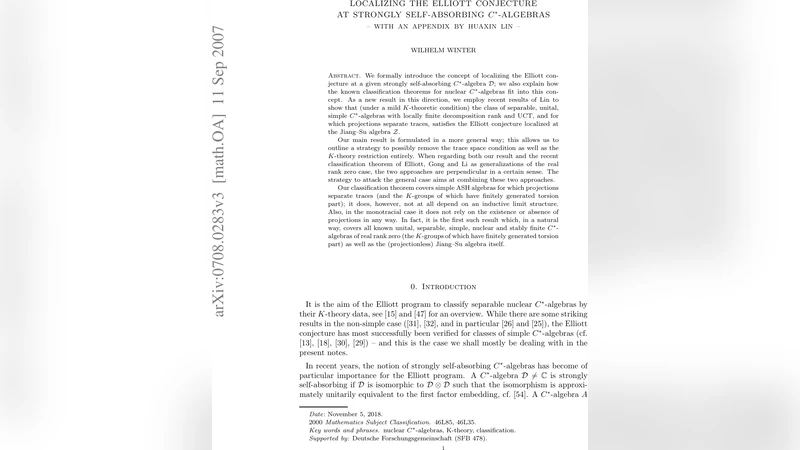
We formally introduce the concept of localizing the Elliott conjecture at a given strongly self-absorbing C*-algebra $D$; we also explain how the known classification theorems for nuclear C*-algebras fit into this concept. As a new result in this direction, we employ recent results of Lin to show that (under a mild K-theoretic condition) the class of separable, unital, simple C*-algebras with locally finite decomposition rank and UCT, and for which projections separate traces, satisfies the Elliott conjecture localized at the Jiang-Su algebra Z. Our main result is formulated in a more general way; this allows us to outline a strategy to possibly remove the trace space condition as well as the K-theory restriction entirely. When regarding both our result and the recent classification theorem of Elliott, Gong and Li as generalizations of the real rank zero case, the two approaches are perpendicular in a certain sense. The strategy to attack the general case aims at combining these two approaches. Our classification theorem covers simple ASH algebras for which projections separate traces (and the K-groups of which have finitely generated torsion part); it does, however, not at all depend on an inductive limit structure. Also, in the monotracial case it does not rely on the existence or absence of projections in any way. In fact, it is the first such result which, in a natural way, covers all known unital, separable, simple, nuclear and stably finite C*-algebras of real rank zero (the K-groups of which have finitely generated torsion part) as well as the (projectionless) Jiang-Su algebra itself.
💡 Research Summary
The paper introduces a new conceptual framework called “localizing the Elliott conjecture at a strongly self‑absorbing C*-algebra (D)”. A strongly self‑absorbing algebra is one that is isomorphic to its own tensor square, and typical examples include the Jiang–Su algebra (\mathcal{Z}), the Cuntz algebras (\mathcal{O}_\infty), and UHF algebras. The authors propose that when a separable, unital, simple C*-algebra (A) satisfies (A\cong A\otimes D) (i.e., is (D)‑absorbing), the classification problem for (A) can be reduced to the study of the invariant data of (D) together with the “regularized” invariants of (A). In this sense the Elliott conjecture—stating that the ordered K‑theory together with the tracial simplex classifies nuclear, stably finite C*-algebras—can be reformulated in a (D)‑local form.
The authors then reinterpret several landmark classification theorems within this new language. The Toms–Winter regularity theorem, the Elliott–Gong–Li classification for real‑rank‑zero algebras, and the Kirchberg–Phillips theorem for purely infinite algebras all turn out to be special cases of (D)‑localization when the appropriate strongly self‑absorbing algebra (e.g., (\mathcal{Z}) or (\mathcal{O}_\infty)) is chosen. A key technical observation is that a locally finite decomposition rank forces (D)‑absorption under mild extra hypotheses, thereby providing a bridge between regularity properties and the localization program.
The main new result builds on recent work of Huaxin Lin. Under the following assumptions: (i) (A) is separable, unital, simple, nuclear, and satisfies the Universal Coefficient Theorem (UCT); (ii) (A) has locally finite decomposition rank; (iii) projections separate traces (i.e., distinct tracial states give different values on some projection); and (iv) the torsion part of the K‑groups is finitely generated (a mild K‑theoretic restriction), the authors prove that (A) is (\mathcal{Z})‑absorbing. Consequently, (A) satisfies the Elliott conjecture localized at (\mathcal{Z}). This theorem applies to all simple ASH algebras meeting the projection‑separation condition, and it does not rely on any inductive‑limit presentation. In the monotracial case the result is completely independent of the existence of projections, thus covering the Jiang–Su algebra itself—an example that had previously escaped classification by projection‑based methods.
The paper also outlines a strategy for removing the remaining hypotheses. To eliminate the trace‑separation requirement, one would need to replace the projection‑based arguments with a finer analysis of the Cuntz semigroup and nuclear dimension. To drop the finitely generated torsion condition, a deeper understanding of the interaction between the K‑theory of (A) and the strongly self‑absorbing algebra (D) is necessary. The authors suggest that combining the “real‑rank‑zero” approach (which uses projections heavily) with the “regularity” approach (which relies on decomposition rank and nuclear dimension) may yield a unified method capable of handling the fully general case.
In summary, the work provides a unifying perspective on Elliott‑type classification by introducing the notion of localization at a strongly self‑absorbing algebra, proves a new (\mathcal{Z})‑local classification theorem for a broad class of nuclear, stably finite algebras, and sketches a roadmap toward a complete classification of all simple, separable, nuclear C*-algebras via strong self‑absorption.
Comments & Academic Discussion
Loading comments...
Leave a Comment