A Generic Rate Equation for modeling Enzymatic Reactions under Living Conditions
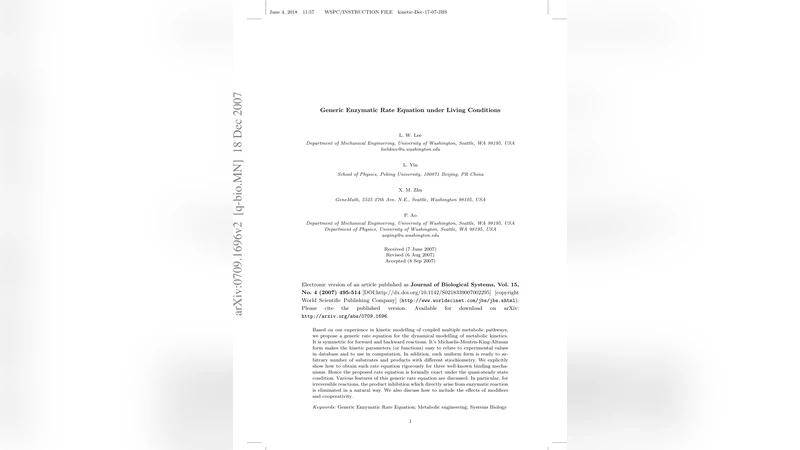
Based on our experience in kinetic modeling of coupled multiple metabolic pathways we propose a generic rate equation for the dynamical modeling of metabolic kinetics. Its symmetric form makes the kinetic parameters (or functions) easy to relate to values in database and to use in computation. In addition, such form is workable to arbitrary number of substrates and products with different stoichiometry. We explicitly show how to obtain such rate equation exactly for various binding mechanisms. Hence the proposed rate equation is formally rigorous. Various features of such a generic rate equation are discussed. For irreversible reactions, the product inhibition which directly arise from enzymatic reaction is eliminated in a natural way. We also discuss how to include the effects of modifiers and cooperativity.
💡 Research Summary
The paper addresses a long‑standing bottleneck in kinetic modeling of metabolic networks: the lack of a unified, mathematically rigorous rate law that can be applied to reactions of arbitrary stoichiometry, reversibility, and regulatory complexity. Drawing on extensive experience with coupled pathway simulations, the authors propose a “generic rate equation” (GRE) that possesses a symmetric, denominator‑centric structure. In this formulation the overall reaction velocity V is expressed as
V = V_max · (Π_i
Comments & Academic Discussion
Loading comments...
Leave a Comment