Discrete Monodromy, Pentagrams, and the Method of Condensation
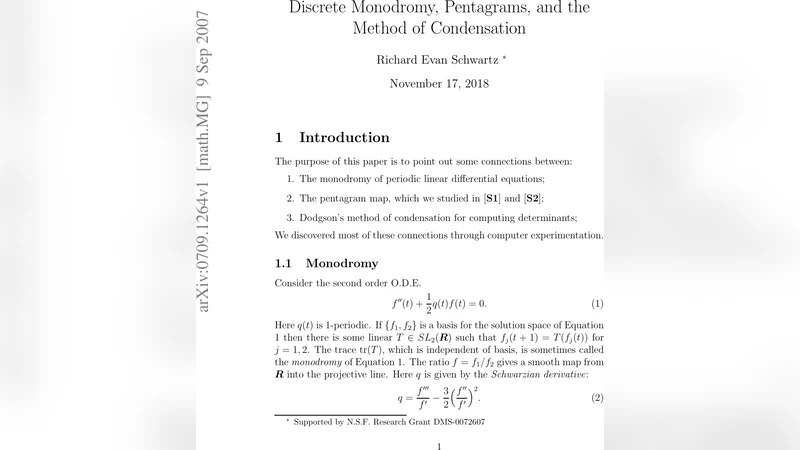
This paper considers a simple geometric construction, called the Pentagram map. The pentagram map, performed on N-gons, gives rise to a birational mapping on the space of all N-gons. This paper finds what conjecturally are all the invariants for this map, and along the way relates the construction to the monodromy of 3rd order differential equations, and also to Dodgson’s method of condensation for computing determinants.
💡 Research Summary
The paper investigates the pentagram map, a simple geometric construction that takes an N‑gon in the plane and produces a new N‑gon by intersecting consecutive shortest diagonals. Although the operation looks elementary, it defines a highly non‑trivial birational transformation on the moduli space of labeled N‑gons. The author’s main achievement is a complete description of the invariants of this map and a demonstration that the pentagram map is an integrable system in the Liouville‑Arnold sense.
The exposition proceeds in three intertwined parts. First, the author formalizes the pentagram map as a rational map (T:\mathcal{P}_N\to\mathcal{P}N). Given vertices ((z_i){i=1}^N) in the complex plane, the new vertex (w_i) is expressed explicitly by a rational function of four consecutive vertices: \
Comments & Academic Discussion
Loading comments...
Leave a Comment