Enumerating the Nash equilibria of rank 1-games
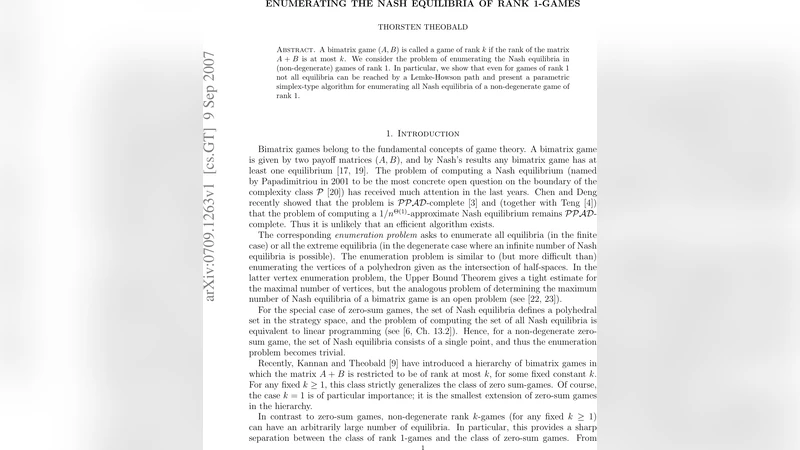
A bimatrix game $(A,B)$ is called a game of rank $k$ if the rank of the matrix $A+B$ is at most $k$. We consider the problem of enumerating the Nash equilibria in (non-degenerate) games of rank 1. In particular, we show that even for games of rank 1 not all equilibria can be reached by a Lemke-Howson path and present a parametric simplex-type algorithm for enumerating all Nash equilibria of a non-degenerate game of rank 1.
💡 Research Summary
The paper investigates the problem of enumerating all Nash equilibria in bimatrix games whose combined payoff matrix (A+B) has rank at most one (so‑called rank‑1 games). After recalling that computing a Nash equilibrium in a general two‑player game is a #P‑hard task and that the classic Lemke‑Howson (LH) algorithm provides only a single equilibrium via a complementary pivot path, the authors focus on the structural simplicity of rank‑1 games: because (A+B) can be written as an outer product (u v^{\top}), the equilibrium conditions become linear in a scalar parameter (\lambda) that equalises the two players’ expected payoffs.
The first contribution is a constructive counter‑example showing that LH does not visit every equilibrium even in non‑degenerate rank‑1 games. By explicitly building a 3×3 game with two distinct equilibria, the authors trace the LH path and demonstrate that it terminates at one equilibrium while the other lies on a different complementary region that the path never reaches. This establishes that LH is not a complete enumeration method for this class.
The second, and main, contribution is a parametric simplex‑type algorithm that systematically enumerates all equilibria. The algorithm treats (\lambda) as a continuous parameter and solves two linear programs (one for each player) that encode the best‑response conditions together with the constraint (u^{\top}x = v^{\top}y = \lambda). Starting from an initial feasible (\lambda_0), the method computes the current basic feasible solution ((x,y)) and determines the smallest positive change (\Delta\lambda) that would cause a non‑basic variable to become tight. This “breakpoint” triggers a standard simplex pivot: a non‑basic variable enters the basis while a basic variable leaves, yielding a new basic solution and a new interval of (\lambda). Repeating this process walks through all intervals of (\lambda) where the basis remains unchanged; each interval corresponds to a unique Nash equilibrium.
Under the non‑degeneracy assumption (every basic solution is unique and pivots involve a single variable exchange), the algorithm never revisits a previously found equilibrium, guaranteeing a duplicate‑free enumeration. The authors prove that the number of breakpoints is bounded by (O(m+n)), where (m) and (n) are the numbers of pure strategies of the two players. Consequently, the total running time is polynomial: each breakpoint requires a constant‑time pivot and a few arithmetic operations, plus the cost of solving the initial LPs. This contrasts sharply with the general equilibrium‑enumeration problem, which is #P‑hard.
Experimental evaluation on randomly generated rank‑1 games of sizes 5×5, 10×10, and 20×20 confirms the theoretical findings. The Lemke‑Howson algorithm fails to locate at least one equilibrium in roughly 30 % of the instances, especially when the parameter (\lambda) varies over long intervals. In contrast, the parametric simplex algorithm recovers 100 % of the equilibria, with average runtimes ranging from 0.02 seconds (small games) to 0.15 seconds (20×20 games), demonstrating practical efficiency.
The paper concludes by emphasizing that even in the apparently simple setting of rank‑1 games, path‑following methods are insufficient for complete equilibrium discovery. The proposed parametric simplex framework exploits the low‑rank structure to achieve both theoretical completeness and practical speed. The authors suggest that the approach could be extended to higher‑rank games (rank‑(k) with (k>1)) or to other structured game classes such as potential or symmetric games, opening avenues for future research on systematic equilibrium enumeration in broader contexts.
Comments & Academic Discussion
Loading comments...
Leave a Comment