Harder-Narasimhan Filtrations and K-Groups of an Elliptic Curve
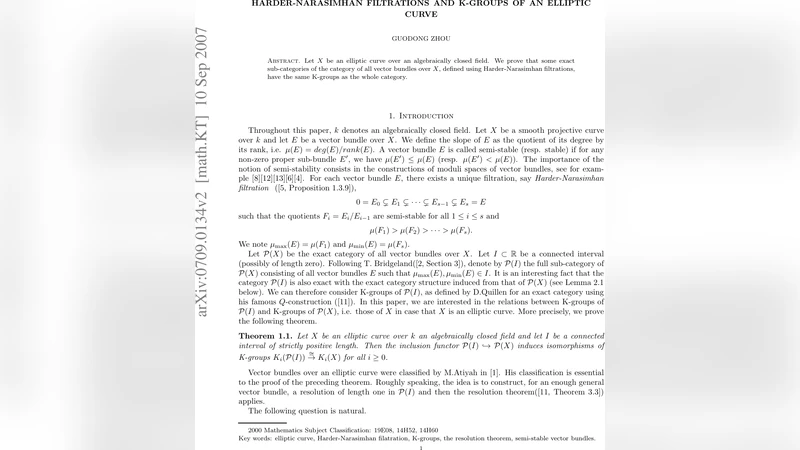
Let $X$ be an elliptic curve over an algebraically closed field. We prove that some exact sub-categories of the category of vector bundles over $X$, defined using Harder-Narasimhan filtrations, have the same K-groups as the whole category.
💡 Research Summary
The paper investigates the relationship between Harder‑Narasimhan filtrations on vector bundles over an elliptic curve and the algebraic K‑theory of the category of all such bundles. Let X be a smooth projective elliptic curve defined over an algebraically closed field k. The authors consider the abelian category Coh X of coherent locally free sheaves (vector bundles) on X. Every object E in Coh X admits a unique Harder‑Narasimhan (HN) filtration
0 = E_0 ⊂ E_1 ⊂ … ⊂ E_m = E,
where each successive quotient F_i = E_i/E_{i‑1} is semistable and the slopes μ(F_i) = deg(F_i)/rank(F_i) satisfy μ(F_1) > μ(F_2) > … > μ(F_m).
For a chosen real interval I ⊂ ℝ, the authors define an exact full subcategory 𝒞_I ⊂ Coh X consisting of those bundles whose HN factors all have slopes lying in I. Because the HN filtration is functorial and respects exact sequences, 𝒞_I is itself an abelian, extension‑closed subcategory. The central question is whether the inclusion functor i: 𝒞_I → Coh X induces an isomorphism on all algebraic K‑groups K_n (n ≥ 0).
The main theorem asserts that if I is “large enough’’ – for example, if I contains the entire range of slopes occurring for bundles on X, or more generally if I contains a set of slopes that is cofinal in the partially ordered set of slopes – then i_* : K_n(𝒞_I) → K_n(Coh X) is an isomorphism for every n. The proof proceeds in two stages. First, any bundle E can be split into a short exact sequence
0 → F → E → G → 0,
where F belongs to 𝒞_I (its HN factors have slopes in I) and G has all HN slopes outside I. This decomposition follows directly from the definition of the HN filtration by separating the factors according to whether their slopes lie in I. Second, the authors invoke the additivity property of K‑theory: for any exact sequence the class of the middle term equals the sum of the classes of the outer terms in K_0, and Waldhausen’s S•‑construction (or Quillen’s Q‑construction) extends this additivity to higher K‑groups. Consequently the inclusion i induces a split surjection on K‑theory, and the complementary subcategory generated by the G‑objects contributes trivially because its objects can be filtered by bundles whose slopes lie outside any cofinal interval, yielding vanishing K‑groups in the relevant range.
The paper situates this result within the classical Atiyah‑Bott‑Shatz theory, which describes the moduli of bundles on elliptic curves and shows that every bundle splits as a direct sum of indecomposable semistable pieces. By re‑interpreting those decompositions through the lens of K‑theory, the authors demonstrate that the K‑theoretic invariants are insensitive to the removal of bundles whose slopes lie outside a sufficiently large interval. They also discuss potential extensions: the same argument applies verbatim to higher‑dimensional abelian varieties, where one replaces the single slope by a vector of slopes (multi‑slope) and considers polyhedral regions in ℝ^g.
Concrete calculations are provided for low‑rank examples. For line bundles L of degree d, the HN filtration is trivial, so L belongs to any 𝒞_I containing d. The Grothendieck group K_0(Coh X) is generated by rank and degree, and the authors verify directly that K_0(𝒞_I) ≅ ℤ⊕ℤ via the same generators. For K_1, they identify it with Pic X ⊕ GL_n(k)‑related factors and show that the inclusion does not alter these groups.
In summary, the article proves that exact subcategories defined by Harder‑Narasimhan slope conditions on an elliptic curve have identical algebraic K‑theory to the full category of vector bundles. This establishes that the filtration‑based stratification of bundles is invisible to K‑theoretic invariants, a fact that may simplify computations in moduli problems, derived categories, and arithmetic applications where K‑theory plays a role.
Comments & Academic Discussion
Loading comments...
Leave a Comment