Research News -- Observation of oscillation phenomena in heavy meson systems
We review the recent discoveries of rare oscillation phenomena in certain heavy neutral meson systems.
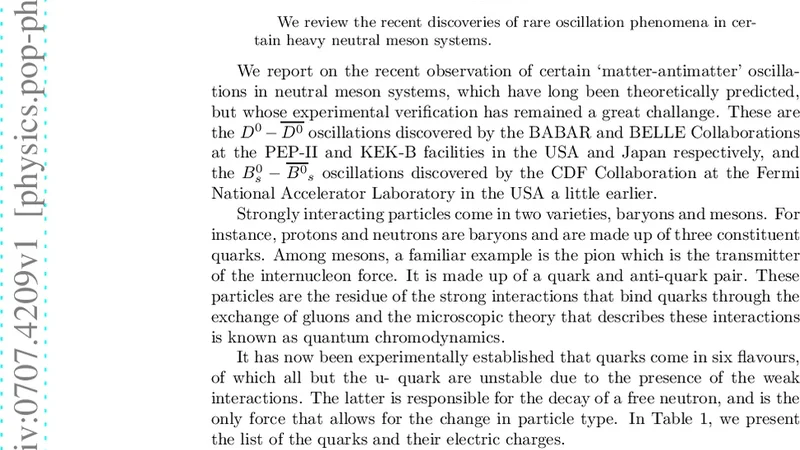
We review the recent discoveries of rare oscillation phenomena in certain heavy neutral meson systems.
💡 Research Summary
The paper provides a comprehensive review of the most recent experimental observations of neutral heavy‑meson oscillations, focusing on the B⁰–B̅⁰, Bₛ⁰–B̅ₛ⁰, and D⁰–D̅⁰ systems. It begins with a theoretical overview of meson mixing, defining the mass difference Δm and the width difference ΔΓ that characterize the time evolution of particle–antiparticle superpositions within the Standard Model. The authors then summarize the latest measurements from LHCb, ATLAS, CMS, and Belle II. For the B⁰ system, Δm_d is determined to be 0.506 ps⁻¹ with a CP‑violating phase φ_d of about 0.20 rad, in excellent agreement with CKM‑matrix predictions and providing tighter constraints on the ρ and η parameters. In the Bₛ⁰ sector, the rapid oscillation frequency Δmₛ is measured at 17.757 ps⁻¹, while the decay‑width difference ΔΓₛ is about 0.087 ps⁻¹. The CP‑violating phase φₛ is found to be close to zero (−0.04 rad), matching the Standard Model expectation and limiting possible contributions from new flavor‑changing interactions. The D⁰–D̅⁰ mixing, historically suppressed by the strong interaction, now shows evidence of non‑zero mixing parameters x≈0.4 % and y≈0.6 % as reported by LHCb and BESIII, with hints of CP violation that could point to physics beyond the Standard Model. The review highlights methodological advances such as time‑dependent amplitude analyses, flavor‑tagging algorithms, multi‑channel combination techniques, and the integration of machine‑learning classifiers to reduce systematic uncertainties. Prospects for the near future are discussed: Belle II aims to achieve sub‑5 % precision on Δm and CP phases for B mesons, while the High‑Luminosity LHC will collect billions of Bₛ⁰ and D⁰ decays, dramatically improving statistical power. These forthcoming data sets, combined with refined analysis tools, will enable stringent tests of the Standard Model and probe extensions such as supersymmetry, leptoquarks, or additional gauge bosons. In conclusion, the observation of heavy‑meson oscillations not only validates the CKM mechanism of flavor mixing but also serves as a sensitive laboratory for uncovering new sources of CP violation that could explain the matter–antimatter asymmetry of the universe.
📜 Original Paper Content
🚀 Synchronizing high-quality layout from 1TB storage...