Likelihood ratios and Bayesian inference for Poisson channels
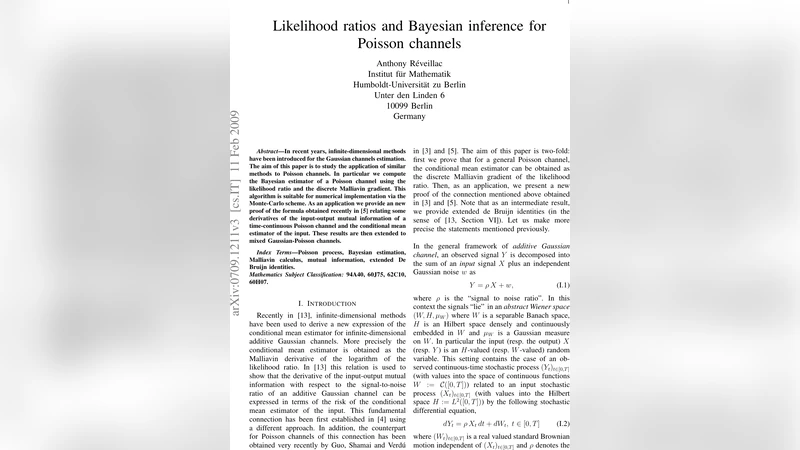
In recent years, infinite-dimensional methods have been introduced for the Gaussian channels estimation. The aim of this paper is to study the application of similar methods to Poisson channels. In particular we compute the Bayesian estimator of a Poisson channel using the likelihood ratio and the discrete Malliavin gradient. This algorithm is suitable for numerical implementation via the Monte-Carlo scheme. As an application we provide an new proof of the formula obtained recently by Guo, Shamai and Verdu'u relating some derivatives of the input-output mutual information of a time-continuous Poisson channel and the conditional mean estimator of the input. These results are then extended to mixed Gaussian-Poisson channels.
💡 Research Summary
The paper extends infinite‑dimensional stochastic analysis techniques, originally developed for Gaussian channels, to the setting of Poisson communication channels. After a concise introduction that reviews the success of Malliavin calculus‑based methods in Gaussian estimation, the authors formulate a continuous‑time Poisson channel model: the input is a stochastic intensity process (X_t) and the output is a counting process (Y_t) whose conditional law given (X) is Poisson with rate (X_t).
The core technical contribution is the construction of a likelihood ratio (or Radon‑Nikodym derivative) between the true output law and a reference law, together with the discrete Malliavin gradient (the “difference operator” appropriate for jump processes). By expressing the logarithmic derivative of the likelihood ratio through this gradient, the authors obtain an explicit representation of the Bayesian estimator (the posterior mean of (X_t) given the observed path of (Y)). The estimator appears as a functional of the likelihood ratio and its Malliavin derivative, mirroring the well‑known Gaussian formula where the posterior mean is the prior mean plus a term involving the score function.
From an algorithmic standpoint, the derived expression is amenable to Monte‑Carlo implementation. The authors outline a practical scheme: (1) simulate many independent sample paths of the input intensity; (2) for each path generate the corresponding Poisson output; (3) compute the likelihood ratio and its discrete Malliavin gradient along each trajectory; (4) average the resulting quantities to approximate the posterior mean. This Monte‑Carlo estimator scales well with the dimensionality of the input process and avoids the need for solving high‑dimensional PDEs or performing variational optimization, which are typical bottlenecks in traditional Bayesian filtering for point‑process observations.
A second major result revisits the information‑theoretic identity originally proved by Guo, Shamai, and Verdú (2008) for Poisson channels: the derivative of the mutual information (I(X;Y)) with respect to the channel’s scaling parameter equals the expected squared error between the input and its conditional mean estimator. The paper supplies a new proof of this identity that relies directly on the likelihood‑ratio/Malliavin‑gradient framework, thereby providing a more transparent probabilistic interpretation. The proof shows that the derivative of the mutual information can be written as an expectation of the Malliavin derivative of the log‑likelihood, which coincides with the conditional mean error term.
Finally, the authors generalize the methodology to mixed Gaussian‑Poisson channels, where observations consist of both a continuous Gaussian component and a jump‑driven Poisson component. By treating the two parts independently—defining separate likelihood ratios and Malliavin gradients for the Gaussian and Poisson contributions—and then combining them, they obtain a unified Bayesian estimator for the mixed channel. The same Monte‑Carlo recipe applies, making the approach attractive for practical communication systems that experience both thermal noise and photon‑counting (or event‑based) noise.
In summary, the paper makes three intertwined contributions: (i) a rigorous infinite‑dimensional Malliavin‑calculus based derivation of the Bayesian posterior mean for Poisson channels; (ii) a Monte‑Carlo algorithm that implements this estimator efficiently; and (iii) a new, conceptually simple proof of the Guo‑Shamai‑Verdú mutual‑information/estimation relationship, extended to hybrid Gaussian‑Poisson settings. These results deepen the theoretical link between information theory and stochastic calculus for point‑process channels and open the door to practical, high‑dimensional Bayesian inference in photon‑limited communication and related applications.
Comments & Academic Discussion
Loading comments...
Leave a Comment