Open Access does not increase citations for research articles from The Astrophysical Journal
We demonstrate conclusively that there is no "Open Access Advantage" for papers from the Astrophysical Journal. The two to one citation advantage enjoyed by papers deposited in the arXiv e-print server is due entirely to the nature and timing of the …
Authors: Michael J. Kurtz, Edwin A. Henneken
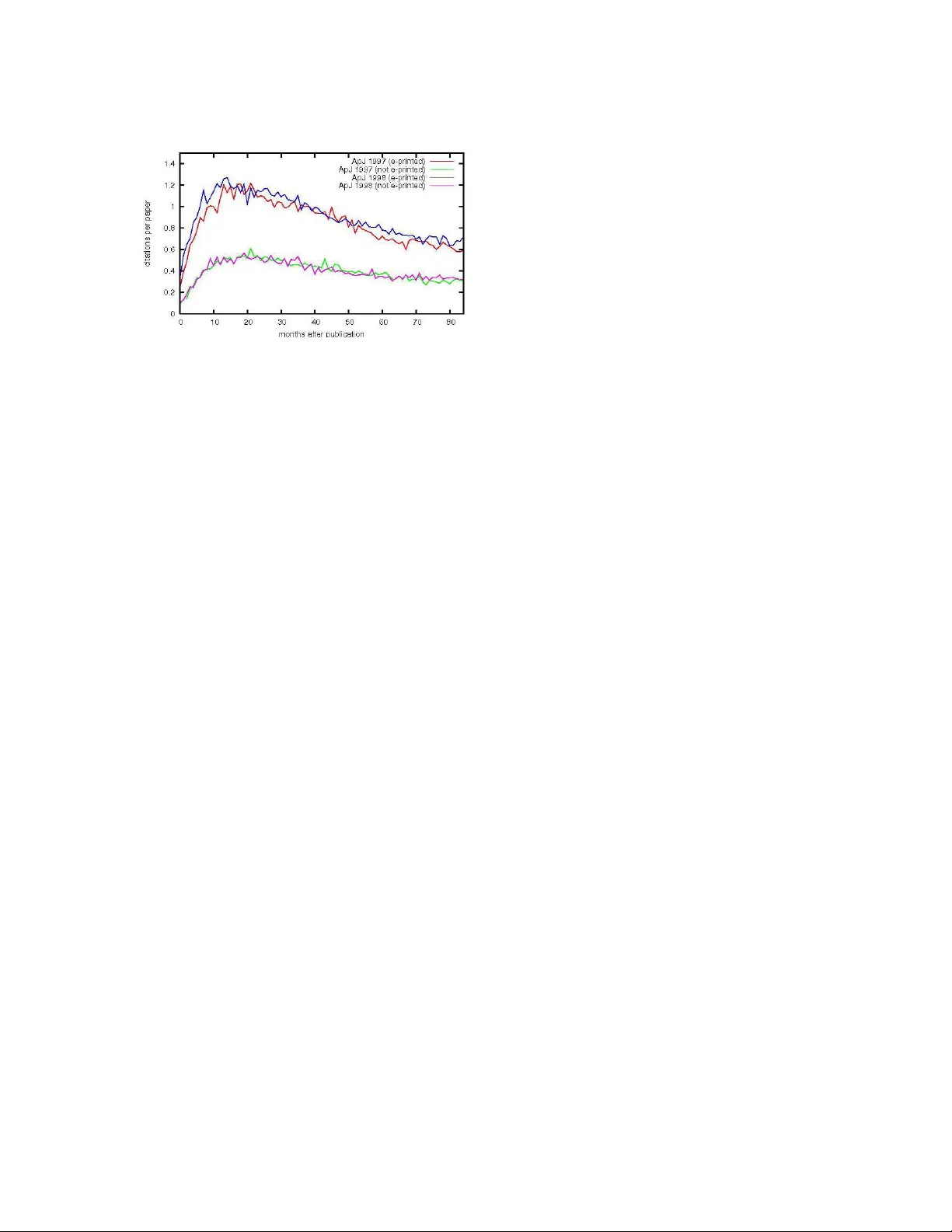
Open Acce ss d oes not increase citations for researc h art icles from The Astrophysical Journal Michael J. Kurtz and Edwin A. Hennek en Harvard-Sm ithso nian Center for As troph ysics 0. ABSTRA CT We demons trate conclusi vely that ther e is no “Open Ac cess Advan tage” for pap ers from the Astro ph ysic al Jo urna l. The t wo to one citat ion advantage enjoy ed by papers d epos ited in the arXiv e-print server is due entir ely t o the nature and timing o f the depo sited pape rs. This may have impl ication s for other d isciplin es. 1. INTRODU CTION Lawren ce ( 2001) first showed that research articles which hav e been po sted on t he int ernet have higher citation rates than arti cle s whi ch have not. The init ial as sumpt ion was that this was causal, because more p eop le could ac cess and read these papers they wer e cited more. This assumption was strength ened by th e analysis of Harnad and Brody (2004), who used phys ics articl es which were eith er deposited in arX iv (Gins parg, 1996), o r no t, and found that arXiv depo sited arti cles w ere better cited by mor e than a factor of two . Kurtz, et al (2005a ) inv estigat ed thr ee poss ible causes for th e effect: Early Acc ess (EA), arX iv deposited pap ers are cited mor e beca use th ey are available s everal mon ths before the j o urnal versions; Qua lity Bias (QB), e ither the best researchers tend to u se arXi v, or r esear chers tend to post thei r b est papers; and Op en Access (OA ), by bei ng available for fr ee on the int ernet more people are able to read the arXiv deposited papers, thus they ar e mor e cited. Kurtz, e t al (2005a) found t hat the EA an d QB pos tulates were abl e to account f or all th eir measurements , whi ch were f or papers in astro physics. They w ere unable to find an y OA effect. Th ey expla ined this by sugg esting that in a well funded f ield lik e astrop hysics essentially everyon e who is in a pos ition to write r es earch articles has full access to th e literat ure. Using different methodo logies Moed (20 07 ) studied the literature of sol id state ph ysics and came to very similar conclusions . The Southam pto n group resp onded by refining their analysis (Brody, et a l 2007), making plausible argument s e xplaining Kurtz, e t al . and Mo ed’s results, and reassert ing their clai ms that OA is th e dominan t effect. The diffic ulty with distingu ishing am ong t he various h ypoth eses is t hat, unti l now, th ere has been no case wh ere they are clearly separat ed. Just the act of an author self de pos iting a paper on line in an op en archive creates a po ssible bias compared to the a uthor/p aper which is not deposited. We have found a datas et which does not have this bias; i n 1997 the on-line Astrop hysical Jo urnal was a fully open access journa l, no subscription barri er existed. One was erected on January 1, 1998. By comparing the c itation experi ences of diff erent sets of articles f rom the 199 7 and 1998 ApJ we are able t o show c onclus ively the (non) e xist ence of the OA e ffect. 2. DATA We use citatio n records for papers publish ed in the Astro ph ysic al Journal in 1 997 and 19 98 taken fro m the ci tation databas e of the Smithson ian/NASA Astro ph ysic s Data System (K urtz, e t a l 2005b; ADS) . The data are divided i nto four categ or ies, by year, and by whether they were depos ited i n the arXiv e-print serv er (G insparg, 1996 ). The matching of j ournal articles with their arX iv versions is a routin e part of t h e ongoing arXiv- ADS c ollaboration (He nne ken, e t al, 2 006a). In 1997 ther e were 9 65 Ap J papers depos ited in arXiv, and 1408 whi ch wer e not; in 199 8 12 43 were depos ited and 110 5 were not. The Astrop hysical Journal i s among the first major scholarl y j ournals to have a full online version; the Letters section we nt onlin e (HTML and PDF) on July 1, 199 5, with the main journal com ing online on January 1, 1 997 (Boyce, e t al 1 996). By mid 1997 the online ve rs ion was bei ng re ad more via the ADS than the print v er sion was i n all th e world’s research li brar ies, combin ed (Kurtz, et al 2000). The Astro physi cal Journal impl em ented access contro ls, requiring potential readers to h ave subscription s, on January 1, 1998; from that time on they have had a three year mov ing window, so articles c an be v iewed only b y subs cribers until they are 36 mon ths old. The pr e-1998 art icles were not put behind the subscription wall when it was erect ed, thus th ey hav e always be en “open access.” 3. ANALYSI S The f igure p lots the citation h istories for th e four subsets (1997 deposited in arXiv, or not and 1998 deposited in arXiv, or no t) o f the As troph ysical Journal papers . The most obvious e ffect (Henneken, e t al 2006b) i s that arXiv depos ited papers are cit ed at about twic e the rate of no n- deposited papers; next we see th at the 1998 arX iv deposited papers have their peak c itation rate earlier than the 19 97 deposited papers, part of a long term trend sho wn by Brod y, et al. (20 06). Here w e wi ll dis cuss the bot tom two lin es on the graph, representing t he 1997 and 19 98 non-arXiv deposited ApJ articl es. T h ese two subsets represent a near perfe ct s ample to comp are th e effects of open a ccess ab sent th e complicating factor of any po ssibl e self ar chiving b ias. Bo th sets of arti cles come from authors who c hose not to sel f archi ve in arXi v, but on e of the s ets (1997) is fully open access, while the other (1998) i s fully toll or clo sed acc ess. As is c lear by inspection of the fig ure the two curves over lay ea ch oth er nearly perfectl y. There is no signifi cant differ ence in the c itation hist ories of the two sets, in partic ular ther e is no signifi cant differen ce for the f irst 36 month s following publication , where t he 1 997 articles were OA and the 1 998 articles we re not. There is also no significant di fferenc e in th e integral counts f or these two sets o f articl es over any time per iod. This shows di rectly that there is n o open access citation ad vantag e, ind ependent of the EA and SB effects, for the Ast roph ysical Journal. 4. DISCUSSI ON The existenc e of a larg e differential b etween articles put on-line through author self archiving, sho wn fi rst by La wren ce (2001) has been repeatedly c onfirm ed (includ ing in our fig ure), and is firmly estab lished. The issu e, as posed by Kurtz, et al . (2005a) i s w hether all or p art of t his differentia l is c aused by the differing c ost compo nents, th at self archived art icles are availabl e free, without subscription , while non sel f archived articles re quire that a fee (subscr iption) be paid. Here we hav e shown conclusivel y that for th e Astro ph ysic al Jo urnal th ere is no c ost com pon ent to the citation differ ential, conf irming out pre vious result in astro physics (K urtz, et a l. 2005a) and Moed’s (200 7) in condens ed matt er physi cs. There are a number of excell ent argu m ents i n f avor of changing th e sc ientific pub lication syst em to an open access model. The open access citation advantage is not on e of th em. 5. REFEREN CES Boyce, P .B. , B iemesd erfer, C., and Owens, E., 1996 Vist as in As tron omy 10, 423 Brody, T., Harnad, S., and Carr, L., 2006 Jo urnal of the American Society f or Informat ion Science an d Techn ology 5 7, 1060 Brody, T., Car r, L., Gingras, Y., Hajje m, C., Harnad, S., and Swan , A., 2007 CTWatch Quarterly, 3, no. 3, 42 Ginsp arg, P., 1996 in U N ESCO Conf on Electronic Publishing in S cience Harnad, S. an d Bro dy, T., 20 04 D-Lib, 10, no. 6 Henneken, E ., Kurtz, M.J., Acc omaz zi, A., Grant, C., Thomps on, D., Bohle n, E., Murray, S.S, Ginsp arg, P ., and W arn er, S., 2006a Learned Publishing, 20, 16 Henneken, E .A., Kurtz, M.J., Eichhorn, G., Accomazz i, A., G rand, C., Thom pso n, D. , and Murray, S.S., 2006b Jo urnal of El ectron ic Publishing, 9, no. 2 Kurtz, M.J., Eichh orn, G., Accomazzi, A., Grant, C., Murray, S.S. , and Wats on, J.M., 2000 Astro no my and Astrophysics Suppl ement Series, 14 3, 41 Kurtz, M.J., Eichh orn, G., Accomazzi, A., Grant, C., Henneken, E. and Murray, S.S., 2005a Informat ion Proc essing and Managem ent, 41, 1395 Kurtz, M.J., Eichh orn, G., Accomazzi, A., Grant, C., Demleitner, M., and Mu rray, S.S. 2005b Journal of the American Society for Informat ion Sci ence and T echnolog y, 56, 36 Lawren ce, S., 20 01 Natur e, 411, 521 Moed. H.F., 200 7 Journal of the Am erican So ciety for Information Science and Technology, early view, DOI: 1 0.100 2/asi.20663
Original Paper
Loading high-quality paper...
Comments & Academic Discussion
Loading comments...
Leave a Comment