Categories of categories
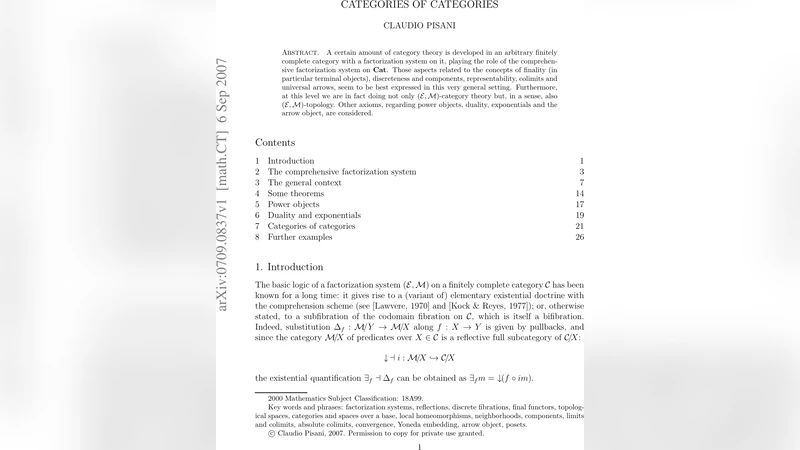
A certain amount of category theory is developed in an arbitrary finitely complete category with a factorization system on it, playing the role of the comprehensive factorization system on Cat. Those aspects related to the concepts of finality (in particular terminal objects), discreteness and components, representability, colimits and universal arrows, seem to be best expressed in this very general setting. Furthermore, at this level we are in fact doing not only (E,M)-category theory but, in a sense, also (E,M)-topology. Other axioms, regarding power objects, duality, exponentials and the arrow object, are considered.
💡 Research Summary
The paper develops a substantial portion of category theory inside an arbitrary finitely complete category K equipped with a factorization system ((E,M)). The system is required to behave analogously to the comprehensive factorization system on Cat, where every morphism factors as an (E)-morphism (playing the role of a “surjection”) followed by an (M)-morphism (playing the role of a “monomorphism”). By assuming the existence of such a system, the author is able to reinterpret many foundational notions—final objects, discreteness, components, representability, colimits, and universal arrows—in a setting that is far more general than the usual category of categories.
The first part of the work shows that a terminal object can be defined as an object (1) such that the unique morphism (X\to 1) belongs to (E) for every (X) in K. The stability of (E) under pullback and the orthogonality between (E) and (M) guarantee both existence and uniqueness of such an object whenever the factorization system satisfies the usual axioms (every morphism admits an ((E,M))-factorization, (E) is closed under composition, etc.). This mirrors the classical characterization of terminal objects in Cat, but now the proof works inside any finitely complete category with the prescribed factorization.
Next, the paper introduces a notion of “discrete objects” and “components”. An (M)-morphism is interpreted as an internal equivalence relation, while an (E)-morphism identifies the equivalence classes. The collection of (E)-images of an object yields its set of components, providing a categorical analogue of connected components of a space or of a category. The author proves that these components are stable under pullback along (M)-maps and that they satisfy a universal property similar to the component functor in Cat.
Representability is treated through the lens of universal arrows. Given a functor (F: K\to L) (where (L) is another finitely complete category with a compatible ((E,M))-system), a universal arrow from an object (A) to (F) is required to be an (E)-morphism (u: A\to FA) such that any other morphism (A\to FB) factors uniquely through (u) via an (M)-morphism. This definition reproduces the usual universal property of colimits when (F) is a diagram functor, and the paper shows that the existence of such universal arrows is equivalent to the existence of certain colimits in K. Moreover, the factorization system guarantees the uniqueness of the colimit up to a unique (M)-isomorphism.
A particularly innovative contribution is the development of an “((E,M))-topology”. By declaring (E)-maps to be “open” and (M)-maps to be “closed”, the author imports topological intuition into the categorical framework. Within this viewpoint, power objects (subobject classifiers) and exponential objects are examined. The existence of a power object for an object (X) is shown to be equivalent to the ability to form an internal lattice of (E)-subobjects of (X). Exponential objects (Y^X) are constructed when the factorization system admits a suitable internal hom that respects the ((E,M))-structure. The arrow object (\mathbf{Arr}(K)) is introduced as a categorical object whose points are morphisms of K, and its universal property is proved: any morphism (f: A\to B) corresponds uniquely to an (M)-map into (\mathbf{Arr}(K)) together with an (E)-projection. This object plays a central role in formulating internal versions of natural transformations and adjunctions.
The paper also discusses additional axioms that may be imposed on K: a duality axiom (symmetry between (E) and (M) when the factorization system is self‑dual), the existence of a subobject classifier, and the requirement that the arrow object be exponentiable. When these axioms hold, K behaves much like a topos, but with the crucial difference that the “open/closed” distinction is governed by the chosen ((E,M))-system rather than by a Grothendieck topology.
In the concluding section, the author emphasizes that the whole development shows how the comprehensive factorization on Cat is not an isolated phenomenon but a special case of a far more general pattern. By working in any finitely complete category equipped with a suitable ((E,M))-factorization, one can recover the essential machinery of category theory—terminal objects, components, colimits, representability—while simultaneously gaining a topological perspective that unifies categorical and spatial intuitions. The results open the door to “((E,M))-category theory” as a framework for studying categories enriched over various logical or geometric contexts, and suggest further research directions such as the interaction with higher‑dimensional factorization systems, internal sheaf theory, and the development of homotopical analogues.
Comments & Academic Discussion
Loading comments...
Leave a Comment