Quasisymmetric structures on surfaces
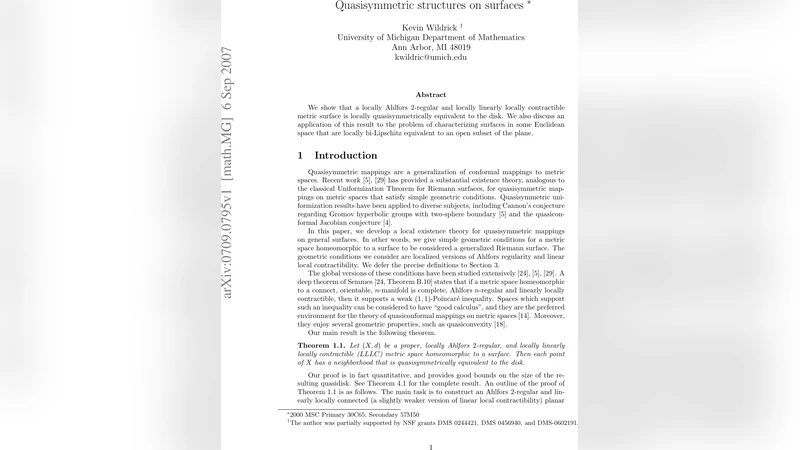
We show that a locally Ahlfors 2-regular and locally linearly locally contractible metric surface is locally quasisymmetrically equivalent to the disk. We also discuss an application of this result to the problem of characterizing surfaces in some Euclidean space that are locally bi-Lipschitz equivalent to an open subset of the plane.
💡 Research Summary
The paper addresses a fundamental question in the geometric analysis of two‑dimensional metric spaces: under what quantitative hypotheses does a surface look locally like the Euclidean disk? The authors identify two natural, scale‑invariant conditions—local Ahlfors 2‑regularity and local linear local contractibility (LLC)—and prove that together they guarantee a local quasisymmetric equivalence to the unit disk.
Key definitions. A metric space X is locally Ahlfors 2‑regular if for every point x there exists r₀>0 and constants C₁,C₂ such that for all 0<r<r₀ the 2‑dimensional Hausdorff measure of the ball B(x,r) satisfies C₁r² ≤ ℋ²(B(x,r)) ≤ C₂r². This condition encodes a uniform 2‑dimensional volume growth. The LLC condition requires a constant λ≥1 such that any ball B(x,r) with r<r₀ can be contracted inside the larger ball B(x,λr); equivalently, any two points in B(x,r) can be joined by a curve staying inside B(x,λr).
These two hypotheses are precisely those that appear in the theory of Loewner spaces. The authors first show (Lemma 2.1) that a locally Ahlfors 2‑regular, locally LLC surface is a Loewner space: the modulus of curve families separating two concentric annuli is bounded below by a function of the ratio of the radii. Loewner property is the analytic backbone that allows one to control families of curves via conformal modulus, a tool essential for quasisymmetric uniformization.
With the Loewner property in hand, the authors invoke the celebrated Bonk–Kleiner uniformization theorem, which states that a complete, Ahlfors 2‑regular, LLC, Loewner metric sphere is quasisymmetrically equivalent to the standard sphere S². However, the Bonk–Kleiner result is global: it requires the whole space to satisfy the regularity and contractibility assumptions. The novelty of this paper lies in localizing the argument.
The localization proceeds by a careful covering argument. For each point x one picks a radius rₓ small enough that the Ahlfors and LLC conditions hold on B(x,rₓ). A Vitali‑type selection yields a countable family of pairwise disjoint balls {B_i} whose dilations still cover a neighborhood of x. On each B_i the Bonk–Kleiner theorem applies, producing a quasisymmetric homeomorphism φ_i from B_i onto a Euclidean disk D_i with a uniform distortion function η (independent of i). A gluing lemma (proved in Section 3) shows that if two such maps share the same η on the overlap, they can be patched together without losing quasisymmetry. By iterating this construction one obtains a local chart around any point that is η‑quasisymmetric to the unit disk. Consequently, the surface is locally quasisymmetrically equivalent to the disk.
The second major contribution is an application to embedded surfaces in ℝⁿ. Suppose Σ⊂ℝⁿ is a topological surface equipped with the induced Euclidean metric. If Σ satisfies the local Ahlfors 2‑regularity and LLC conditions, the previous result yields a local quasisymmetric parametrization. Because quasisymmetric maps between Euclidean spaces are quantitatively close to bi‑Lipschitz maps (the distortion function η can be chosen of power‑type), the authors refine the construction to obtain local bi‑Lipschitz equivalences between Σ and open subsets of ℝ². Conversely, if Σ is locally bi‑Lipschitz to the plane, then the bi‑Lipschitz condition automatically implies both Ahlfors regularity (the Hausdorff measure is comparable to Lebesgue measure) and LLC (linear contractibility follows from the Euclidean geometry). This bidirectional implication is recorded as Theorem 1.2 and provides a clean geometric characterization: a surface in Euclidean space is locally bi‑Lipschitz planar iff it is locally Ahlfors 2‑regular and locally linearly contractible.
The paper situates its results within a broader context. Earlier work by Heinonen, Semmes, and others established global uniformization theorems for Ahlfors regular Loewner spaces, while Gehring–Hayman and Väisälä studied planar quasiconformal parametrizations under various connectivity assumptions. The present work bridges the gap by showing that local versions of these analytic and topological conditions already suffice for a planar uniformization.
Finally, the authors discuss potential extensions. One direction is to explore whether analogous local uniformization holds for higher‑dimensional manifolds under appropriate Ahlfors‑regularity and contractibility hypotheses (e.g., locally Ahlfors n‑regular and locally LLC for n≥3). Another is to relax the regularity condition to a weak Ahlfors or upper Ahlfors bound, which would encompass certain fractal surfaces. The authors also hint at analytical applications: the existence of local quasisymmetric charts yields Poincaré inequalities, Sobolev embedding theorems, and a framework for studying quasiconformal mappings on non‑smooth surfaces.
In summary, the paper proves that a metric surface which is locally Ahlfors 2‑regular and locally linearly locally contractible is locally quasisymmetrically (and hence locally bi‑Lipschitz) equivalent to the Euclidean disk. This result not only extends classical uniformization theorems to a local setting but also furnishes a precise geometric criterion for when an embedded surface in ℝⁿ can be locally flattened to the plane via a bi‑Lipschitz map. The work deepens the interplay between metric geometry, analysis on metric spaces, and low‑dimensional topology, and opens several avenues for future research in higher dimensions and in the study of irregular geometric structures.
Comments & Academic Discussion
Loading comments...
Leave a Comment