In the industry, numerous commercial packages provide tools to introduce, and analyse human behaviour in the product's environment (for maintenance, ergonomics...), thanks to Virtual Humans. We will focus on control. Thanks to algorithms newly introduced in recent research papers, we think we can provide an implementation, which even widens, and simplifies the animation capacities of virtual manikins. In order to do so, we are going to express the industrial expectations as for Virtual Humans, without considering feasibility (not to bias the issue). The second part will show that no commercial application provides the tools that perfectly meet the needs. Thus we propose a new animation framework that better answers the problem. Our contribution is the integration - driven by need ~ of available new scientific techniques to animate Virtual Humans, in a new control scheme that better answers industrial expectations.
Deep Dive into Designing a Virtual Manikin Animation Framework Aimed at Virtual Prototyping.
In the industry, numerous commercial packages provide tools to introduce, and analyse human behaviour in the product’s environment (for maintenance, ergonomics…), thanks to Virtual Humans. We will focus on control. Thanks to algorithms newly introduced in recent research papers, we think we can provide an implementation, which even widens, and simplifies the animation capacities of virtual manikins. In order to do so, we are going to express the industrial expectations as for Virtual Humans, without considering feasibility (not to bias the issue). The second part will show that no commercial application provides the tools that perfectly meet the needs. Thus we propose a new animation framework that better answers the problem. Our contribution is the integration - driven by need ~ of available new scientific techniques to animate Virtual Humans, in a new control scheme that better answers industrial expectations.
The work we are introducing here takes place in a far larger context: the industrial design process. The Virtual Human (VH) is to fit the concurrent engineering design approach.
Large-scale concurrent engineering is now regarded as very attractive (one talk about “engineers’ dream”) [Dur03]. It is held by IT innovation as well as by new organisation and management methods. That is rational methods have to be developed to take advantage of industrial IT objects or machines, such as Digital Mock-Up (DMU) reviews to support large collaborative teams… In such a framework, DMU is no longer an assembly model in a CAD tool, but an object managed by a Product Data Management (PDM) tool, which supports the product’s integrity through collaborative work.
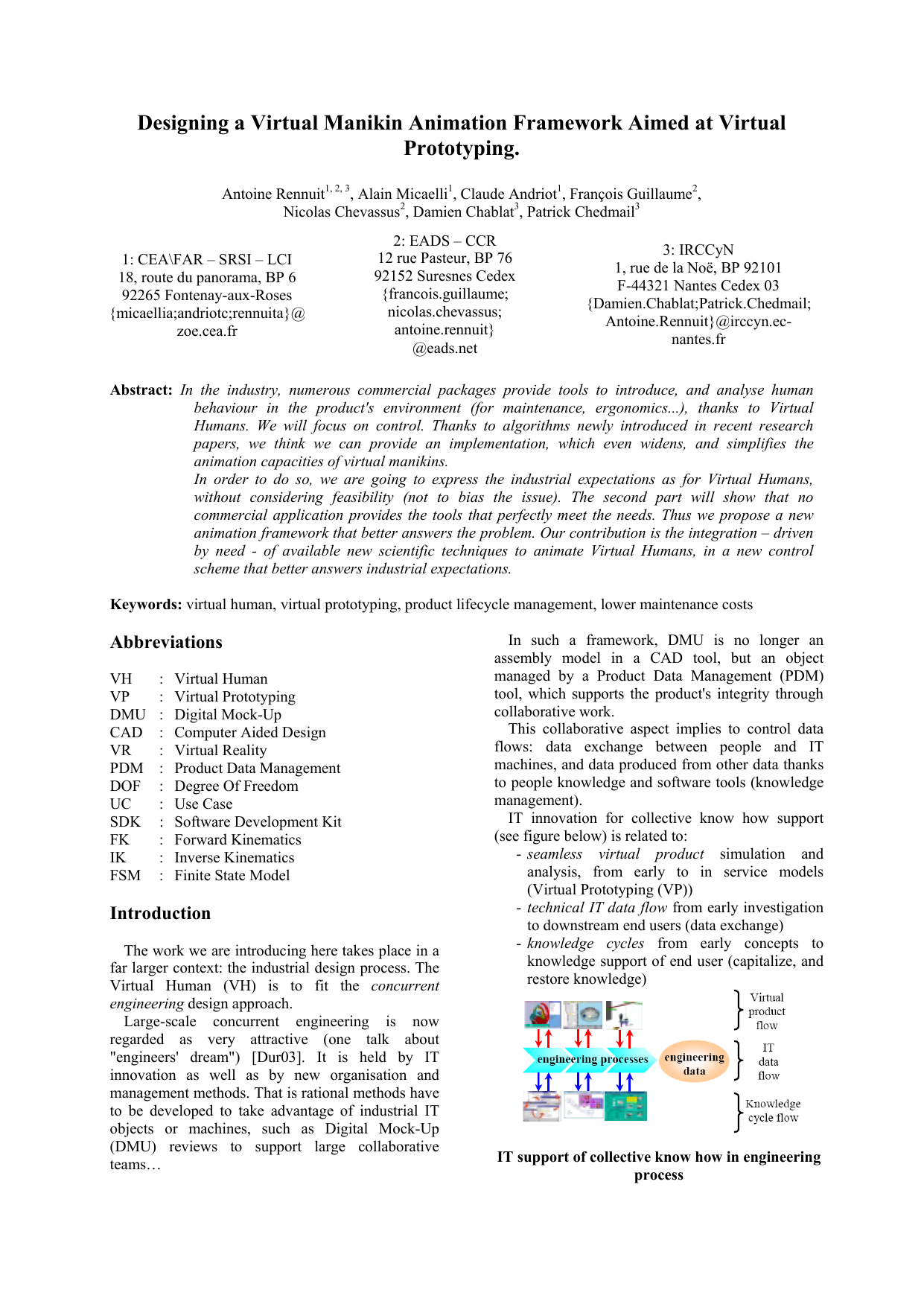
This collaborative aspect implies to control data flows: data exchange between people and IT machines, and data produced from other data thanks to people knowledge and software tools (knowledge management).
IT innovation for collective know how support (see figure below) is related to:
-seamless virtual product simulation and analysis, from early to in service models (Virtual Prototyping (VP)) -technical IT data flow from early investigation to downstream end users (data exchange) -knowledge cycles from early concepts to knowledge support of end user (capitalize, and restore knowledge)
2: EADS -CCR 12 rue Pasteur, BP 76 92152 Suresnes Cedex {francois.guillaume; nicolas.chevassus; antoine.rennuit} @eads.net 1: CEA\FAR -SRSI -LCI 18, route du panorama, BP 6 92265 Fontenay-aux-Roses {micaellia;andriotc;rennuita}@ zoe.cea.fr 3: IRCCyN 1, rue de la Noë, BP 92101 F-44321 Nantes Cedex 03 {Damien.Chablat;Patrick.Chedmail;
Antoine.Rennuit}@irccyn.ecnantes.fr
As stated above, this remains an “engineer’s dream”, several great problems still remain. The one we will focus on comes from obtaining a seamless virtual product (red arrows on the above figure), and looks for human centred design.
A product is being designed to satisfy human’s needs (Human Centric Design), thus human should naturally be incorporated within the design process. Actually, this is such a complex system, that it is very hard to take it into consideration as a constraint all along the design phase.
One should simulate, and introduce it into the VP virtual environment, but due to its high number of Degrees Of Freedom (DOF), controlling it is not so well handled: there are no thoroughly satisfying commercial solutions, and above all, they do not perfectly fit the VP framework. Need as for Virtual Humans is identified but the answers could be improved thanks to new control algorithms, and increasing computer capacities.
In the remaining sections of the paper, we will make a complete review of the industrial need, to understand better the industrial expectations as for Virtual Humans control. We will then establish a survey of the commercial packages available aimed at controlling a Virtual Human, show their deficiencies, and conclude to the inadequacy of existing solutions to the problem. This will allow us to introduce the new notion of motion scale, and thanks to it describe the design of a package better answering needs, thanks to newly introduced control algorithm.
As explained above, the virtual human, is a fantastic way to carry constraints linked to humans’ interactions with the product (better known as ergonomics, accessibility checking…) in the designing process. A company using VH can expect benefits such as shorter design time, lower development costs, improved quality, increased productivity, enhanced safety, heightened moral… We can see VH fits perfectly to VP philosophy.
To fulfil all expectations of industrialists, we will adopt a systematic approach while expressing the need for a Virtual Human software package, in order to pick out the whole expression of need.
Ideally, the product will be tested in all situations. All these tests should be available to a VH animation package. To pick out them all, we analyse the product lifecycle.
In EADS, Product Lifecycle Management (PLM) analysis is seen as follows:
PLM steps organisation in the concurrent engineering process, as seen by EADS. (simplified scheme highlighting the steps that will benefit most of VH)
Improving the PLM steps’ quality can directly be perceived as beneficial, and profitable by the client. It generates competitive advantages in a straightforward way! In the following paragraphs, we will enumerate the stakes and challenges of each use case (which existed prior to the introduction of Virtual Prototyping), the contribution points Virtual Humans can bring to them, and then the competitive advantages resulting from using VH. This will allow us to list all the needed features of the animation package to use, thus expressing our need.
• develop human centred products, evaluate designs based on ergonomic factors Now that we showed the need for Virtual Humans, and revealed the benefits they could bring to industrialists
…(Full text truncated)…
This content is AI-processed based on ArXiv data.