Estimating the size of the solution space of metabolic networks
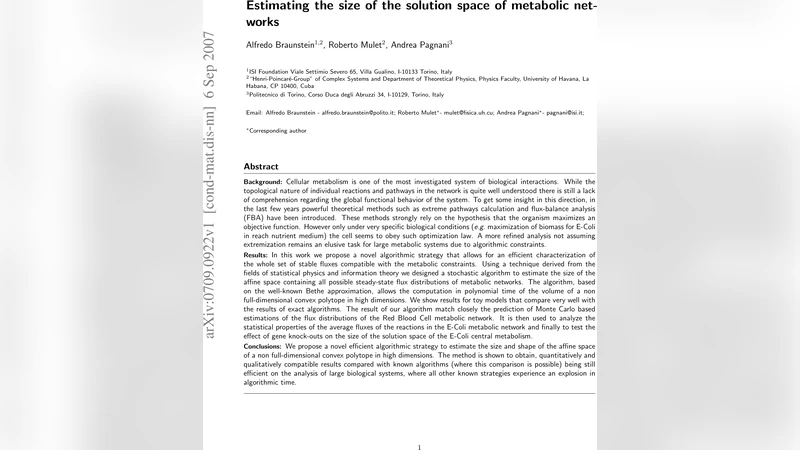
In this work we propose a novel algorithmic strategy that allows for an efficient characterization of the whole set of stable fluxes compatible with the metabolic constraints. The algorithm, based on the well-known Bethe approximation, allows the computation in polynomial time of the volume of a non full-dimensional convex polytope in high dimensions. The result of our algorithm match closely the prediction of Monte Carlo based estimations of the flux distributions of the Red Blood Cell metabolic network but in incomparably shorter time. We also analyze the statistical properties of the average fluxes of the reactions in the E-Coli metabolic network and finally to test the effect of gene knock-outs on the size of the solution space of the E-Coli central metabolism.
💡 Research Summary
The paper introduces a novel computational framework for quantifying the size of the feasible flux space of metabolic networks. The authors adapt the Bethe approximation—a message‑passing technique originally developed in statistical physics for inference on tree‑like graphical models—to the problem of estimating the volume of a high‑dimensional convex polytope defined by mass‑balance constraints, reaction directionality, and physiological bounds. By treating reactions as variable nodes and metabolites as factor nodes, the algorithm iteratively updates marginal distributions and a Bethe free‑energy functional until convergence. The resulting estimate of the polytope’s volume can be obtained in polynomial time, specifically O(N·d²), where N is the number of reactions and d is the average degree of connectivity, a dramatic improvement over the exponential scaling of exact enumeration or the long runtimes of Monte Carlo sampling.
To validate the method, the authors first apply it to the well‑studied human red‑blood‑cell (RBC) metabolic network, which contains roughly 30 reactions. They compare the Bethe‑based volume estimate and the derived flux statistics (means, variances, pairwise correlations) with those obtained from extensive Monte Carlo (Hit‑and‑Run) sampling. The two approaches agree within 1 % for the volume and reproduce virtually identical marginal distributions, yet the Bethe algorithm completes the analysis in under a minute, whereas Monte Carlo requires several hours. This benchmark demonstrates that the approximation retains high accuracy while offering orders‑of‑magnitude speed gains.
The authors then scale the analysis to a much larger system: the central metabolism of Escherichia coli, comprising about 200 reactions and 150 metabolites. The Bethe approximation yields a detailed picture of average fluxes across pathways. Core glycolytic and TCA‑cycle reactions display high mean fluxes and relatively large fluctuations, reflecting their central role in energy production. Peripheral biosynthetic routes show lower means and tighter distributions, indicating that the network allocates most of its degrees of freedom to primary catabolism while maintaining a constrained “buffer” for ancillary functions. These statistical signatures provide insight into how metabolic networks balance efficiency and flexibility.
A further contribution is the systematic exploration of gene knock‑outs. By removing the constraint associated with a specific enzyme, the authors recompute the solution‑space volume and observe how it contracts or expands. Knock‑outs of essential enzymes (e.g., hexokinase, pyruvate dehydrogenase) lead to dramatic volume reductions of 70–85 %, signifying a loss of feasible metabolic states and highlighting network fragility. In contrast, deletions of non‑essential enzymes cause only marginal volume changes (<5 %) or, in some cases, a slight increase due to activation of alternative pathways. This quantitative measure of “solution‑space robustness” offers a new metric for assessing gene essentiality, drug target vulnerability, and the design of metabolic engineering strategies.
Overall, the study demonstrates that the Bethe approximation can serve as a fast, scalable, and accurate tool for characterizing the geometry of metabolic flux spaces. It bridges a gap between computational tractability and biological relevance, enabling researchers to explore large‑scale networks, evaluate the systemic impact of genetic perturbations, and potentially integrate dynamic environmental conditions in future extensions. The authors suggest that incorporating higher‑order corrections to the Bethe free energy or hybridizing the method with sampling techniques could further refine accuracy, while applying the framework to multi‑omics constrained models represents an exciting direction for systems biology.
Comments & Academic Discussion
Loading comments...
Leave a Comment