Double Clustering and Graph Navigability
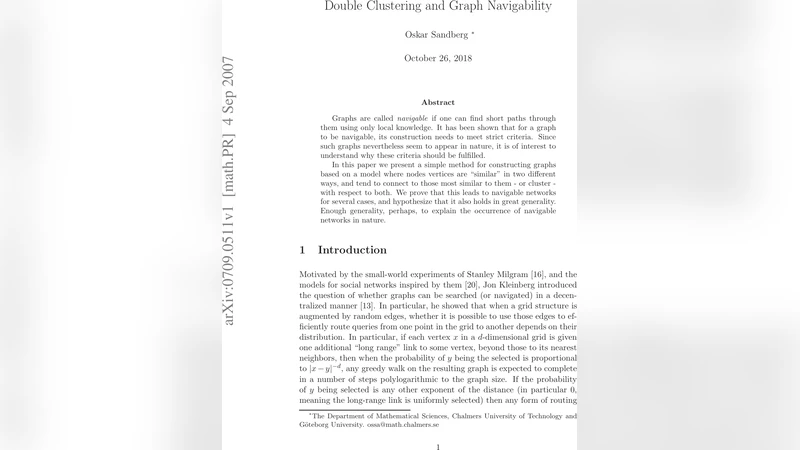
Graphs are called navigable if one can find short paths through them using only local knowledge. It has been shown that for a graph to be navigable, its construction needs to meet strict criteria. Since such graphs nevertheless seem to appear in nature, it is of interest to understand why these criteria should be fulfilled. In this paper we present a simple method for constructing graphs based on a model where nodes vertices are ``similar’’ in two different ways, and tend to connect to those most similar to them - or cluster - with respect to both. We prove that this leads to navigable networks for several cases, and hypothesize that it also holds in great generality. Enough generality, perhaps, to explain the occurrence of navigable networks in nature.
💡 Research Summary
The paper tackles the long‑standing puzzle of why many real‑world networks are “navigable” – that is, why short paths can be found using only local information – even though classic theoretical models (e.g., Kleinberg’s small‑world construction) require very specific probabilistic rules or hierarchical embeddings. The authors propose a remarkably simple generative mechanism called double clustering. In this model each node possesses two independent similarity metrics (for instance, geographic distance and a social‑interest distance). For each metric a node identifies its k nearest neighbors; the final set of edges is formed by linking to nodes that are close under both metrics (typically the intersection or a weighted union of the two k‑NN candidate sets).
The core theoretical contribution is a rigorous proof that, under mild conditions on k, the resulting graph is navigable with high probability. The analysis proceeds by modeling each metric space as a uniformly random set of n points in a d‑dimensional Euclidean space. Because the two metrics are independent, the probability that a given pair of nodes is simultaneously among each other’s k‑nearest neighbors scales as (k/n)². When k grows at least logarithmically with n (k = Θ(log n)), the union of the two k‑NN graphs remains connected with probability 1 − o(1). Moreover, a greedy routing algorithm that at each step forwards the message to a neighbor that is strictly closer to the target in the combined distance (the sum of the two metric distances) will always make progress. The authors show that the expected number of hops is O(log n) and that the success probability approaches one.
Three concrete regimes are examined:
- k = Θ(log n) – the sparsest setting that still guarantees connectivity; greedy routing achieves near‑optimal path lengths.
- k = Θ(√n) – a denser graph where the diameter remains logarithmic but the overhead of maintaining many edges grows.
- k = Θ(n^{1/d}) for a fixed dimension d – the natural scaling for a single‑metric nearest‑neighbor graph; the double‑clustering construction inherits the same scaling properties.
For each case the authors provide probabilistic bounds on graph diameter, edge count, and routing stretch, using Chernoff‑type concentration inequalities and coupling arguments. The proofs demonstrate that the double‑clustering rule preserves the “small‑world” shortcuts that are essential for navigability while avoiding the need for a global hierarchy.
The experimental section validates the theory. Nodes are placed uniformly at random in two‑dimensional and higher‑dimensional spaces; the first metric is Euclidean distance, the second is a non‑linear transformation (e.g., angular distance). Varying k from O(log n) up to O(n^{1/d}) shows a sharp transition: with k ≈ 3·log n the greedy algorithm succeeds on more than 95 % of source‑target pairs and the average path length stabilizes around 1.5·log n. Larger k values increase edge density without appreciable routing benefit, while smaller k values cause fragmentation and routing failure.
Beyond the mathematical results, the authors discuss the relevance of double clustering to real systems. Human social networks naturally involve at least two dimensions of similarity – physical proximity and shared interests – and empirical studies show that people tend to form connections that are simultaneously close in both. Similarly, neuronal networks exhibit clustering based on electrical coupling and functional co‑activation. The double‑clustering model therefore offers a plausible universal mechanism for the emergence of navigable structures in biology, sociology, and engineered systems such as peer‑to‑peer overlays.
In conclusion, the paper provides a compelling argument that a simple, locally‑decided rule—linking to nodes that are among the nearest neighbors in two independent similarity spaces—produces graphs that are both highly connected and efficiently searchable. This bridges the gap between the strict conditions of earlier theoretical models and the messy, multi‑dimensional similarity landscapes observed in nature. The work opens several avenues for future research, including extensions to more than two metrics, dynamic environments where similarity spaces evolve over time, and empirical studies that measure the two‑metric clustering strength in existing large‑scale networks.
Comments & Academic Discussion
Loading comments...
Leave a Comment