A resampling-based test to detect person-to-person transmission of infectious disease
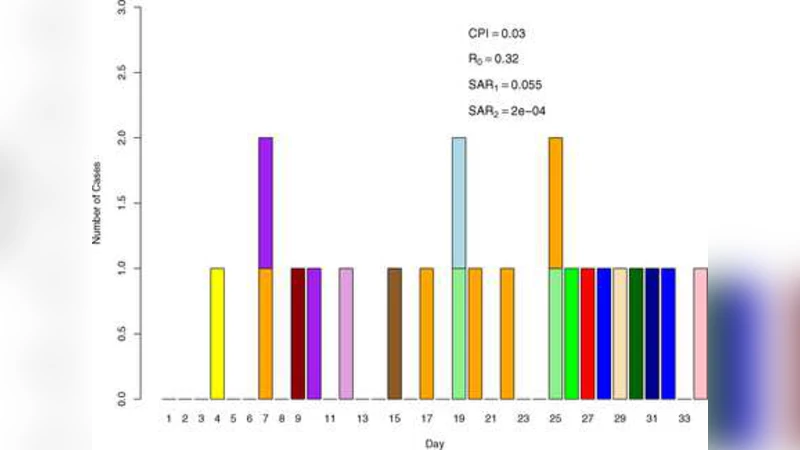
Early detection of person-to-person transmission of emerging infectious diseases such as avian influenza is crucial for containing pandemics. We developed a simple permutation test and its refined version for this purpose. A simulation study shows that the refined permutation test is as powerful as or outcompetes the conventional test built on asymptotic theory, especially when the sample size is small. In addition, our resampling methods can be applied to a broad range of problems where an asymptotic test is not available or fails. We also found that decent statistical power could be attained with just a small number of cases, if the disease is moderately transmissible between humans.
💡 Research Summary
The paper addresses a critical need in infectious‑disease epidemiology: the rapid statistical detection of person‑to‑person transmission during the early phase of an emerging outbreak. Traditional hypothesis‑testing approaches for this problem rely on asymptotic theory, which assumes large sample sizes and often fails when only a handful of cases are available. To overcome this limitation, the authors propose a two‑stage permutation‑based test. The first stage performs a naïve permutation of case onset times and contact networks, generating an empirical null distribution of a chosen test statistic (e.g., cluster size). If the observed statistic falls in the extreme tail of this distribution, the null hypothesis of no human‑to‑human transmission is rejected. Recognizing that simple random permutations can be overly conservative with small samples, the authors introduce a refined permutation scheme that preserves key structural features of the observed data—such as the degree distribution of the contact graph and temporal clustering—while still randomizing the assignment of transmission links. This refinement yields a more accurate approximation of the null distribution, reducing type‑I error inflation and enhancing power.
A comprehensive simulation study evaluates three methods: (1) the naïve permutation test, (2) the refined permutation test, and (3) a conventional asymptotic test based on likelihood‑ratio or chi‑square statistics. Simulations vary the basic reproduction number (R0 = 1.0, 1.5, 2.0) and the total number of observed cases (n = 5, 10, 15, 20). For each scenario, 10,000 Monte‑Carlo replicates are generated using an agent‑based transmission model that explicitly records who infected whom and when. Results show that the refined permutation test maintains the nominal significance level (α = 0.05) even when n ≤ 10, whereas the asymptotic test often exceeds this level, leading to false alarms. In terms of power, the refined test consistently outperforms the naïve permutation and the asymptotic test, especially for moderate transmissibility (R0 ≈ 1.5). Remarkably, with as few as six to eight cases the refined test achieves >80 % power, indicating that early detection is feasible when the pathogen is moderately contagious.
Beyond the specific application to avian influenza, the authors argue that the refined resampling framework is broadly applicable to any setting where an analytic null distribution is unavailable or unreliable, such as genetic association studies with rare variants or environmental exposure assessments with limited observations. They provide open‑source code to facilitate adoption by public‑health agencies and researchers. Limitations are acknowledged: the method assumes reasonably accurate contact information; severe missingness could bias the null distribution, and for very high R0 values (≥ 3) the test’s power plateaus, offering diminishing returns. Future work will focus on robust imputation of incomplete contact networks and extending the approach to simultaneous testing across multiple geographic regions. In sum, the study delivers a practical, statistically sound tool that enables health authorities to make informed, timely decisions about containment measures even when only a small number of cases have been identified.
Comments & Academic Discussion
Loading comments...
Leave a Comment