Differential and graphical approaches to multistability theory for chemical reaction networks
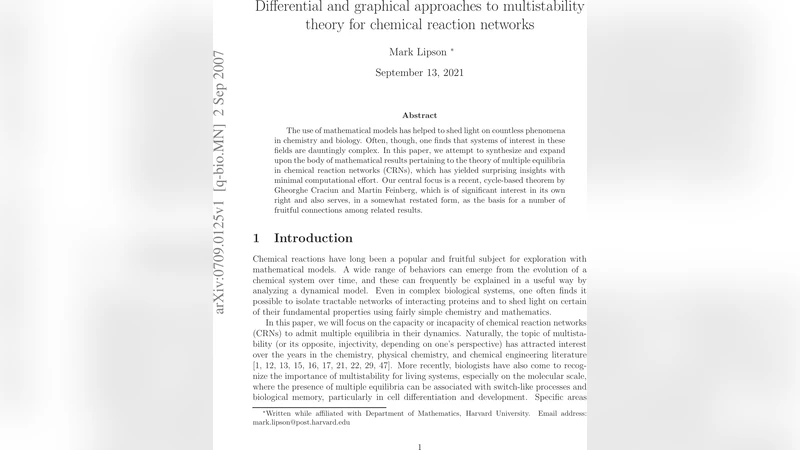
The use of mathematical models has helped to shed light on countless phenomena in chemistry and biology. Often, though, one finds that systems of interest in these fields are dauntingly complex. In this paper, we attempt to synthesize and expand upon the body of mathematical results pertaining to the theory of multiple equilibria in chemical reaction networks (CRNs), which has yielded surprising insights with minimal computational effort. Our central focus is a recent, cycle-based theorem by Gheorghe Craciun and Martin Feinberg, which is of significant interest in its own right and also serves, in a somewhat restated form, as the basis for a number of fruitful connections among related results.
💡 Research Summary
The paper presents a unified framework that combines differential and graphical methods to assess multistability— the existence of multiple stable equilibria—in chemical reaction networks (CRNs). Beginning with a motivation rooted in the ubiquity of multistable behavior in biochemical systems, the authors highlight the computational challenges posed by large‑scale networks and the need for criteria that require minimal numerical effort.
The authors first recapitulate the standard dynamical description of CRNs under mass‑action kinetics, where the state vector of species concentrations evolves according to a system of ordinary differential equations. The Jacobian matrix of this system encodes local stability properties, and its injectivity (i.e., the mapping from concentrations to reaction rates being one‑to‑one) guarantees the absence of multiple steady states. Traditional injectivity tests involve checking sign patterns of the Jacobian or verifying that it is a P‑matrix, but these approaches can become cumbersome for high‑dimensional systems.
The centerpiece of the manuscript is a detailed exposition of the Craciun‑Feinberg cycle theorem. By translating the reaction network into a species‑reaction graph and an interaction graph, the theorem links the sign structure of cycles (directed loops) in these graphs to the sign pattern of the Jacobian’s principal minors. A “critical cycle” whose edges all carry the same sign forces the Jacobian to be a P‑matrix, thereby ensuring injectivity and precluding multistability. Conversely, the presence of cycles with mixed signs signals a potential violation of injectivity, opening the door to multiple equilibria. The authors provide rigorous proofs, illustrate the construction of the relevant graphs, and discuss how the theorem subsumes several earlier results, including Horn‑Jackson’s complex‑balancing conditions, Feinberg’s deficiency zero and one theorems, and Banaji‑Craciun’s sign‑determined injectivity criteria.
A comparative analysis follows, showing that the graphical approach sidesteps the heavy algebraic machinery of deficiency theory. While deficiency theory relies on stoichiometric subspace dimensions and the computation of network deficiency, the cycle‑based method reduces the problem to a combinatorial search for specific loops, dramatically lowering computational overhead. The paper also demonstrates that the two perspectives are not mutually exclusive; rather, they can be integrated to provide stronger, more nuanced conclusions about a network’s capacity for multistability.
To validate the theory, the authors apply it to two biologically relevant examples. In the first case, a MAPK cascade— a prototypical signaling module— is examined. Traditional numerical bifurcation analysis would require extensive parameter sweeps to locate multiple steady states, whereas the cycle‑based test identifies a single critical cycle whose uniform sign guarantees uniqueness of the equilibrium, matching simulation results with far less effort. In the second example, a synthetic enzymatic circuit designed to exhibit bistability is analyzed. By deliberately introducing a mixed‑sign cycle, the authors show how the graphical criteria predict the emergence of two stable steady states, providing a design rule for synthetic biologists.
The discussion acknowledges limitations: the current framework assumes mass‑action kinetics and deterministic dynamics, and extensions to Michaelis‑Menten or Hill‑type rate laws, stochastic effects, and time‑varying inputs remain open problems. The authors suggest that advanced graph‑search algorithms (e.g., depth‑first search with pruning, graph compression techniques) could further accelerate cycle detection in very large networks. They also propose integrating experimental data (e.g., flux measurements) to refine the graph structure and validate theoretical predictions.
In conclusion, the paper demonstrates that differential (Jacobian‑based) and graphical (cycle‑based) analyses are complementary tools for multistability theory. The Craciun‑Feinberg cycle theorem emerges as a unifying principle that connects a variety of earlier results, offering a powerful, low‑computational‑cost method to predict the presence or absence of multiple equilibria in complex chemical reaction networks. This synthesis not only advances theoretical understanding but also provides practical guidance for the design and analysis of biochemical and synthetic systems.