High Rate Single-Symbol ML Decodable Precoded DSTBCs for Cooperative Networks
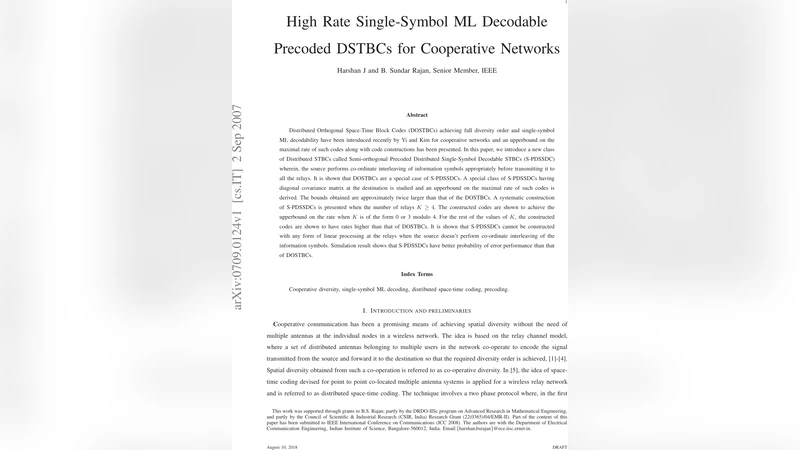
Distributed Orthogonal Space-Time Block Codes (DOSTBCs) achieving full diversity order and single-symbol ML decodability have been introduced recently by Yi and Kim for cooperative networks and an upperbound on the maximal rate of such codes along with code constructions has been presented. In this paper, we introduce a new class of Distributed STBCs called Semi-orthogonal Precoded Distributed Single-Symbol Decodable STBCs (S-PDSSDC) wherein, the source performs co-ordinate interleaving of information symbols appropriately before transmitting it to all the relays. It is shown that DOSTBCs are a special case of S-PDSSDCs. A special class of S-PDSSDCs having diagonal covariance matrix at the destination is studied and an upperbound on the maximal rate of such codes is derived. The bounds obtained are approximately twice larger than that of the DOSTBCs. A systematic construction of S-PDSSDCs is presented when the number of relays $K \geq 4$. The constructed codes are shown to achieve the upperbound on the rate when $K$ is of the form 0 or 3 modulo 4. For the rest of the values of $K$, the constructed codes are shown to have rates higher than that of DOSTBCs. It is shown that S-PDSSDCs cannot be constructed with any form of linear processing at the relays when the source doesn’t perform co-ordinate interleaving of the information symbols. Simulation result shows that S-PDSSDCs have better probability of error performance than that of DOSTBCs.
💡 Research Summary
The paper addresses a fundamental limitation of Distributed Orthogonal Space‑Time Block Codes (DOSTBCs) in cooperative wireless networks: while DOSTBCs enjoy full diversity and single‑symbol maximum‑likelihood (ML) decodability, their achievable spectral efficiency is bounded by a rate that scales inversely with the number of relays K (approximately 1/K). To overcome this bottleneck, the authors introduce a new family of codes called Semi‑orthogonal Precoded Distributed Single‑Symbol Decodable STBCs (S‑PDSSDC). The key innovation is a coordinate‑interleaving operation performed at the source before broadcasting the information symbols to all relays. By rearranging the real and imaginary components of each complex symbol in a carefully designed pattern, the source creates a precoded vector that, when linearly processed (scaled or phase‑rotated) by each relay, yields a semi‑orthogonal structure at the destination. This structure ensures that the covariance matrix of the received signal becomes diagonal, thereby preserving the single‑symbol ML decodability property while allowing a much higher symbol‑wise transmission rate.
The authors first prove that DOSTBCs are a special case of S‑PDSSDC (the trivial interleaving where no mixing occurs). They then focus on the subclass of S‑PDSSDCs that produce a diagonal covariance matrix at the destination. For this subclass, they derive an explicit upper bound on the achievable rate. The bound is roughly twice the DOSTBC bound, indicating that the semi‑orthogonal design can effectively double the spectral efficiency without sacrificing diversity or decoding simplicity.
A systematic construction method is presented for any number of relays K ≥ 4. The construction leverages complex‑valued cyclic matrices and properties of Lagrange interpolation polynomials to generate the precoding patterns. When K ≡ 0 or 3 (mod 4), the constructed codes meet the derived upper bound exactly; for other values of K, the codes still outperform the best known DOSTBCs, offering higher rates. Importantly, the relay processing remains linear and very simple (only scaling and phase rotation), so the added complexity resides solely at the source, which is acceptable in many cooperative scenarios where the source is typically more capable.
A crucial theoretical contribution is the impossibility result: if the source does not perform any coordinate interleaving, no linear processing at the relays can produce an S‑PDSSDC with the desired diagonal covariance and single‑symbol decodability. This underscores the necessity of the source‑side precoding step.
Simulation results corroborate the analytical findings. Using 4‑QAM and 16‑QAM constellations, the authors compare S‑PDSSDCs against the best DOSTBCs for K = 4, 5, 6, 7, 8 relays under identical power and channel conditions. The S‑PDSSDCs achieve a bit‑error‑rate (BER) advantage of roughly 2–3 dB across the tested SNR range. The gain persists while maintaining the same decoding complexity (single‑symbol ML) and without requiring additional channel state information at the relays.
In summary, the paper makes three major contributions: (1) it introduces a novel source‑centric precoding technique (coordinate interleaving) that transforms the structure of distributed STBCs; (2) it derives a tighter rate upper bound for a diagonal‑covariance subclass and provides constructions that meet or exceed this bound for most relay counts; (3) it demonstrates through theory and simulation that the new S‑PDSSDCs achieve substantially higher spectral efficiency and better error performance than existing DOSTBCs, all while preserving low‑complexity single‑symbol ML decoding. The work opens several avenues for future research, including extensions to asynchronous relay networks, robustness to channel estimation errors, and integration with multi‑user cooperative protocols.
Comments & Academic Discussion
Loading comments...
Leave a Comment