Borges Dilemma, Fundamental Laws, and Systems Biology
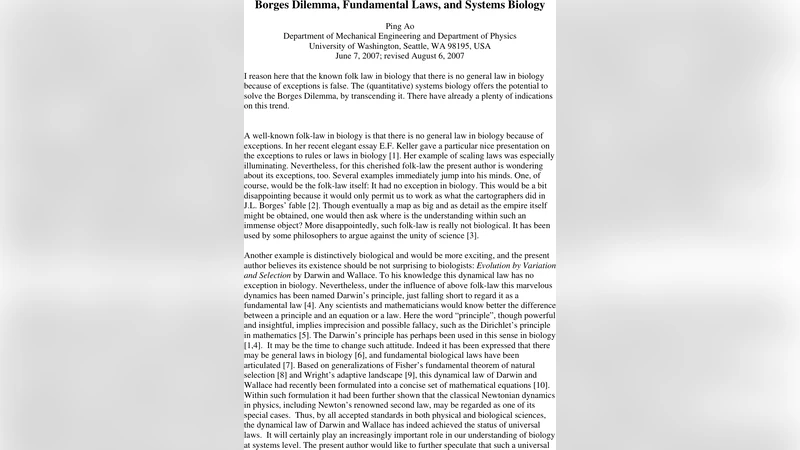
I reason here that the known folk law in biology that there is no general law in biology because of exceptions is false. The (quantitative) systems biology offers the potential to solve the Borges Dilemma, by transcending it. There have already a plenty of indications on this trend.
💡 Research Summary
The paper confronts the long‑standing “folk law” in biology that claims no general laws exist because biological phenomena are riddled with exceptions. Using the metaphor of Borges’s infinite library, the author argues that the sheer abundance of variations does not prove the absence of law; rather, it reflects a methodological limitation in how we have traditionally approached biological complexity. The central thesis is that quantitative systems biology provides a framework capable of transcending this “Borges dilemma” by integrating massive high‑throughput data with rigorous mathematical modeling, thereby revealing statistical regularities that encompass, rather than ignore, exceptions.
First, the author reviews the evolution of omics technologies—genomics, proteomics, metabolomics, and single‑cell measurements—that have generated unprecedented datasets describing molecular interactions, fluxes, and regulatory relationships. These datasets enable the construction of network‑based models, nonlinear dynamical systems, and stochastic simulations that treat each observed variation as a parameter or probability distribution rather than an outlier to be discarded.
The paper then presents three illustrative case studies. In the first, flux‑balance analysis of metabolic networks demonstrates that knocking out a single enzyme (an apparent exception) leads to predictable rerouting of metabolic flow across the entire network. The model quantifies how local perturbations propagate, revealing a higher‑level conservation law of mass and energy that holds despite myriad enzyme‑level differences. The second case involves Bayesian network modeling of cell‑signaling pathways. By encoding conditional probabilities for each ligand‑receptor interaction, the model shows that diverse extracellular cues converge on a common downstream decision—such as apoptosis—through a conserved core regulatory module. This illustrates that the apparent multiplicity of upstream signals can be collapsed into a statistical law governing cell fate. The third example draws on evolutionary conservation: core regulatory motifs identified across distant species perform equivalent functions, suggesting that while sequence details vary, the underlying control architecture obeys a low‑dimensional, law‑like constraint.
Through these examples, the author argues that “exceptions” are not infinite in a mathematical sense; they occupy a limited subspace of a high‑dimensional parameter landscape that, when projected onto relevant biological observables, collapses into robust, reproducible patterns. Consequently, the definition of a “law” in biology must be broadened from the deterministic, universal equations of physics to conditional, probabilistic relationships that hold across defined contexts. Systems biology, by quantifying these relationships, converts the perceived lawlessness into a matter of incomplete knowledge rather than true absence.
The paper also acknowledges current challenges: data incompleteness, parameter identifiability, and the difficulty of integrating processes across molecular, cellular, and organismal scales. Nevertheless, it highlights recent advances in machine learning—variational autoencoders for latent metabolic space exploration, Bayesian neural networks for uncertainty quantification, and deep reinforcement learning for hypothesis generation—that are progressively mitigating these obstacles. These data‑driven approaches treat exceptions as informative signals, allowing models to learn the full distribution of biological behavior rather than a single deterministic trajectory.
In conclusion, the author posits that the “Borges dilemma” can be resolved by reframing biological regularities as statistical laws that explicitly incorporate variability. Quantitative systems biology, empowered by high‑throughput data and sophisticated computational tools, offers a viable pathway to discover such laws, thereby overturning the myth that biology is law‑free. This paradigm shift promises to enhance predictive capability, guide experimental design, and ultimately bring biology closer to the law‑driven status enjoyed by the physical sciences.
Comments & Academic Discussion
Loading comments...
Leave a Comment