2-gerbes and 2-Tate spaces
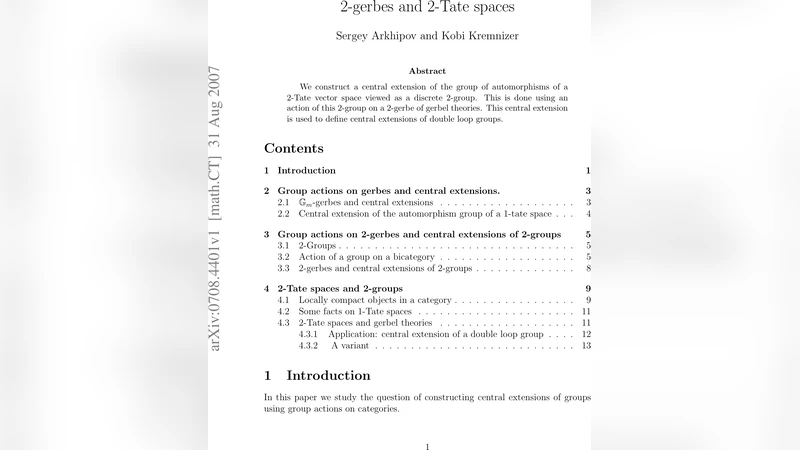
We construct a central extension of the group of automorphisms of a 2-Tate vector space viewed as a discrete 2-group. This is done using an action of this 2-group on a 2-gerbe of gerbel theories. This central extension is used to define central extensions of double loop groups.
💡 Research Summary
The paper develops a novel construction of a central extension for the automorphism group of a 2‑Tate vector space, treating this automorphism group as a discrete 2‑group (i.e., a bicategory with one object). The authors begin by recalling the classical notion of a Tate vector space—a topological vector space that can be written as an ind‑pro limit of finite‑dimensional spaces—and then iterate this construction to define a 2‑Tate space. A 2‑Tate space carries a double filtration and a compatible decomposition into a direct sum of “lattices,” providing a natural setting for higher‑dimensional linear algebra.
Because the automorphisms of a 2‑Tate space naturally form a 2‑group rather than an ordinary group, the paper adopts the language of bicategories. Objects of this 2‑group are the automorphisms themselves, 1‑morphisms are natural isomorphisms between automorphisms, and 2‑morphisms are modifications between those isomorphisms. This higher‑categorical perspective is essential for encoding the subtle coherence data that appear when one attempts to “central‑extend’’ such a symmetry.
The central technical device is a 2‑gerbe, which the authors call a “gerbel theory.” A 2‑gerbe can be thought of as a categorified line bundle: its objects are gerbes (ordinary 1‑gerbes) equipped with additional 2‑morphisms satisfying a higher cocycle condition. By constructing a canonical gerbel theory attached to any 2‑Tate space, the authors obtain a geometric object on which the discrete 2‑group acts. The action is defined by a functor that sends an automorphism to the pull‑back of the gerbel theory, and similarly transports 1‑ and 2‑morphisms.
Crucially, the authors show that this action is “coherent” in the sense that for any composable pair of automorphisms the induced equivalences of gerbel theories differ by a canonical element of the multiplicative group (\mathbb{G}_m). This discrepancy is precisely the data of a 2‑cocycle for the 2‑group, and it yields a central extension by (\mathbb{G}_m). In other words, the original discrete 2‑group embeds into a new 2‑group whose center is the ordinary abelian group (\mathbb{G}_m).
Having built this abstract machinery, the paper applies it to double loop groups. For a reductive algebraic group (G), the double loop group (L^2G = \operatorname{Map}(S^1 \times S^1, G)) can be realized as the automorphism group of a natural 2‑Tate space built from the space of Laurent series in two variables. The central extension constructed from the gerbel theory therefore provides a canonical 2‑dimensional analogue of the familiar Kac–Moody central extension for ordinary loop groups. The authors verify that the resulting extension satisfies the expected properties: it restricts to the usual affine central extension on each factor, and its curvature corresponds to a canonical 2‑form on the double loop space, reminiscent of the Wess–Zumino term in two‑dimensional conformal field theory.
The final sections discuss broader implications. The authors argue that their construction bridges higher‑categorical representation theory, infinite‑dimensional geometry, and quantum field theory. In particular, the 2‑gerbe central extension should play a role in the categorified geometric Langlands program, in the study of 2‑vector bundles, and in the quantization of higher‑form gauge fields appearing in string‑theoretic contexts. They also outline possible extensions to multi‑loop groups, to higher Tate spaces (3‑Tate, etc.), and to connections with higher algebraic K‑theory. The paper thus opens a new avenue for exploring central extensions beyond the traditional one‑dimensional setting, providing both a solid categorical foundation and concrete examples that link to existing structures in mathematics and physics.
Comments & Academic Discussion
Loading comments...
Leave a Comment