Multi-agent systems, Equiprobability, Gamma distributions and other Geometrical questions
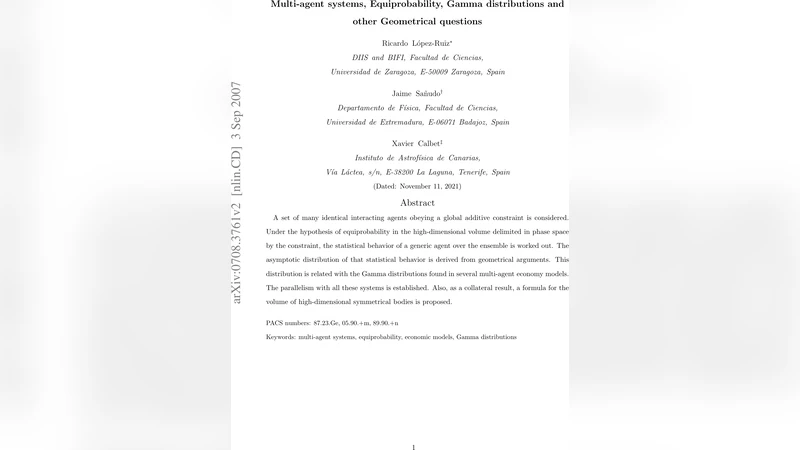
A set of many identical interacting agents obeying a global additive constraint is considered. Under the hypothesis of equiprobability in the high-dimensional volume delimited in phase space by the constraint, the statistical behavior of a generic agent over the ensemble is worked out. The asymptotic distribution of that statistical behavior is derived from geometrical arguments. This distribution is related with the Gamma distributions found in several multi-agent economy models. The parallelism with all these systems is established. Also, as a collateral result, a formula for the volume of high-dimensional symmetrical bodies is proposed.
💡 Research Summary
The paper investigates a large ensemble of identical interacting agents that are constrained by a single additive global rule, such as a fixed total amount of wealth, energy, or any conserved quantity. The authors assume that, within the high‑dimensional region of phase space defined by this constraint, all microscopic configurations are equally probable (the principle of equiprobability). Under this hypothesis they derive the statistical behavior of a typical agent by projecting the uniform distribution onto a single coordinate.
Mathematically the problem reduces to evaluating the ratio of two volumes: the full N‑dimensional volume V_N(E) allowed by the constraint, and the (N‑1)-dimensional volume V_{N‑1}(E‑x) that remains when one agent’s variable is fixed at a value x. This yields the marginal density
p(x) = V_{N‑1}(E‑x) / V_N(E).
Using the known recursive relations for the volumes of symmetric bodies (simplex for an equality constraint, hypersphere for an inequality constraint) the authors express V_k in terms of Beta and Gamma functions. The recursion leads to a closed‑form expression for p(x) that is precisely a Gamma distribution:
p(x) = (β^α / Γ(α)) x^{α‑1} e^{‑βx},
where the shape parameter α depends on the number of agents (α = N‑1 for the equality case, α = N/2 for the inequality case) and the scale parameter β is set by the total conserved amount E and the dimension. Consequently, as the number of agents grows, the distribution of any single agent’s share converges to a Gamma law whose mean is E/N and whose variance shrinks as 1/N.
The authors then connect this geometric result to a variety of multi‑agent economic models that have been studied empirically and numerically. In models such as the Chakraborti‑Chakrabarti saving‑propensity model, the Yard‑Sale model, and other kinetic‑exchange frameworks, the stationary distribution of wealth is observed to be Gamma‑like. The paper shows that these apparently different microscopic exchange rules can be understood as particular realizations of the same underlying equiprobable geometry, thereby providing a unifying theoretical foundation.
A secondary contribution is a general formula for the volume of high‑dimensional symmetric bodies. By treating both the simplex (equality constraint) and the hypersphere (inequality constraint) within a single recursive scheme, the authors obtain a compact expression V_N(E) = C_N E^γ, where C_N is a dimension‑dependent constant and γ equals N for the simplex and N/2 for the hypersphere. This formula not only reproduces the classic results (V_N = E^N/N! for a simplex, V_N = π^{N/2}E^{N/2}/Γ(N/2+1) for a sphere) but also clarifies how the volume scales with the constraint magnitude in a unified manner.
The paper is organized as follows: an introductory section reviews the motivation and previous work; the second section formalizes the global additive constraint and the equiprobability hypothesis; the third section derives the recursive volume relations and presents the geometric calculations; the fourth section obtains the marginal Gamma distribution; the fifth section compares the theoretical predictions with results from established economic exchange models; the sixth section discusses the generalized volume formula and potential applications in statistical physics, information theory, and optimization; and the final section summarizes the findings and outlines directions for future research.
In summary, the study demonstrates that a simple geometric principle—uniform sampling of the high‑dimensional region defined by a global additive constraint—naturally leads to Gamma‑distributed individual variables. This insight bridges kinetic‑exchange economic models with statistical‑mechanical reasoning and supplies a versatile tool for evaluating volumes of high‑dimensional symmetric sets, opening avenues for cross‑disciplinary applications.
Comments & Academic Discussion
Loading comments...
Leave a Comment