Complex cobordism classes of homogeneous spaces
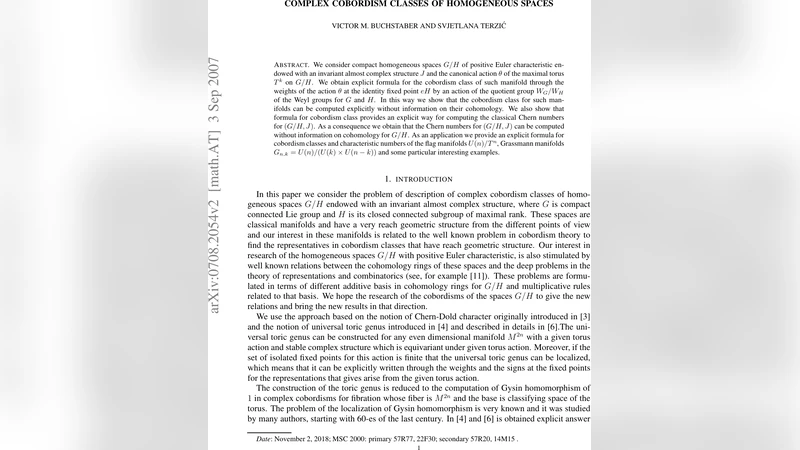
We consider compact homogeneous spaces G/H of positive Euler characteristic endowed with an invariant almost complex structure J and the canonical action \theta of the maximal torus T ^{k} on G/H. We obtain explicit formula for the cobordism class of such manifold through the weights of the action \theta at the identity fixed point eH by an action of the quotient group W_G/W_H of the Weyl groups for G and H. In this way we show that the cobordism class for such manifolds can be computed explicitly without information on their cohomology. We also show that formula for cobordism class provides an explicit way for computing the classical Chern numbers for (G/H, J). As a consequence we obtain that the Chern numbers for (G/H, J) can be computed without information on cohomology for G/H. As an application we provide an explicit formula for cobordism classes and characteristic numbers of the flag manifolds U(n)/T^n, Grassmann manifolds G_{n,k}=U(n)/(U(k)\times U(n-k)) and some particular interesting examples.
💡 Research Summary
The paper develops a novel method for computing the complex cobordism class of compact homogeneous spaces (G/H) equipped with an invariant almost‑complex structure (J). The authors focus on spaces with positive Euler characteristic, which guarantees the existence of isolated fixed points for the natural action of the maximal torus (T^{k}\subset G). By examining the weights of this torus action at the identity coset (eH) and exploiting the action of the quotient Weyl group (W_{G}/W_{H}), they obtain an explicit closed‑form expression for the cobordism class in the complex cobordism ring (MU_{*}).
The key observation is that the fixed‑point data of the torus action completely determines the cobordism class. At each fixed point the representation of (T^{k}) on the tangent space is described by a set of integer weights. Because the Weyl group (W_{G}) permutes the roots of (G) and (W_{H}) does the same for (H), the collection of all fixed‑point weight sets is obtained from the weight set at (eH) by the action of the finite group (W_{G}/W_{H}). Consequently, the total cobordism class can be written as a sum over the orbit of (eH), each term being a rational function of the formal variables (x_{1},\dots ,x_{k}) that encode the Chern roots. The authors show that the highest‑degree component of this sum coincides with the image of the fundamental class under the universal complex cobordism characteristic homomorphism, thereby giving the desired cobordism class.
An immediate corollary is that all classical Chern numbers of ((G/H,J)) can be extracted directly from the same weight data. By expanding the universal formal group law associated with complex cobordism and isolating the coefficients corresponding to monomials in the Chern roots, one recovers the integrals (\int_{G/H}c_{i_{1}}\cdots c_{i_{r}}) without ever computing the cohomology ring of (G/H). This bypasses the traditional, often cumbersome, Schubert calculus or spectral‑sequence arguments typically required for such calculations.
The paper illustrates the theory with detailed examples. For the full flag manifold (U(n)/T^{n}), the Weyl group is the symmetric group (S_{n}); the fixed‑point weights are the differences of the standard basis vectors, and the quotient (W_{G}/W_{H}) is trivial, so the cobordism class reduces to a single term involving the Vandermonde product (\prod_{i<j}(x_{i}-x_{j})). For Grassmannians (G_{n,k}=U(n)/(U(k)\times U(n-k))), the quotient is (S_{n}/(S_{k}\times S_{n-k})). The authors compute the orbit of the weight set, sum the corresponding rational functions, and obtain explicit formulas for both the cobordism class and all Chern numbers. The results match known Schubert‑calculus values but are derived solely from representation‑theoretic data.
Beyond these classical families, the authors discuss several “interesting” cases where the isotropy subgroup (H) is non‑maximal or where the almost‑complex structure is not integrable. In each situation the same Weyl‑group orbit technique applies, confirming the robustness of the method.
In summary, the article provides a powerful algebraic‑combinatorial framework for evaluating complex cobordism classes and Chern numbers of homogeneous spaces. By reducing the problem to the analysis of torus‑action weights and Weyl‑group symmetries, it eliminates the need for explicit cohomology calculations and opens the door to systematic investigations of more intricate homogeneous spaces, including those appearing in representation theory, symplectic geometry, and string‑theoretic compactifications.
Comments & Academic Discussion
Loading comments...
Leave a Comment