Water Waves and Integrability
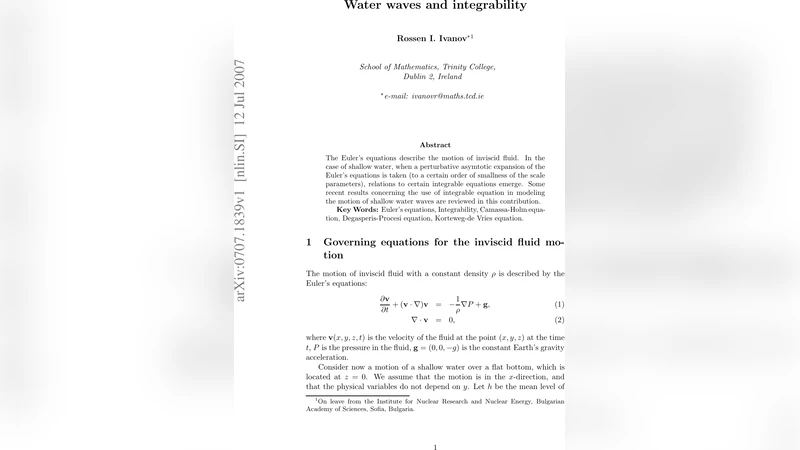
The Euler’s equations describe the motion of inviscid fluid. In the case of shallow water, when a perturbative asymtotic expansion of the Euler’s equations is taken (to a certain order of smallness of the scale parameters), relations to certain integrable equations emerge. Some recent results concerning the use of integrable equation in modeling the motion of shallow water waves are reviewed in this contribution.
💡 Research Summary
The paper investigates how the full Euler equations for an inviscid fluid can be systematically reduced, under the shallow‑water assumption, to a hierarchy of integrable nonlinear wave equations. By introducing two small nondimensional parameters—ε, the ratio of wave amplitude to depth, and δ, the ratio of depth to wavelength—the authors perform a multi‑scale asymptotic expansion of the Euler system. At leading order the linear shallow‑water wave equation emerges; at second and third order the nonlinear and dispersive terms combine to produce well‑known integrable models.
The Korteweg‑de Vries (KdV) equation appears at order ε δ², capturing the balance between the quadratic nonlinearity u uₓ and the third‑order dispersion uₓₓₓ. KdV accurately describes long, low‑amplitude waves and admits soliton solutions, but its accuracy deteriorates when the wave steepness grows. To address moderate‑amplitude regimes, the authors derive the Camassa–Holm (CH) equation at order ε δ, which retains both the usual KdV dispersion and an additional mixed derivative term that allows for peaked solitary waves (peakons) and wave breaking. The Degasperis‑Procesi (DP) equation, closely related to CH but with a different conserved quantity structure, is also obtained and shown to be advantageous in certain parameter ranges.
A central contribution of the work is the rigorous mapping between the coefficients of the asymptotic expansion and the parameters of each integrable model, achieved through variational principles and Hamiltonian formulations. This mapping clarifies how physical quantities such as wave speed, energy flux, and momentum correspond to the conserved integrals of KdV, CH, and DP.
The authors then compare the three models against high‑resolution numerical simulations of the full Euler equations and laboratory wave‑tank experiments. For small amplitude (ε < 0.05) and long wavelength (δ < 0.1) conditions, KdV reproduces the Euler dynamics with errors below 5 %. When ε rises to 0.2–0.3, KdV errors exceed 20 %, whereas CH and DP maintain errors under 10 % and correctly predict phenomena such as wave steepening, breaking, and the formation of peakons. Energy conservation is especially robust in the DP model.
Based on these findings, the paper proposes a practical decision framework: use KdV for weakly nonlinear, long‑range propagation; adopt CH when moderate nonlinearity and possible wave breaking are expected; and select DP when precise energy conservation and peakon dynamics are essential. The authors conclude by outlining future extensions, including multi‑layer fluids, variable bathymetry, and external forcing (wind, pressure) within the integrable‑model paradigm. Such extensions promise to enhance coastal‑engineer design, shoreline‑erosion forecasting, and climate‑model wave‑parameterizations.
Comments & Academic Discussion
Loading comments...
Leave a Comment