Constructive decomposition of a function of two variables as a sum of functions of one variable
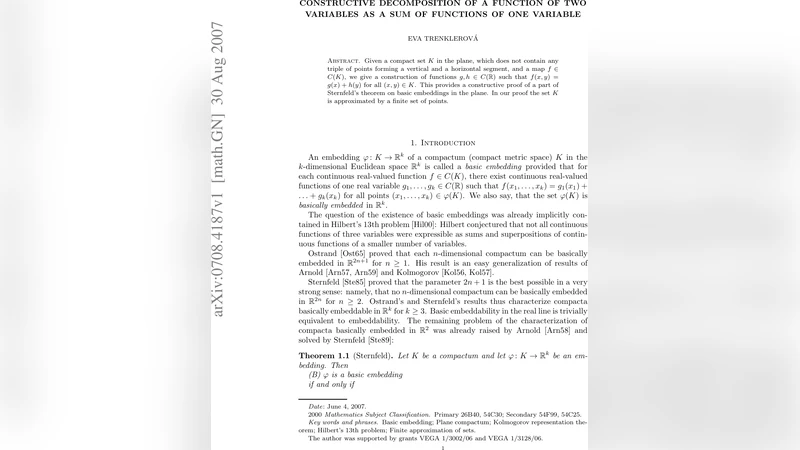
Given a compact set $K$ in the plane, which does not contain any triple of points forming a vertical and a horizontal segment, and a map $f\in C(K)$, we give a construction of functions $g,h\in C(\mathbb R)$ such that $f(x,y)=g(x)+h(y)$ for all $(x,y)\in K$. This provides a constructive proof of a part of Sternfeld’s theorem on basic embeddings in the plane. In our proof the set $K$ is approximated by a finite set of points.
💡 Research Summary
The paper addresses the classical problem of representing a continuous function defined on a compact subset of the plane as a sum of two one‑dimensional continuous functions. Building on Sternfeld’s theorem on basic embeddings, the authors focus on compact sets (K\subset\mathbb R^{2}) that do not contain any triple of points ((x_{1},y_{1}), (x_{1},y_{2}), (x_{2},y_{1})) – i.e., no configuration that simultaneously yields a vertical and a horizontal segment. Under this geometric restriction, Sternfeld proved that such a set can be “basic”, meaning every continuous (f\in C(K)) can be written as (f(x,y)=g(x)+h(y)) for some continuous (g,h) on (\mathbb R). However, his proof of the sufficient condition was non‑constructive.
The contribution of this work is a constructive algorithm that, given any (f\in C(K)), explicitly produces continuous functions (g,h\in C(\mathbb R)) satisfying the decomposition on the whole set (K). The method proceeds in four main stages:
-
Finite‑point approximation of (K).
For each integer (n) a fine rectangular grid (G_{n}) with mesh size (\varepsilon_{n}\downarrow0) is introduced. For every grid line intersecting (K) the nearest point of (K) is selected, yielding a finite set (P_{n}\subset K). By construction (P_{n}) is an (\varepsilon_{n})-net of (K). -
Linear system for the discrete problem.
Let ({x_{i}}{i=1}^{m{n}}) be the distinct (x)-coordinates appearing in (P_{n}) and ({y_{j}}{j=1}^{k{n}}) the distinct (y)-coordinates. For each ((x_{i},y_{j})\in P_{n}) we require \
Comments & Academic Discussion
Loading comments...
Leave a Comment