Tate motives and the fundamental group
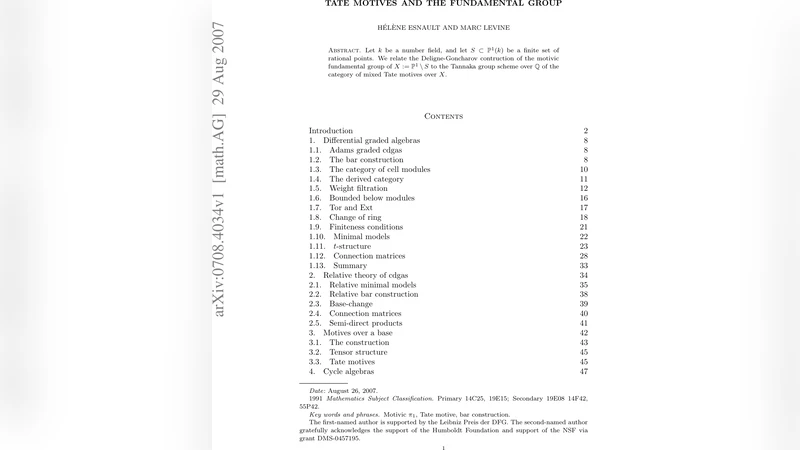
Let k be a number field, and let S be a finite set of k-rational points of P^1. We relate the Deligne-Goncharov contruction of the motivic fundamental group of X:=P^1_k- S to the Tannaka group scheme of the category of mixed Tate motives over X.
💡 Research Summary
The paper investigates the relationship between two a priori different constructions of a “motivic fundamental group” for the punctured projective line over a number field. Let k be a number field, S ⊂ ℙ¹(k) a finite set of k‑rational points, and X = ℙ¹ₖ \ S. On one hand, Deligne and Goncharov defined a motivic fundamental group π₁^{mot}(X, x) by means of a cosimplicial complex of mixed Tate motives, equipped with a weight filtration, a “bar” construction, and a normalization that mimics the de Rham, Betti, and ℓ‑adic realizations simultaneously. On the other hand, the category of mixed Tate motives over X, denoted MTM_X, is a neutral Tannakian category: it is ℚ‑linear, generated by the Tate objects ℚ(n), carries a canonical weight filtration, and admits a fiber functor ω_x (the “point‑based realization”) which sends a motive to its various cohomological realizations at a chosen base point x ∈ X(k). The Tannakian formalism then produces a pro‑algebraic group scheme G_{MTM_X} = Aut^{⊗}(ω_x), which is traditionally called the motivic Galois group of MTM_X.
The main theorem of the article is the canonical isomorphism
π₁^{mot}(X, x) ≅ G_{MTM_X}
as affine group schemes over ℚ. In other words, the Deligne‑Goncharov construction of the motivic fundamental group coincides with the Tannaka dual of the category of mixed Tate motives on X. The proof proceeds in several steps:
-
Realization Compatibility. The authors first show that the Betti, de Rham, and ℓ‑adic realizations of π₁^{mot}(X, x) agree with the corresponding realizations of objects in MTM_X. This uses the comparison isomorphisms between singular cohomology, de Rham cohomology, and ℓ‑adic étale cohomology for X, together with the fact that the bar construction respects these realizations.
-
Weight and Bar Filtrations. The weight filtration on π₁^{mot} (induced from the weight filtration on mixed Tate motives) is proved to be compatible with the natural grading on the Hopf algebra of functions on G_{MTM_X}. Moreover, the bar differential coincides with the Lie coalgebra structure coming from the Tannakian Lie algebra of MTM_X. This step requires a careful analysis of the “depth” filtration that appears in the study of multiple zeta values.
-
Tannakian Reconstruction. By invoking the Tannakian reconstruction theorem, the authors demonstrate that any tensor‑preserving endomorphism of the fiber functor ω_x must preserve the weight filtration and the bar structure. Consequently, the group of such endomorphisms is exactly the group of ℚ‑points of π₁^{mot}(X, x). Hence the two groups are identified.
-
Explicit Examples. The paper works out the classical case S = {0,1,∞}, where X = ℙ¹ \ {0,1,∞}. In this situation the coordinate Hopf algebra of π₁^{mot} is generated by the motivic multiple polylogarithms, and the weight‑depth grading reproduces the known structure of the motivic Lie algebra of multiple zeta values. For a general finite S, the authors describe how the generators correspond to K‑theoretic symbols and higher cyclotomic units, illustrating that the motivic fundamental group encodes deep arithmetic information.
The significance of the result is twofold. First, it places the Deligne‑Goncharov motivic fundamental group firmly inside the well‑established Tannakian framework, showing that no “new” group scheme is introduced beyond the motivic Galois group of mixed Tate motives on X. Second, it provides a conceptual bridge between the concrete Hopf‑algebraic description (via bar constructions and multiple polylogarithms) and the abstract categorical description (via fiber functors). This bridge allows one to transport results from one side to the other: for instance, the known Galois‑action constraints on multiple zeta values can be interpreted as constraints on the Tannakian Lie algebra of MTM_X, and conversely, Tannakian techniques can be used to study the structure of motivic iterated integrals.
In the concluding section the authors outline several directions for future research. They suggest extending the analysis to higher‑dimensional varieties where the mixed Tate condition fails, investigating whether a similar identification holds for more general mixed motives, and exploring the implications for the conjectural “cosmic Galois group” acting on periods. They also propose a systematic study of the depth‑filtration on π₁^{mot} as a tool for understanding the hierarchy of relations among multiple zeta values and their generalizations.
Overall, the paper achieves a unifying perspective: the motivic fundamental group of a punctured projective line is not an exotic object but precisely the Tannaka dual of the mixed Tate motives over that curve. This insight deepens our understanding of the interplay between algebraic geometry, K‑theory, and the arithmetic of special values of L‑functions.
Comments & Academic Discussion
Loading comments...
Leave a Comment