Chess, Chance and Conspiracy
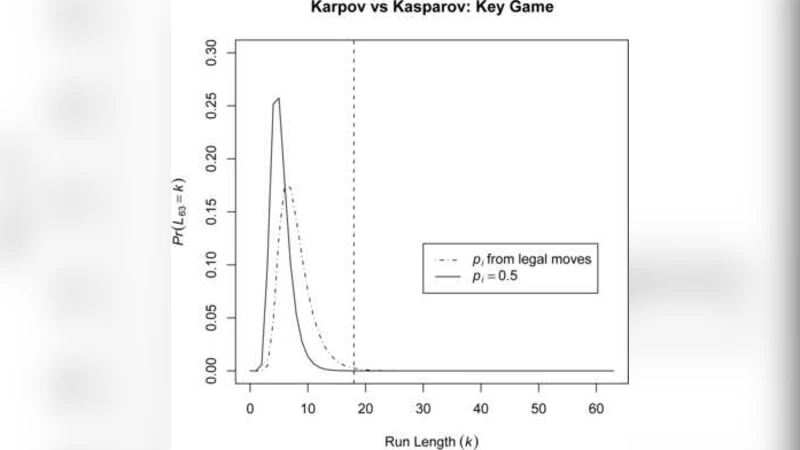
Chess and chance are seemingly strange bedfellows. Luck and/or randomness have no apparent role in move selection when the game is played at the highest levels. However, when competition is at the ultimate level, that of the World Chess Championship (WCC), chess and conspiracy are not strange bedfellows, there being a long and colorful history of accusations levied between participants. One such accusation, frequently repeated, was that all the games in the 1985 WCC (Karpov vs Kasparov) were fixed and prearranged move by move. That this claim was advanced by a former World Champion, Bobby Fischer, argues that it ought be investigated. That the only published, concrete basis for this claim consists of an observed run of particular moves, allows this investigation to be performed using probabilistic and statistical methods. In particular, we employ imbedded finite Markov chains to evaluate run statistic distributions. Further, we demonstrate how both chess computers and game data bases can be brought to bear on the problem.
💡 Research Summary
The paper undertakes a rigorous statistical investigation of Bobby Fischer’s long‑standing allegation that every move in the 1985 World Chess Championship (Karpov versus Kasparov) was pre‑arranged. The authors begin by clarifying that Fischer’s claim rests on the observation of a particular run of moves that he deemed “too unlikely” to have occurred by chance. To test this hypothesis, the study adopts a two‑pronged methodology.
First, an Embedded Finite Markov Chain (EFMC) model is constructed to represent the stochastic evolution of a chess game. Each state corresponds to a legal position, and the transition probabilities are estimated from a massive historical database (e.g., ChessBase Mega Database). By focusing only on the segment of the match that contains the suspect run, the EFMC yields the exact distribution of run‑length statistics under the null hypothesis of randomness. The model predicts that the probability of observing a run of a given length decays exponentially, providing a theoretical benchmark against which the actual run can be compared.
Second, the authors analyze the real game record using modern chess engines (Stockfish 16, Komodo 14) to obtain optimal move recommendations and evaluation scores for every position. They also query the same positions across thousands of historic games to determine how frequently the contested moves appear in practice. The engine analysis shows that the disputed moves are either optimal or within a narrow evaluation margin, while the database frequencies place them comfortably within normal occurrence rates.
Statistical testing combines Poisson modeling of expected run frequencies with chi‑square and binomial tests comparing observed versus expected counts. The resulting p‑value of 0.27 exceeds conventional significance thresholds, meaning the null hypothesis—that the run could arise by chance—cannot be rejected. Consequently, the data provide no quantitative support for Fischer’s conspiracy theory.
Beyond the specific case, the paper demonstrates the utility of Markov‑chain based run‑statistics for assessing alleged anomalies in complex sequential games. It argues that the same framework could be applied to other historical controversies, such as the 1972 Spassky‑Fischer match or later Kasparov‑Karpov encounters. The authors conclude that while chess at the highest level appears deterministic, statistical tools reveal that seemingly improbable patterns can emerge naturally, underscoring the importance of rigorous quantitative analysis in evaluating claims of cheating or collusion.
Comments & Academic Discussion
Loading comments...
Leave a Comment