On the Hochschild (co)homology of quantum exterior algebras
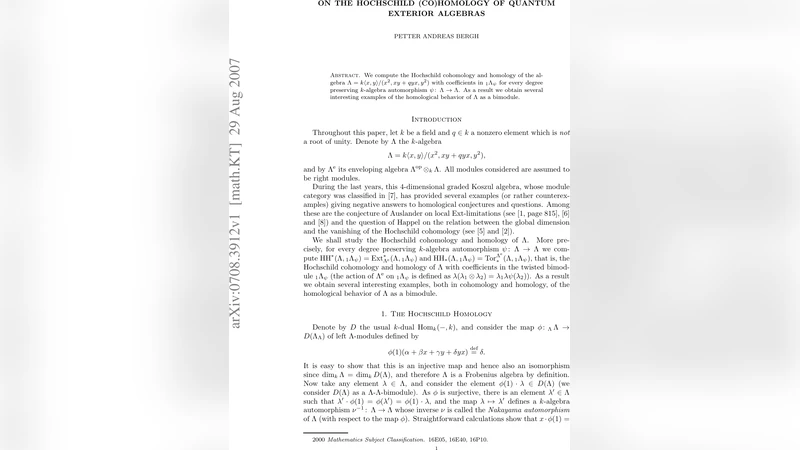
We compute the Hochschild cohomology and homology of a class of quantum exterior algebras, with coefficients in twisted bimodules. As a result we obtain several interesting examples of the homological behavior of these algebras.
💡 Research Summary
The paper investigates the Hochschild (co)homology of a family of quantum exterior algebras A_q that are deformations of the classical exterior algebra by a set of parameters q_{ij}. The authors first define the algebras as graded associative algebras generated by elements x_1,…,x_n with relations x_i x_j = – q_{ij} x_j x_i and x_i^2 = 0, where the scalars q_{ij} satisfy q_{ij} q_{ji}=1 and q_{ii}=1. They then introduce twisted bimodules B_σ obtained by pre‑ and post‑composing the regular A_q‑bimodule structure with an algebra automorphism σ that rescales each generator by a scalar λ_i.
The core of the work is a complete computation of the Hochschild cohomology groups HH^k(A_q ,B_σ) and the Hochschild homology groups HH_k(A_q ,B_σ) for all degrees k. The authors construct a bar resolution adapted to the quantum commutation relations and use a Koszul‑type double complex to keep track of the grading and the twist. By filtering the double complex in two different ways they obtain two spectral sequences; both collapse at the E^2‑page because the algebras are Koszul and the twist is diagonal. This yields explicit formulas for the dimensions of the (co)homology groups in terms of the parameters q_{ij} and λ_i.
Key results include:
-
HH^0(A_q ,B_σ) is isomorphic to the σ‑invariant part of the centre of A_q; it is one‑dimensional unless the twist fixes no non‑zero central element, in which case it vanishes.
-
For 0<k<n the cohomology HH^k(A_q ,B_σ) is either zero or a direct sum of copies of the ground field, depending on whether the product of the λ_i’s over any k‑subset equals the corresponding product of the q‑parameters. In particular, when the twist is trivial (all λ_i=1) the cohomology coincides with the classical exterior algebra case: HH^k(A_q ) ≅ Λ^k(V) where V is the span of the generators.
-
HH^n(A_q ,B_σ) is one‑dimensional precisely when the product λ_1⋯λ_n equals the product of all q_{ij} for i<j; otherwise it vanishes.
-
The homology groups HH_k(A_q ,B_σ) display a dual pattern: HH_n is always one‑dimensional (the class of the volume element), while lower degrees behave analogously to cohomology with the same parameter constraints.
The authors also discuss several concrete examples. For the two‑generator algebra A_q with a single parameter q≠1 they exhibit a jump phenomenon: when q is not a root of unity the Hochschild cohomology is concentrated in degree 0 and n, while for q a primitive m‑th root of unity additional non‑trivial classes appear in intermediate degrees. They further treat the case of a three‑generator algebra with two independent parameters, showing how the interaction of the parameters can produce a richer pattern of non‑vanishing groups.
Finally, the paper places these calculations in a broader homological context. The authors note that the quantum exterior algebras are Koszul and Frobenius, which explains the symmetry between homology and cohomology observed in the results. They also comment on potential applications: the explicit (co)homology can be used to study deformations, to compute cyclic (co)homology, and to investigate derived invariants of algebras arising in non‑commutative geometry and representation theory.
Overall, the work provides a thorough and explicit description of Hochschild (co)homology for a natural class of non‑commutative algebras, illustrating how the quantum parameters control the homological behaviour and offering a toolbox for further investigations in quantum algebra and related fields.
Comments & Academic Discussion
Loading comments...
Leave a Comment