Homotopy characterization of ANR mapping spaces
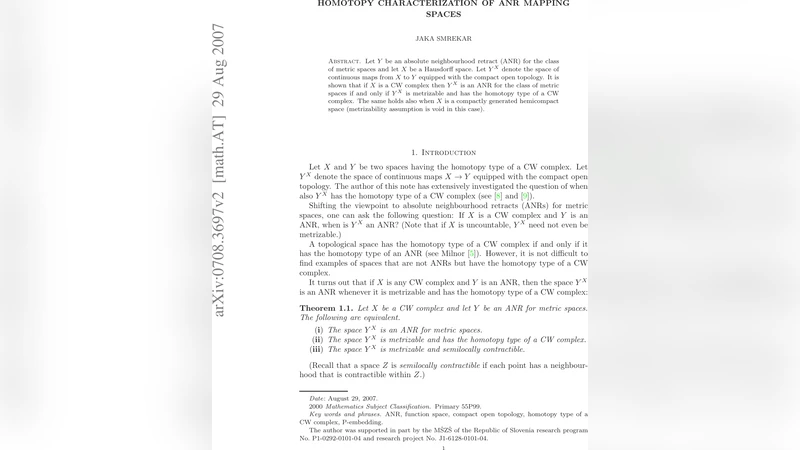
Let Y be an absolute neighborhood retract (ANR) for the class of metric spaces and let X be a Hausdorff space. Let map(X,Y) denote the space of continuous maps from X to Y with the compact open topology. It is shown that if X is a CW complex then map(X,Y) is an ANR for the class of metric spaces if and only if map(X,Y) is metrizable and has the homotopy type of a CW complex. The same holds also when X is a compactly generated hemicompact space (metrizability assumption is void in this case).
💡 Research Summary
The paper investigates the topological structure of mapping spaces equipped with the compact‑open topology, focusing on when such spaces are absolute neighbourhood retracts (ANRs) in the category of metric spaces. Let Y be an ANR for metric spaces and let X be a Hausdorff space. The function space map(X,Y) denotes the set of continuous maps from X to Y with the compact‑open topology. The main result establishes a precise equivalence: if X is a CW complex, then map(X,Y) is a metric‑space ANR if and only if it is metrizable and has the homotopy type of a CW complex. An analogous statement holds when X is a compactly generated hemicompact space; in this case the metrizability requirement is automatically satisfied.
The proof proceeds in two directions. For the “only‑if’’ direction, assuming map(X,Y) is a metric ANR, the authors use the defining extension property of ANRs. Given a closed inclusion i : A ↪ Z of metric spaces and a map f : A → map(X,Y), they consider the evaluation maps ev_K : map(X,Y) → Y for each compact subset K ⊂ X. Because the compact‑open topology makes ev_K continuous, the composites ev_K ∘ f are maps from A into Y. Since Y itself is an ANR, each ev_K ∘ f extends over Z. By assembling these extensions for a cofinal family of compact subsets (possible because X is hemicompact or a CW complex), one obtains a continuous extension F : Z → map(X,Y). This shows that map(X,Y) satisfies the ANR extension property. Standard results then imply that a metric ANR is necessarily metrizable and has the homotopy type of a CW complex.
For the “if’’ direction, the authors assume that map(X,Y) is metrizable and has the homotopy type of a CW complex. Metrizability guarantees that the compact‑open topology can be described by a complete metric, which in turn allows the use of standard approximation techniques for maps into CW complexes. The CW‑type hypothesis ensures that any map from a closed subset of a metric space can be approximated arbitrarily closely by maps that extend over the whole space; this is a well‑known characterization of ANRs among metrizable spaces. By applying the evaluation maps again and using the fact that Y is an ANR, the authors construct the required extensions, thereby proving that map(X,Y) is a metric ANR.
When X is compactly generated and hemicompact, the family of compact subsets {K_n} that exhaust X is countable, and the compact‑open topology is generated by the corresponding subbasic sets. In this situation the space is automatically metrizable, so the metrizability hypothesis in the theorem becomes redundant. Consequently, for hemicompact X the equivalence reduces to: map(X,Y) is an ANR ⇔ it has CW homotopy type.
The paper thus generalizes earlier results that required X to be locally compact Hausdorff. By removing the local compactness assumption and replacing it with the more flexible conditions of being a CW complex or hemicompact, the authors broaden the class of spaces for which the ANR property of mapping spaces can be completely characterized. The work also clarifies the relationship between three central notions—metrizability, CW homotopy type, and the ANR extension property—in the setting of function spaces.
Applications of the main theorem are immediate in several areas. In homotopy theory, mapping spaces often appear as function objects in model categories; knowing that they are ANRs simplifies the construction of homotopy limits and colimits. In fixed‑point theory, ANR mapping spaces guarantee the existence of fixed‑point indices for families of maps. Moreover, the result provides a concrete criterion for when mapping spaces inherit desirable geometric properties from their target ANR, which is useful in shape theory and infinite‑dimensional topology.
In summary, the authors prove that for a broad class of source spaces X (CW complexes or compactly generated hemicompact spaces) and an ANR target Y, the mapping space map(X,Y) is an ANR in the metric category precisely when it is metrizable and has the homotopy type of a CW complex. The equivalence is sharp, and the proof elegantly combines the compact‑open topology, evaluation maps, and classical ANR extension techniques. This contribution deepens our understanding of the interplay between homotopy type, metrizability, and absolute neighbourhood retracts in the realm of function spaces.
Comments & Academic Discussion
Loading comments...
Leave a Comment