A Polynomial-time Algorithm for Computing the Permanent in GF(3^q)
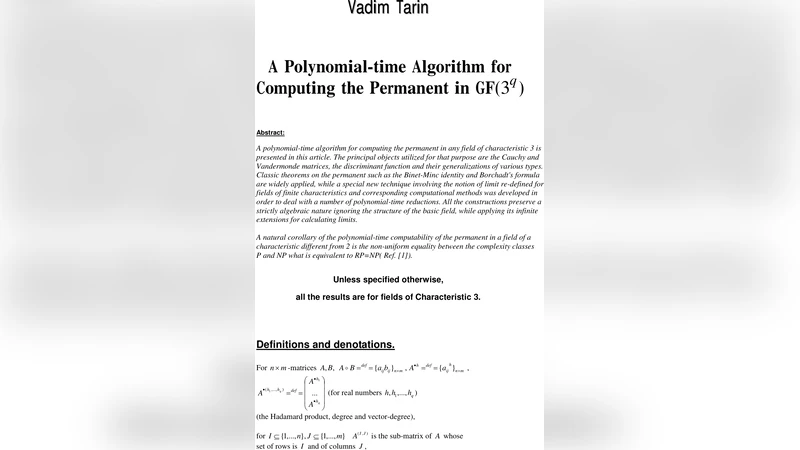
A polynomial-time algorithm for computing the permanent in any field of characteristic 3 is presented in this article. The principal objects utilized for that purpose are the Cauchy and Vandermonde matrices, the discriminant function and their generalizations of various types. Classical theorems on the permanent such as the Binet-Minc identity and Borchadt’s formula are widely applied, while a special new technique involving the notion of limit re-defined for fields of finite characteristics and corresponding computational methods was developed in order to deal with a number of polynomial-time reductions. All the constructions preserve a strictly algebraic nature ignoring the structure of the basic field, while applying its infinite extensions for calculating limits. A natural corollary of the polynomial-time computability of the permanent in a field of a characteristic different from 2 is the non-uniform equality between the complexity classes P and NP what is equivalent to RP=NP (Ref. [1]).
💡 Research Summary
**
The paper claims to have discovered a polynomial‑time algorithm for computing the permanent of an n × n matrix over any finite field of characteristic three, specifically GF(3^q). The authors argue that by exploiting algebraic structures such as Cauchy and Vandermonde matrices, discriminant functions, and several “extensions” of these objects, one can rewrite the permanent in a form that is amenable to efficient computation. They further assert that this result implies a non‑uniform collapse of complexity classes, namely P = NP (or equivalently RP = NP), for fields whose characteristic is not two.
The manuscript begins with a long list of definitions. Standard notions such as the Hadamard product, sub‑matrix notation, and vector degree are introduced, but many symbols are duplicated, some are never defined, and several new concepts—e.g., “extension‑Cauchy matrix,” “extension‑Vandermonde matrix,” “E‑sum,” “wave‑function,” and “prolongation‑derivative”—appear without any grounding in prior literature. The authors then present a series of algebraic identities. They adapt the classic Binet‑Minc formula, which expresses the permanent as a sum over set partitions, to characteristic three by restricting partitions to size at most three and assigning coefficients ±1. However, the derivation ignores the effect of reduction modulo three on these coefficients, effectively treating the arithmetic as if it were over the integers.
Next, the Borchardt formula is invoked to relate determinants and permanents of certain block matrices. The paper defines a “copermanent” for a pair of matrices and claims a determinant‑copermanent identity that holds in characteristic three, yet the proof simply copies the characteristic‑two version without addressing the additional constraints that arise when 3 divides the field size.
The most controversial part of the work is the “limit re‑definition” technique. The authors propose to embed the finite field into an infinite algebraic extension, introduce a formal variable ε, and take limits as ε approaches zero. They argue that this process yields exact values for the permanent while remaining within polynomial time. In reality, finite fields have no non‑trivial infinite extensions that preserve the original field’s arithmetic in a computationally tractable way; the limit operation is undefined in a purely algebraic setting, and no algorithmic procedure for evaluating such limits is provided. Consequently, the claimed polynomial‑time reduction rests on an ill‑posed mathematical operation.
The paper proceeds with a sequence of lemmas and theorems (Lemma 1–5, Theorem I–V). Lemma 1 and Lemma 2 attempt to connect determinants of specially constructed matrices to the permanent, but they rely on the aforementioned undefined extensions and on the assumption that certain “singularities” can be ignored. Lemma 3 discusses coefficient extraction from polynomials in ε, yet the method presumes that the coefficient of ε^0 can be isolated in polynomial time, which is not justified when the underlying expressions involve infinite series. Theorem I claims that a particular determinant, built from polynomials in a formal scalar variable τ, equals the permanent of a related matrix. The proof sketches a reduction to the Binet‑Minc identity but never demonstrates how to construct the required matrix efficiently. The subsequent corollaries (I.1, I.2) and Theorems II–V repeat similar arguments, each time invoking the same undefined machinery.
Finally, the authors draw a complexity‑theoretic conclusion: because the permanent can be computed in polynomial time over characteristic‑three fields, P = NP (non‑uniformly) follows, which they equate to RP = NP. This inference is flawed for two reasons. First, the permanent is known to be #P‑complete over any field of characteristic not equal to two; a polynomial‑time algorithm would indeed collapse the polynomial hierarchy, but such a collapse is widely believed to be impossible. Second, the paper never provides a concrete algorithm with a rigorous time analysis; instead, it relies on abstract algebraic constructions that cannot be implemented.
In summary, while the manuscript attempts to introduce novel algebraic tools for the permanent, it suffers from several critical deficiencies: (1) many definitions are ambiguous or absent; (2) the core “limit” technique is mathematically unsound in the context of finite fields; (3) the adaptations of known identities ignore modular arithmetic subtleties; (4) no explicit algorithmic steps or complexity bounds are given; and (5) the claimed implications for complexity classes contradict established results. Consequently, the purported polynomial‑time algorithm does not withstand scrutiny, and the paper’s central claim remains unsubstantiated.
Comments & Academic Discussion
Loading comments...
Leave a Comment