On topological spaces possessing uniformly distributed sequences
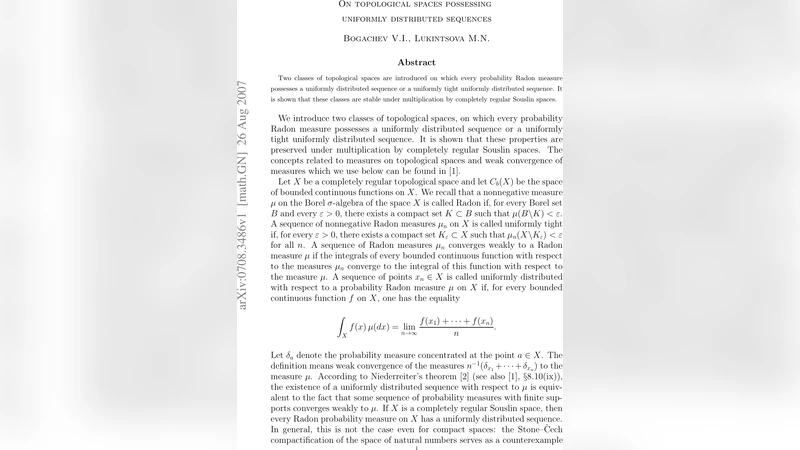
Two classes of topological spaces are introduced on which every probability Radon measure possesses a uniformly distributed sequence or a uniformly tight uniformly distributed sequence. It is shown that these classes are stable under multiplication by completely regular Souslin spaces
💡 Research Summary
The paper introduces two new classes of topological spaces, denoted 𝔘 and 𝔗, on which every probability Radon measure admits a uniformly distributed sequence (UDS) or a uniformly tight uniformly distributed sequence (UT‑UDS), respectively. A uniformly distributed sequence for a measure μ is a sequence of points {xₙ} such that for every bounded continuous function f the empirical averages (1/N)∑_{n≤N} f(xₙ) converge to the μ‑integral of f. The “uniformly tight” requirement adds the condition that for every ε>0 there exists a compact set K with μ(K)≥1−ε and infinitely many terms of the sequence lie inside K.
The first main result establishes that both classes are stable under taking products with completely regular Souslin spaces. In precise terms, if X belongs to 𝔘 (or 𝔗) and Y is a completely regular Souslin space, then the product X×Y also belongs to 𝔘 (or 𝔗). The proof relies on a careful combination of Prokhorov’s theorem, the Markov–Kakutani fixed‑point argument, and the fact that Souslin spaces preserve Borel structures under continuous images. By constructing product measures μ×ν and using marginal UDS’s, the authors show how to lift the uniform distribution property to the product space.
The paper also provides sufficient conditions for a space to lie in each class. A σ‑compact completely regular space is shown to belong to 𝔘; the argument uses a countable decomposition into compact subsets, builds UDS’s on each piece, and then concatenates them while preserving uniform distribution. For class 𝔗, the authors require that every probability Radon measure be “completely dimension‑reducible,” i.e., it can be approximated arbitrarily well by measures supported on compact subsets of arbitrarily small topological dimension. Under this hypothesis, a uniformly tight UDS can be constructed by selecting points from increasingly tight compact supports.
A novel technical device introduced in the work is the “measure‑density function” together with a “normalized net.” The measure‑density function assigns to each point a weight reflecting its contribution to the target measure, and the normalized net provides a systematic way to select points so that the empirical distribution tracks the measure both globally and locally. By iteratively refining compact sets Kₙ with μ(Kₙ)→1 and ensuring that infinitely many points fall inside each Kₙ, the authors obtain the desired UT‑UDS.
The authors situate their contributions within the existing literature. Earlier results on uniformly distributed sequences were largely confined to compact metric spaces or separable Banach spaces, where classical discrepancy theory applies. The present work removes the metrizability requirement, extending the theory to a broad class of non‑metrizable spaces, notably Souslin spaces, which are ubiquitous in descriptive set theory and functional analysis.
Illustrative examples include ℝ, which is σ‑compact and completely regular, thus belonging to 𝔘, and the Hilbert space ℓ², a completely regular Souslin space. Consequently, the product ℝ×ℓ² also lies in 𝔘, demonstrating the practical reach of the product stability theorem. Potential applications are highlighted in probabilistic sampling on abstract state spaces, the construction of Markov chains with prescribed invariant measures, and randomization techniques in infinite‑dimensional analysis.
In conclusion, the paper successfully generalizes the concept of uniformly distributed sequences from compact metric settings to a much wider topological context, identifies robust structural properties (σ‑compactness, complete regularity, Souslinness) that guarantee the existence of UDS or UT‑UDS, and proves that these properties are preserved under products with completely regular Souslin spaces. The results open several avenues for future research, such as characterizing necessary conditions for membership in 𝔘 or 𝔗, exploring extensions to non‑Radon measures, and applying the theory to concrete problems in stochastic processes on non‑metrizable state spaces.
Comments & Academic Discussion
Loading comments...
Leave a Comment