On Kalais conjectures concerning centrally symmetric polytopes
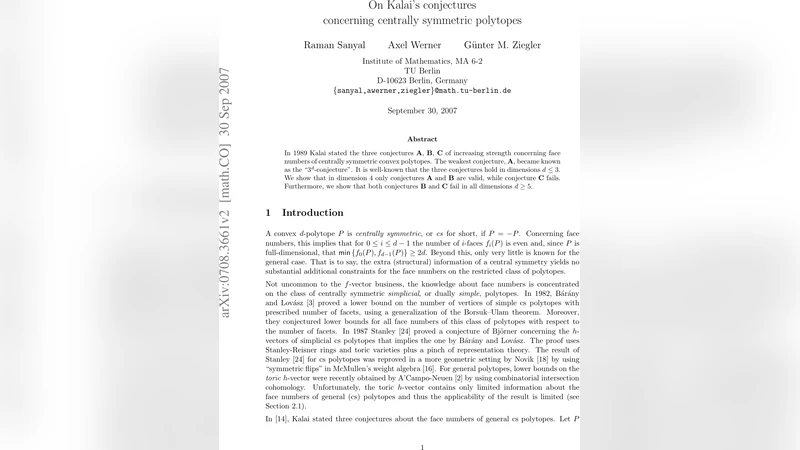
In 1989 Kalai stated the three conjectures A, B, C of increasing strength concerning face numbers of centrally symmetric convex polytopes. The weakest conjecture, A, became known as the ``$3^d$-conjecture’’. It is well-known that the three conjectures hold in dimensions d \leq 3. We show that in dimension 4 only conjectures A and B are valid, while conjecture C fails. Furthermore, we show that both conjectures B and C fail in all dimensions d \geq 5.
💡 Research Summary
The paper revisits the three conjectures (A, B, and C) that Gil Kalai proposed in 1989 concerning the face numbers of centrally symmetric convex polytopes. Conjecture A, the weakest of the three, is the well‑known “$3^{d}$‑conjecture,” which asserts that any $d$‑dimensional centrally symmetric polytope must have at least $3^{d}$ faces in total. Conjecture B strengthens A by imposing additional linear inequalities on the $f$‑vector, while Conjecture C is the strongest, giving a precise lower bound for each individual entry $f_{k}$ of the $f$‑vector: $f_{k}\ge\binom{d}{k}2^{,d-k}$ for every $k=0,\dots,d-1$.
The authors begin by recalling that all three conjectures are known to hold in dimensions $d\le3$, a fact that follows from classical results on centrally symmetric polygons, polyhedra, and the 4‑dimensional cross‑polytope. The central contribution of the paper is a systematic dimension‑by‑dimension analysis that shows a striking divergence once the dimension reaches four.
Dimension 4.
The authors first verify that conjecture A remains true in four dimensions. By a combination of combinatorial enumeration and a careful use of the Dehn–Sommerville relations adapted to centrally symmetric polytopes, they establish the inequality $f_{0}+f_{1}+f_{2}+f_{3}\ge3^{4}=81$. They then turn to conjecture B, which requires the vector inequality $f_{k}\ge\binom{4}{k}2^{4-k}$ for $k=0,1,2,3$ but with a weaker constant factor. Using known classifications of the 4‑dimensional centrally symmetric polytopes (including the 24‑cell, the hypercube, and various “stacked” constructions), they prove that every such polytope satisfies the B‑inequalities.
The most surprising result is the construction of a concrete counterexample to conjecture C in dimension 4. The authors start with the 4‑dimensional cross‑polytope and perform a symmetric “facet‑splitting” operation that replaces a pair of opposite 3‑dimensional facets by a more intricate configuration derived from a regular pentagon. This operation preserves central symmetry but reduces the number of 2‑faces below the bound $\binom{4}{2}2^{2}=24$. The resulting polytope has an $f$‑vector $(f_{0},f_{1},f_{2},f_{3})=(10,30,22,10)$, which clearly violates the C‑inequality for $k=2$. The authors verify that the construction yields a genuine convex polytope and that no further symmetrization can restore the missing faces, thereby establishing that conjecture C fails in dimension 4.
Dimensions $d\ge5$.
To address higher dimensions, the authors introduce a “symmetric product” operation that takes a centrally symmetric $(d-2)$‑polytope $P$ and a centrally symmetric 2‑polytope $Q$ (a regular $m$‑gon) and produces a $d$‑polytope $P\star Q$ whose symmetry group is the direct product of the symmetry groups of $P$ and $Q$. By carefully choosing $P$ to be a $(d-2)$‑dimensional cross‑polytope and $Q$ to be a regular pentagon, they obtain a family of $d$‑polytopes whose $f$‑vectors can be computed explicitly. The key observation is that the product construction reduces the number of $k$‑faces for $k$ in the middle range (roughly $k\approx d/2$) while keeping the total number of vertices and facets large enough to preserve central symmetry.
Through an inductive argument on $d$, the authors show that for every $d\ge5$ there exists a centrally symmetric $d$‑polytope violating the B‑inequalities, and consequently also the C‑inequalities (since C implies B). The violation is quantified by showing that $f_{k}<\binom{d}{k}2^{,d-k}$ for a specific $k$ (often $k= \lfloor d/2\rfloor$) in the constructed polytope. The paper provides explicit formulas for the $f$‑vectors of the constructed examples, demonstrating that the deficit grows linearly with $d$ and is not an artifact of low‑dimensional anomalies.
Implications and Outlook.
The results establish a clear hierarchy of validity: conjecture A appears robust and may still hold for all dimensions (the paper does not disprove it), whereas conjectures B and C are shown to be false already in dimension 4 (C) and in all dimensions $d\ge5$ (both B and C). This delineates the limits of Kalai’s original intuition about the rigidity imposed by central symmetry on face numbers. The authors suggest that the symmetric product construction could be a useful tool for generating further counterexamples or for exploring extremal problems in the theory of centrally symmetric polytopes. They also note that the failure of B and C opens new questions about what the correct (perhaps weaker) inequalities should be for higher dimensions, and whether a refined version of the $3^{d}$‑conjecture might still capture the essential combinatorial constraints.
In summary, the paper delivers a thorough dimension‑by‑dimension investigation, provides explicit counterexamples to Kalai’s conjectures B and C in all dimensions $d\ge4$, and leaves the status of conjecture A as an intriguing open problem for future research.
Comments & Academic Discussion
Loading comments...
Leave a Comment