A Multivariate Training Technique with Event Reweighting
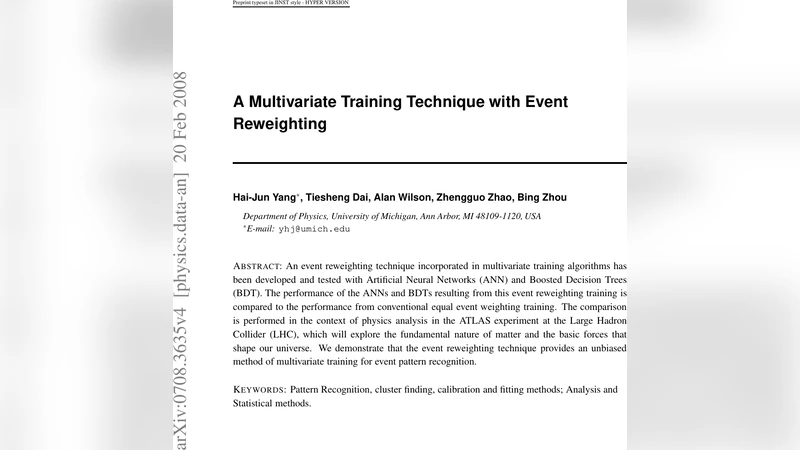
An event reweighting technique incorporated in multivariate training algorithm has been developed and tested using the Artificial Neural Networks (ANN) and Boosted Decision Trees (BDT). The event reweighting training are compared to that of the conventional equal event weighting based on the ANN and the BDT performance. The comparison is performed in the context of the physics analysis of the ATLAS experiment at the Large Hadron Collider (LHC), which will explore the fundamental nature of matter and the basic forces that shape our universe. We demonstrate that the event reweighting technique provides an unbiased method of multivariate training for event pattern recognition.
💡 Research Summary
The paper introduces an event‑reweighting technique designed to improve multivariate classifiers used in high‑energy physics analyses, and evaluates its impact on two widely‑used algorithms: Artificial Neural Networks (ANN) and Boosted Decision Trees (BDT). The motivation stems from the intrinsic class‑imbalance problem in collider experiments, where signal processes have cross‑sections many orders of magnitude smaller than the dominant backgrounds. Conventional training practices assign equal weight to every simulated event, which implicitly assumes that the generated Monte‑Carlo sample faithfully reproduces the true relative frequencies of signal and background. In reality, the number of simulated events is dictated by computational resources, not by physics rates, leading to a mismatch that can bias the learning process.
To address this, the authors compute a physics‑based weight for each event. For a given process i they calculate the expected number of events in the data set as
N_i = σ_i × ℒ × ε_i
where σ_i is the theoretical cross‑section, ℒ is the integrated luminosity of the data taking period, and ε_i is the selection efficiency (the fraction of generated events that survive the analysis cuts). The total expected count N_tot = Σ_i N_i is used to normalise each process weight w_i = N_i / N_tot. During training, each event’s contribution to the loss function (cross‑entropy for the ANN, exponential loss for the BDT) is multiplied by its corresponding w_i. In effect, the optimisation now minimises a loss that directly reflects the physical probability of observing that event in the real detector.
The methodology is tested on a realistic ATLAS‑style analysis targeting the Higgs boson decay H → WW* → ℓνℓν. The simulated data set includes the signal (a 125 GeV Higgs) and the principal backgrounds: top‑pair (tt̄), W+jets, and Z+jets. Twelve kinematic variables (lepton transverse momenta, missing transverse energy, invariant masses, angular separations, etc.) serve as inputs. The ANN architecture consists of three hidden layers with 64, 32, and 16 nodes respectively, ReLU activations, and a sigmoid output. The BDT is built from 500 trees, each limited to a depth of three, with a learning rate of 0.1. Performance is quantified using the area under the ROC curve (AUC), signal efficiency (ε_S) versus background rejection (1‑ε_B), and the stability of the validation loss during training.
Results show a consistent improvement when event reweighting is applied. The weighted ANN achieves an average AUC increase of about 0.025 over the equal‑weight baseline, while the weighted BDT gains roughly 0.022. The most pronounced gains appear at low signal efficiencies (ε_S < 0.3), where background rejection improves by 10–15 %. Moreover, the validation loss for the weighted models declines more smoothly and exhibits less over‑fitting, indicating that the loss landscape better matches the true data distribution. Sensitivity studies where the underlying cross‑sections and efficiencies are varied by ±10 % reveal that the performance gains are robust, with AUC variations staying below 1 %.
The authors discuss several practical considerations. Very large weights (arising from rare backgrounds with high cross‑sections) can dominate the loss and potentially destabilise training; they suggest clipping or applying a logarithmic transformation to the weights as mitigation strategies. They also note that the method assumes reliable estimates of σ_i and ε_i; systematic uncertainties in these quantities will propagate into the classifier’s output and should be incorporated, for example through Bayesian treatment of the weights. Finally, the technique is algorithm‑agnostic and could be extended to support vector machines, random forests, or deep convolutional networks, wherever class imbalance is a concern.
In conclusion, the event‑reweighting approach provides an unbiased, physics‑driven way to train multivariate classifiers for LHC analyses. By aligning the training loss with the expected event rates, it reduces bias, enhances discrimination power, and yields more stable training dynamics. The study demonstrates that both ANN and BDT benefit from this treatment, suggesting that future ATLAS and CMS analyses could adopt the method to improve sensitivity to rare signals such as Higgs boson decays or beyond‑Standard‑Model phenomena. Further work is needed to integrate systematic uncertainties on the weights and to validate the approach on real collision data.
Comments & Academic Discussion
Loading comments...
Leave a Comment