Science-Based Comparative Culture: A New Theme of Experiment for Freshmen in Tohoku University
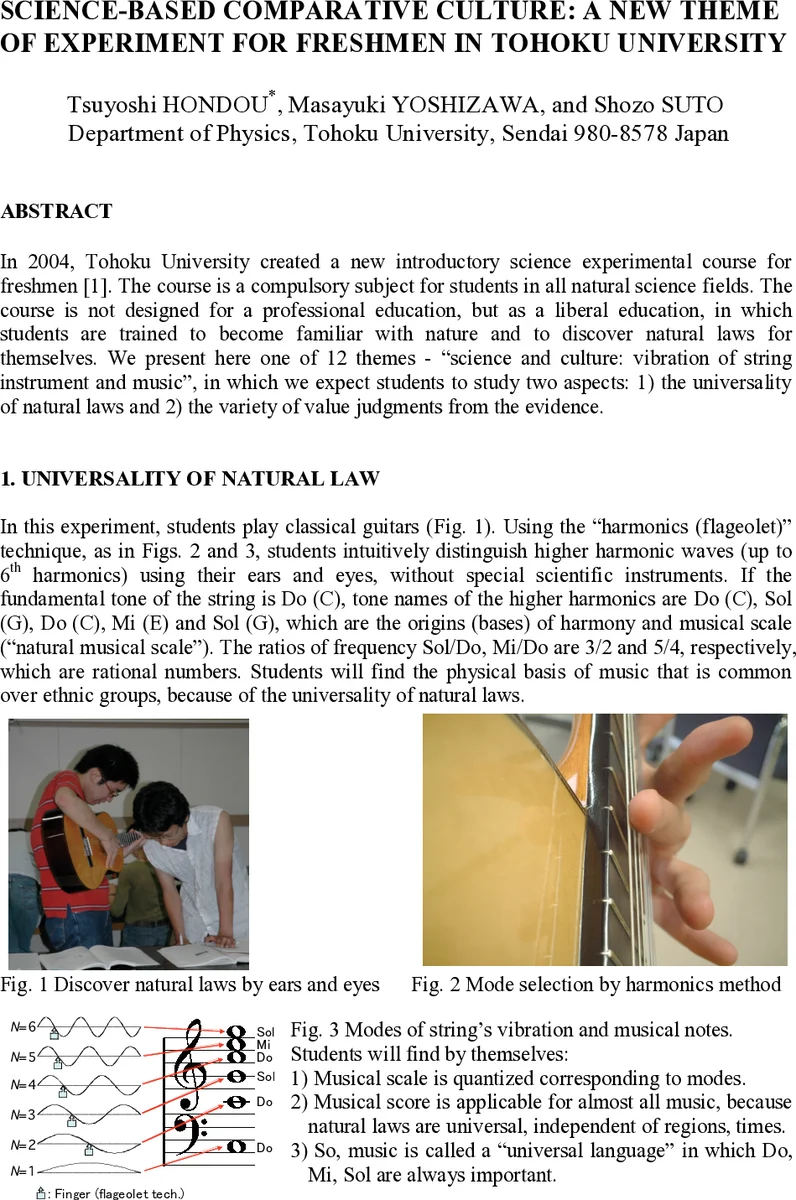
In 2004, Tohoku University created a new introductory science experimental course for freshmen. The course is a compulsory subject for students in all natural science fields. The course is not designed for a professional education, but as a liberal education, in which students are trained to become familiar with nature and to discover natural laws for themselves. We present here one of 12 themes - “science and culture: vibration of string instrument and music”, in which we expect students to study two aspects: 1) the universality of natural laws and 2) the variety of value judgments from the evidence.
💡 Research Summary
In 2004 Tohoku University introduced a compulsory introductory science‑experiment course for all freshmen in the natural‑science streams. Unlike a professional training program, the course is positioned as a liberal‑education experience: students are expected to engage directly with nature, discover physical laws on their own, and reflect on the cultural meanings that arise from scientific evidence. The paper focuses on one of the twelve thematic modules, “Science and Culture: Vibration of String Instruments and Music,” and outlines how it simultaneously addresses two pedagogical goals: (1) the universality of natural laws and (2) the plurality of value judgments that stem from the same empirical data.
The module is organized around a four‑stage learning cycle. First, students are prompted to formulate a concrete research question such as “Why do different string instruments produce different pitches?” Second, they design an experiment in which they systematically vary string length, tension, and linear mass density, using microphones and spectrum‑analysis software to record the resulting sound waves. Third, they collect and analyze data, comparing measured fundamental frequencies with the theoretical prediction f = (1/2L)·√(T/μ). In this stage, students also discuss sources of experimental error (air damping, instrument imperfections, measurement resolution) and learn to quantify uncertainty.
The fourth stage moves beyond pure physics. Students are asked to interpret the same data in cultural contexts, comparing Western violins, Japanese shamisen, Korean gayageum, and other traditional instruments. They examine how differences in construction, playing technique, and aesthetic ideals produce distinct timbres, and they discuss the social, emotional, and symbolic roles of music in each culture. The outcome is presented as a poster that is evaluated on two dimensions: scientific rigor (accuracy of measurements, alignment with theory) and cultural insight (depth of interdisciplinary interpretation).
From an educational‑research perspective, the authors argue that this design achieves several important outcomes. By integrating a hard‑science experiment with a humanities‑oriented discussion, the module cultivates both analytical problem‑solving skills and reflective, interdisciplinary thinking. The explicit contrast between “universal law” and “cultural variability” demonstrates that while scientific evidence is objective, its meaning is mediated by cultural values, thereby fostering a nuanced view of science as a socially embedded activity. Moreover, the dual‑criterion assessment model departs from traditional exam‑centric grading, rewarding students for both technical competence and the ability to situate scientific findings within broader cultural narratives.
The paper also suggests that the framework is readily transferable to other scientific domains. For instance, optics experiments could be linked to visual arts, and chemical reaction studies could be tied to culinary traditions, creating a suite of “science‑culture” modules that reinforce the liberal‑education mission across the curriculum.
In conclusion, the “Science and Culture: Vibration of String Instruments and Music” module exemplifies how a freshman‑level experiment can serve as a microcosm for the university’s broader educational philosophy. It enables students to experience the universality of physical laws through hands‑on measurement while simultaneously appreciating how those laws acquire diverse meanings in different cultural settings. The authors present this as a successful pilot that can be adopted by other institutions seeking to blend rigorous scientific training with cultural literacy, thereby preparing graduates who are both scientifically competent and culturally aware.
Comments & Academic Discussion
Loading comments...
Leave a Comment