Structure of Ann-categories and Mac Lane - Shukla cohomology
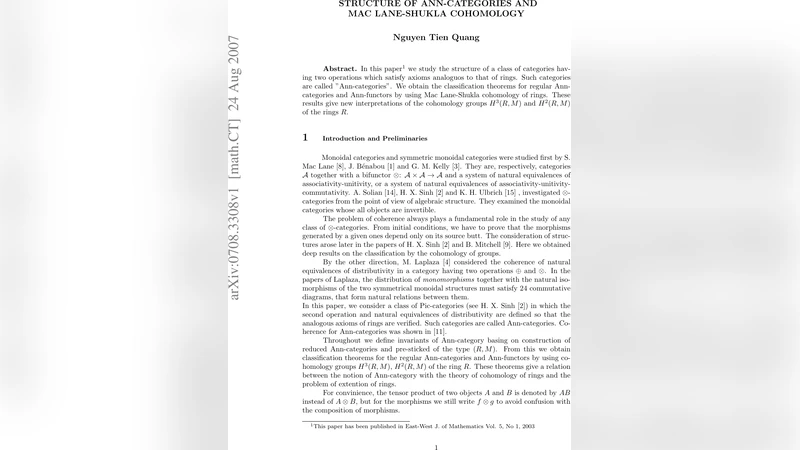
In this paper we study the structure of a class of categories having two operations which satisfy axioms analoguos to that of rings. Such categories are called “Ann - categories”. We obtain the classification theorems for regular Ann - categories and Ann - functors by using Mac Lane - Shukla cohomology of rings. These results give new interpretations of the cohomology groups and of the rings
💡 Research Summary
The paper introduces and studies a new categorical structure called an “Ann‑category”, which is a category equipped with two binary operations that satisfy axioms analogous to those of a ring. An object set carries an additive monoidal structure ((\mathcal{A},\oplus,0)) and a multiplicative monoidal structure ((\mathcal{A},\otimes,1)). The two structures are linked by natural distributivity constraints and coherence conditions that mimic the distributive law, associativity, and unit laws of ordinary rings. When these constraints are strict (i.e., the associators and distributors are identities), the Ann‑category is called regular.
To classify such categories, the author brings in Mac Lane–Shukla cohomology, a hybrid of Mac Lane cohomology (originally designed for non‑commutative rings) and Shukla cohomology (the commutative analogue). For a base ring (R) and an (R)-bimodule (M) that simultaneously supports the additive and multiplicative actions, a cochain complex (C^{\bullet}{\mathrm{ML}}(R,M)) is constructed. Its differential combines the usual Hochschild‑type differential with the Shukla part, producing cohomology groups (H^{n}{\mathrm{ML}}(R,M)).
The central result (Theorem 4.1) states that the equivalence classes of regular Ann‑categories with underlying ring (R) and bimodule of morphisms (M) are in bijection with the third Mac Lane–Shukla cohomology group (H^{3}_{\mathrm{ML}}(R,M)). The proof proceeds by extracting from an Ann‑category a triple ((\alpha,\lambda,\rho)) consisting of the associator for (\otimes) and the left/right distributivity natural isomorphisms. These data satisfy precisely the 3‑cocycle condition in the cochain complex; two categories are equivalent exactly when their triples differ by a coboundary. Consequently, each cohomology class represents a distinct “type” of Ann‑category.
A parallel classification is obtained for Ann‑functors (structure‑preserving functors between Ann‑categories). An Ann‑functor is described by a pair of natural transformations ((\theta,\sigma)) that respect both (\oplus) and (\otimes). These give rise to a 2‑cocycle, and the equivalence classes of Ann‑functors correspond to elements of (H^{2}_{\mathrm{ML}}(R,M)). This mirrors the classical description of ring extensions by second cohomology, but now the “extension” lives in the categorical world and simultaneously encodes additive and multiplicative data.
The paper supplies concrete examples. For the integer ring (\mathbb{Z}) with the standard (\mathbb{Z})‑module, one computes (H^{3}{\mathrm{ML}}(\mathbb{Z},\mathbb{Z})=0); thus any regular Ann‑category over (\mathbb{Z}) is equivalent to the ordinary category of (\mathbb{Z})‑modules with the usual addition and tensor product. In contrast, for a non‑commutative ring such as (\mathbb{F}{p}
Comments & Academic Discussion
Loading comments...
Leave a Comment