Noise-guided evolution within cyclical interactions
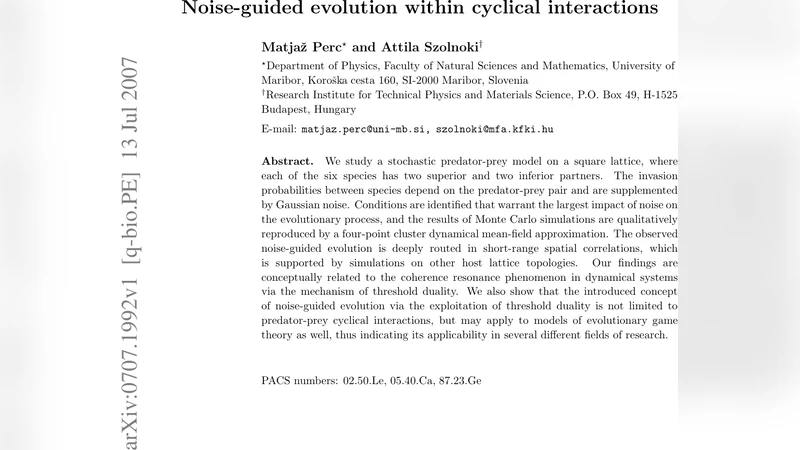
We study a stochastic predator-prey model on a square lattice, where each of the six species has two superior and two inferior partners. The invasion probabilities between species depend on the predator-prey pair and are supplemented by Gaussian noise. Conditions are identified that warrant the largest impact of noise on the evolutionary process, and the results of Monte Carlo simulations are qualitatively reproduced by a four-point cluster dynamical mean-field approximation. The observed noise-guided evolution is deeply routed in short-range spatial correlations, which is supported by simulations on other host lattice topologies. Our findings are conceptually related to the coherence resonance phenomenon in dynamical systems via the mechanism of threshold duality. We also show that the introduced concept of noise-guided evolution via the exploitation of threshold duality is not limited to predator-prey cyclical interactions, but may apply to models of evolutionary game theory as well, thus indicating its applicability in several different fields of research.
💡 Research Summary
The paper investigates how stochastic fluctuations (Gaussian white noise) can fundamentally alter the evolutionary dynamics of a spatial predator‑prey system with cyclic dominance. The authors consider a six‑species model on a square lattice where each species has two superior and two inferior partners, forming a closed loop of dominance reminiscent of the rock‑paper‑scissors‑lizard‑Spock family. In the deterministic version, invasion probabilities are fixed and the system quickly settles into a mosaic of domains that either coexist or lead to the extinction of some species, depending on the initial conditions and the lattice geometry.
To mimic environmental variability, the authors add a Gaussian random term η with zero mean and controllable standard deviation σ to each invasion probability. When the noisy probability exceeds the logical bounds of 0 and 1, the direction of invasion can reverse, effectively allowing a normally inferior species to overtake a superior one. By systematically varying σ, they discover a non‑monotonic response: very low noise leaves the deterministic pattern unchanged, very high noise destroys spatial structure and drives the system toward a well‑mixed, neutral state, but an intermediate range of σ (≈0.2–0.4) maximally amplifies the impact of noise. In this regime a particular species can become disproportionately abundant—a phenomenon the authors term “noise‑guided evolution.”
The underlying mechanism is identified as a “threshold duality.” Each invasion probability has two critical thresholds: one above which the predator reliably invades, and another below which the prey can successfully resist. Noise that is comparable to the gap between these thresholds can push the effective probability back and forth across them, dramatically increasing the likelihood of rare reversal events. This is directly analogous to coherence resonance in excitable dynamical systems, where an optimal noise level maximizes the regularity of noise‑induced spikes.
To support the simulation results analytically, the authors employ a four‑point cluster dynamical mean‑field (CDMF) approximation. By treating a quartet of neighboring sites as a single correlated unit, the CDMF captures short‑range spatial correlations that are invisible to simple pair approximations. The CDMF equations reproduce the Monte‑Carlo data quantitatively, confirming that the observed amplification of noise is rooted in local correlation structures rather than global mean‑field effects.
The robustness of the phenomenon is tested on alternative network topologies. On a triangular lattice (six neighbors per site) the effect is even stronger because the higher coordination enhances local correlation, while on random graphs with longer average path lengths the effect weakens. This confirms that short‑range connectivity is a prerequisite for the threshold‑duality mechanism to operate.
Finally, the authors extend the concept to evolutionary game theory. They embed the same noisy invasion rule into a two‑strategy (cooperate‑defect) game on a lattice. Again, intermediate noise levels can either promote or suppress cooperation depending on the payoff matrix, showing that noise‑guided evolution is not confined to predator‑prey cycles but is a generic feature of systems where interaction outcomes are governed by thresholded probabilities.
In summary, the study demonstrates that (i) stochastic fluctuations can be harnessed to steer evolutionary outcomes, (ii) the effect hinges on a dual‑threshold structure of interaction probabilities, (iii) short‑range spatial correlations amplify the impact of noise, (iv) a four‑point cluster mean‑field theory accurately predicts the phenomenon, and (v) the principle applies across different network topologies and even to strategic games. These insights open new avenues for controlling ecological or socio‑economic systems by deliberately tuning environmental variability, and they bridge concepts from statistical physics, nonlinear dynamics, and evolutionary game theory.
Comments & Academic Discussion
Loading comments...
Leave a Comment