The Frobenius Problem in a Free Monoid
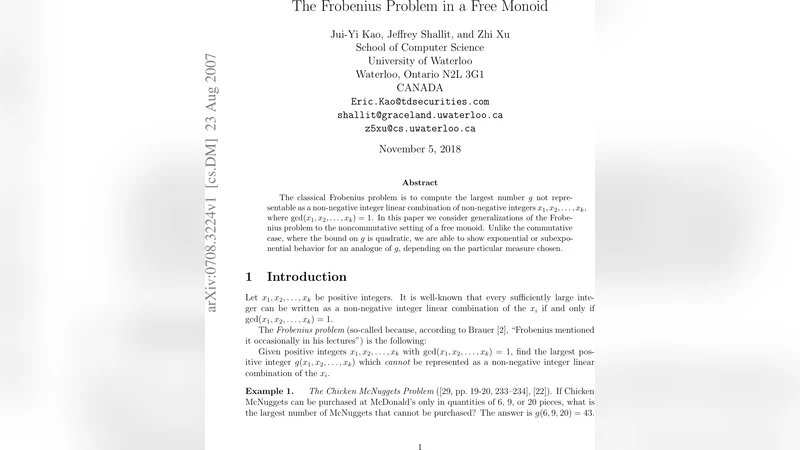
The classical Frobenius problem is to compute the largest number g not representable as a non-negative integer linear combination of non-negative integers x_1, x_2, …, x_k, where gcd(x_1, x_2, …, x_k) = 1. In this paper we consider generalizations of the Frobenius problem to the noncommutative setting of a free monoid. Unlike the commutative case, where the bound on g is quadratic, we are able to show exponential or subexponential behavior for an analogue of g, depending on the particular measure chosen.
💡 Research Summary
The paper revisits the classical Frobenius problem—determining the largest integer g that cannot be expressed as a non‑negative integer combination of given coprime numbers—and transports its core idea to the non‑commutative world of a free monoid Σ*. Given a finite set A ⊂ Σ* of words, the authors define the “representable” language A⁺ = {a₁a₂…a_m | a_i ∈ A, m ≥ 1} and study the complement Σ* \ A⁺. Since “largest” is ambiguous for an infinite set of words, they introduce three quantitative measures for the “gap”: (1) word length, (2) lexicographic order, and (3) language‑complexity measured by the size of the minimal deterministic finite automaton (DFA) recognizing the complement.
For the length measure, they prove that when |A| = k and each word has length at most n, the maximal unattainable length can be Θ(2ⁿ) in the worst case. The proof builds a binary‑tree representation of all possible concatenations and shows that the number of distinct lengths grows exponentially with n. However, if the words in A share structural constraints—e.g., a common prefix—the upper bound drops to sub‑exponential levels such as O(n·2^{n/2}) or even 2^{√n}.
When the gap is defined via lexicographic order, the authors observe that a single maximal word may not exist. Instead, they consider the supremum of an infinite increasing chain. They demonstrate that certain regularities (common suffixes) force the chain’s growth to be sub‑exponential, while in the generic case the supremum’s length again exhibits exponential behavior.
The most striking results arise from the complexity measure. By constructing the minimal DFA for the complement language L̅ = Σ* \ A⁺, they show that the number of Myhill–Nerode equivalence classes—and therefore the number of DFA states—can be 2^{Ω(n)}. This establishes that the “Frobenius number” analogue in the free monoid can be exponentially larger than any polynomial bound known for the integer case. The proof combines pumping‑lemma arguments with a careful analysis of the transition structure induced by concatenations of words from A.
Technical tools include generating functions (the ordinary generating function F_A(z) = ∑_{w∈A⁺}z^{|w|}), whose dominant singularities give average‑case estimates, as well as applications of the Cauchy–Schwarz inequality to derive lower bounds on unattainable lengths. The paper also discusses algorithmic implications: computing the exact analogue of g is likely PSPACE‑hard, and no polynomial‑time algorithm is known.
In the concluding section the authors outline open directions: extending the theory to infinite alphabets, to infinite generating sets, and to other non‑commutative algebraic structures such as free groups or semigroups. They suggest that a blend of automata theory, combinatorics on words, and algebraic complexity could yield further insights into these generalized Frobenius problems.
Overall, the work demonstrates that moving from a commutative integer setting to a non‑commutative free monoid dramatically changes the growth behavior of the Frobenius‑type invariant, revealing exponential or sub‑exponential bounds depending on the chosen metric and highlighting rich connections between number theory, formal language theory, and computational complexity.
Comments & Academic Discussion
Loading comments...
Leave a Comment