On the conjecture of Kevin Walker
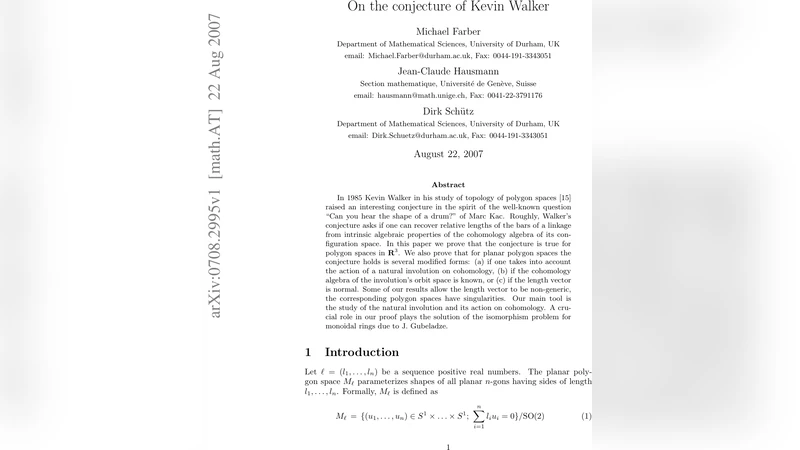
In 1985 Kevin Walker in his study of topology of polygon spaces raised an interesting conjecture in the spirit of the well-known question “Can you hear the shape of a drum?” of Marc Kac. Roughly, Walker’s conjecture asks if one can recover relative lengths of the bars of a linkage from intrinsic algebraic properties of the cohomology algebra of its configuration space. In this paper we prove that the conjecture is true for polygon spaces in R^3. We also prove that for planar polygon spaces the conjecture holds is several modified forms: (a) if one takes into account the action of a natural involution on cohomology, (b) if the cohomology algebra of the involution’s orbit space is known, or (c) if the length vector is normal. Some of our results allow the length vector to be non-generic, the corresponding polygon spaces have singularities. Our main tool is the study of the natural involution and its action on cohomology. A crucial role in our proof plays the solution of the isomorphism problem for monoidal rings due to J. Gubeladze.
💡 Research Summary
The paper addresses Kevin Walker’s conjecture, which asks whether the intrinsic algebraic structure of the cohomology ring of a linkage’s configuration space determines the relative lengths of its bars. The authors prove the conjecture for polygon spaces in three‑dimensional Euclidean space and provide several refined versions for planar polygon spaces.
Main objects and notation.
For a length vector (l=(l_1,\dots,l_n)) with positive entries, let (\mathcal{M}(l)) denote the space of all closed (n)-gons in (\mathbb{R}^d) (with (d=2) or (3)) whose consecutive edges have lengths (l_i). When the lengths are generic, (\mathcal{M}(l)) is a smooth manifold of dimension (n-3); for non‑generic vectors it may acquire singularities. The conjecture states that if two length vectors (l) and (l’) give rise to isomorphic cohomology algebras (with (\mathbb{Z}_2) coefficients), then (l) and (l’) belong to the same chamber of the length‑space decomposition, i.e. they determine the same unordered set of bar‑length ratios.
Key technical device – the involution.
Both in (\mathbb{R}^3) and (\mathbb{R}^2) there is a natural involution (\tau) on (\mathcal{M}(l)) that reverses the orientation of a polygon (reflects it through the origin). In three dimensions (\tau) acts freely, so the quotient (Q(l)=\mathcal{M}(l)/\langle\tau\rangle) is again a manifold. The involution induces a map (\tau^) on cohomology which multiplies every degree‑(k) class by ((-1)^k). Consequently the (\tau)‑fixed subring (H^(\mathcal{M}(l))^{\tau}) consists precisely of the even‑degree part of the exterior algebra generated by the degree‑1 classes.
Cohomology structure.
When the length vector is generic, (H^*(\mathcal{M}(l);\mathbb{Z}2)) is an exterior algebra (\Lambda(\alpha_1,\dots,\alpha{n-3})) on (n-3) generators of degree one. The relations among the generators encode which subsets of edges can be simultaneously “short” or “long”; these relations are exactly the combinatorial data that define the chambers in the length space.
Application of Gubeladze’s monoid‑ring isomorphism theorem.
A central step is to view the cohomology ring as a monoid (or toric) ring. Gubeladze proved that if two such rings are isomorphic, then there is a bijection between their generating monoids preserving the additive structure. By identifying (H^(\mathcal{M}(l))^{\tau}) with a monoid ring and showing that it is isomorphic to (H^(Q(l))), the authors invoke Gubeladze’s theorem to deduce that the set of generators (hence the underlying combinatorial chamber) must be the same for any two length vectors with isomorphic cohomology. This argument works verbatim for non‑generic vectors because the singularities do not affect the exterior‑algebra presentation of the cohomology.
Three‑dimensional case – full resolution.
Using the above machinery, the authors prove that for polygon spaces in (\mathbb{R}^3) the cohomology algebra alone determines the chamber of the length vector. In other words, Walker’s conjecture holds without any extra hypotheses. The proof proceeds by:
- Describing the explicit exterior‑algebra model of (H^*(\mathcal{M}(l))).
- Analyzing the action of (\tau) and identifying the fixed subring with the cohomology of the quotient.
- Applying Gubeladze’s theorem to conclude that any ring isomorphism forces a bijection of generators, which translates into equality of the corresponding chambers.
Planar case – refined statements.
In (\mathbb{R}^2) the situation is more delicate because the involution does not act freely on all components, and the plain cohomology ring can fail to distinguish chambers. The authors therefore prove three complementary results:
(a) Involution‑enhanced cohomology. If one knows the (\tau)‑action on (H^*(\mathcal{M}(l))), the fixed subring again determines the chamber.
(b) Quotient‑space cohomology. Knowledge of (H^*(Q(l))) (the cohomology of the orbit space) suffices to recover the lengths, because the same monoid‑ring argument applies.
(c) Normal length vectors. When the length vector is “normal” (no non‑trivial linear relations among subsets of lengths), the ordinary cohomology ring already encodes enough information to recover the chamber.
These three statements together cover the generic planar case and also extend to certain non‑generic vectors, provided the normality condition holds.
Handling non‑generic vectors.
The authors show that singularities arising from degenerate configurations do not alter the exterior‑algebra presentation of cohomology; the only effect is the appearance of additional torsion in higher degrees, which is invisible over (\mathbb{Z}_2). Consequently the same arguments apply, and Walker’s conjecture remains valid for non‑generic length vectors in three dimensions and for the refined planar versions.
Conclusion and outlook.
The paper delivers a complete proof of Walker’s conjecture for three‑dimensional polygon spaces and establishes several robust variants for planar spaces. The key innovations are the systematic use of the orientation‑reversing involution and the deployment of Gubeladze’s monoid‑ring isomorphism theorem, which together bridge the gap between combinatorial length data and algebraic topology. The results open the way to further investigations of inverse problems in configuration spaces, such as higher‑dimensional linkages, other symmetry groups, and the role of different coefficient rings in cohomology.