On Reedy Model Categories
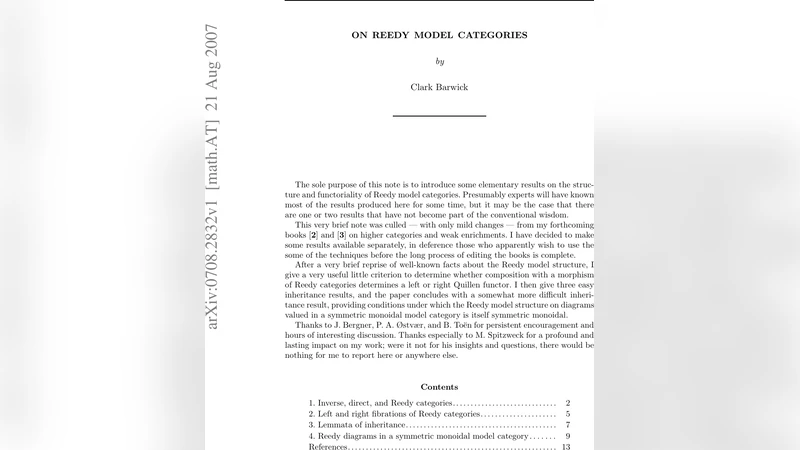
The sole purpose of this note is to introduce some elementary results on the structure and functoriality of Reedy model categories. In particular, I give a very useful little criterion to determine whether composition with a morphism of Reedy categories determines a left or right Quillen functor. I then give a number of useful inheritance results.
💡 Research Summary
The paper “On Reedy Model Categories” is a concise yet thorough exposition of elementary properties of Reedy model categories and their functorial behavior. It begins by recalling the definition of a Reedy category: a small category equipped with a degree function assigning a natural number to each object and two sub‑categories—direct and inverse—governing morphisms that raise or lower degree. When a model category 𝓜 is given, the diagram category 𝓜^ℛ (functors from a Reedy category ℛ to 𝓜) inherits a canonical model structure, often called the Reedy model structure. In this structure weak equivalences are defined objectwise, cofibrations are the so‑called Reedy cofibrations (maps whose latching maps are cofibrations in 𝓜), and fibrations are the Reedy fibrations (maps whose matching maps are fibrations in 𝓜).
The central contribution of the note is a very practical criterion for deciding when pre‑composition with a functor φ: ℛ → 𝒮 between Reedy categories yields a left or right Quillen functor. Classical treatments require checking that φ preserves certain (co)limits and that the induced functor respects latching and matching objects. The author shows that it suffices to verify that φ is a Reedy functor (i.e., for each object s in 𝒮 the subcategory φ⁻¹(≤s) is finite and φ does not increase degree) or an inverse Reedy functor (the dual condition). If φ is Reedy, the induced functor φ⁎: 𝓜^𝒮 → 𝓜^ℛ is automatically a left Quillen functor; if φ is inverse Reedy, φ⁎ is a right Quillen functor. This “one‑line” test replaces a host of technical verifications and is especially valuable when dealing with large families of diagram categories.
After establishing the criterion, the paper explores several inheritance results. First, the author proves that slice and coslice categories of a Reedy model category inherit a Reedy model structure whenever the base object is itself a Reedy diagram. The Quillen adjunctions induced by morphisms of Reedy categories descend to these slices without extra hypotheses. Second, the paper examines Bousfield localizations: if L is a pointwise localization of 𝓜, then the Reedy model structure on 𝓜^ℛ commutes with L‑localization, producing an L‑local Reedy model structure. This shows that one can localize before or after forming diagram categories with no loss of homotopical information. Third, for cofibrantly generated model categories, the author explicitly describes how the generating (co)fibration sets are transferred along φ⁎. When φ is Reedy, the generating cofibrations of 𝓜^𝒮 pull back to a set of generating cofibrations for 𝓜^ℛ; dually, inverse Reedy functors transport generating fibrations.
The note also includes a handful of illustrative examples. Simplicial and cosimplicial objects are treated as diagrams over the simplex category Δ, which is a classic Reedy category; the criterion recovers the well‑known fact that restriction along the inclusion Δ_{≤n} → Δ is a left Quillen functor. The author discusses chain complexes indexed by the category of finite ordinals with order‑preserving maps, showing how the Reedy criterion simplifies the construction of projective model structures on such complexes. Additional examples involve diagram categories over product Reedy categories, demonstrating that the criterion behaves well under Cartesian products.
In the concluding remarks, the author suggests several avenues for future work: extending the criterion to ∞‑categorical Reedy structures, investigating “multi‑Reedy” categories where objects carry several independent degree functions, and applying the inheritance results to equivariant homotopy theory and motivic homotopy theory, where diagram categories often arise from orbit or indexing categories that are naturally Reedy.
Overall, the paper delivers a compact but potent toolkit for researchers working with diagrammatic homotopy theory. By reducing the verification of Quillen adjunctions to a simple condition on the underlying functor of Reedy categories, it streamlines many constructions in model category theory, and the inheritance theorems guarantee that these constructions remain robust under slicing, localization, and cofibrant generation. The results are likely to become standard references for anyone building or manipulating Reedy model structures in algebraic topology, higher category theory, or related fields.