Harmonic nets in metric spaces
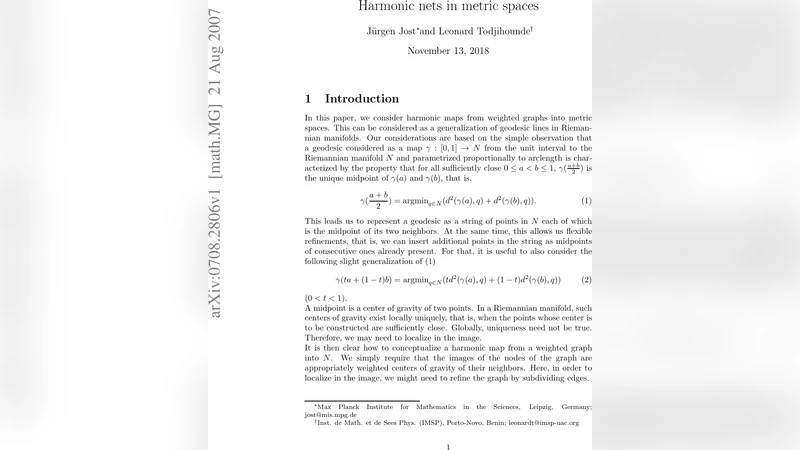
We investigate harmonic maps from weighted graphs into metric spaces that locally admit unique centers of gravity, like Alexandrov spaces with upper curvature bounds. We prove an existence result by constructing an iterative geometric process that converges to such maps, called harmonic nets for short.
💡 Research Summary
The paper “Harmonic nets in metric spaces” extends the classical theory of harmonic maps—traditionally defined between smooth manifolds or Euclidean spaces—to the setting of weighted graphs mapping into general metric spaces that admit locally unique centers of gravity. The authors focus on spaces where, for any finite collection of points with positive weights, the weighted least‑squares minimizer (the “center of gravity”) exists and is unique. Alexandrov spaces with an upper curvature bound are the primary example of such spaces, because their curvature restriction guarantees the uniqueness of geodesic midpoints and thus of weighted centers.
The central object of study is a map f from the vertex set V of a weighted graph G=(V,E,w) into a metric space (X,d). The map is called harmonic if, for every vertex v, the image f(v) coincides with the weighted center of gravity of the images of its neighboring vertices N(v), using the edge weights w_{vu} as the coefficients. This condition is equivalent to the vanishing of the discrete Dirichlet energy
E(f)=½∑{(u,v)∈E} w{uv} d(f(u),f(v))^2,
so harmonic maps are precisely the energy minimizers among all maps V→X.
To construct such maps, the authors introduce a “harmonicization operator” T. Given any map f, (Tf)(v) is defined as the unique weighted center of gravity of {f(u)}{u∈N(v)} with weights {w{vu}}. The operator T is shown to be non‑expansive (i.e., it does not increase the distance between two maps) and to satisfy E(Tf) ≤ E(f). Consequently, iterating T produces a sequence f_{k+1}=Tf_k that monotonically decreases the energy and remains bounded. By invoking fixed‑point theorems for non‑expansive maps in complete metric spaces, together with an Opial‑type convergence argument, the authors prove that the sequence {f_k} converges strongly to a fixed point f* of T. This fixed point is exactly a harmonic map, and the authors refer to the limiting configuration as a “harmonic net.”
The convergence proof proceeds in several steps. First, the decreasing energy sequence is shown to converge to a limit because it is bounded below by zero. Second, the authors establish that any weak cluster point of {f_k} must be a fixed point of T, using the uniqueness of centers of gravity. Third, under the curvature bound (e.g., non‑positive curvature), the weak convergence upgrades to strong convergence, guaranteeing that the entire sequence—not just a subsequence—converges to the harmonic net.
Beyond the theoretical existence result, the paper discusses algorithmic aspects. Computing a weighted center of gravity in an Alexandrov space reduces to solving a convex optimization problem that can be tackled by standard numerical methods, especially when the target space is a model space such as a hyperbolic space or a CAT(k) space. The authors suggest applications in image registration, non‑linear dimensionality reduction on graphs, and physical lattice models where the underlying geometry is non‑Euclidean.
Finally, the authors acknowledge limitations. The requirement of a locally unique center of gravity excludes metric spaces with positive curvature or those lacking convexity properties, and the current analysis does not cover dynamic graphs or stochastic edge weights. Future work is proposed on extending the framework to spaces without curvature bounds, developing efficient approximations for the center‑of‑gravity computation, and studying the behavior of harmonic nets under graph evolution.
In summary, the paper provides a rigorous geometric construction of harmonic maps from weighted graphs into a broad class of metric spaces, establishes convergence of an iterative “harmonicization” process, and opens new avenues for applying harmonic map theory to discrete structures and non‑linear geometric data analysis.
Comments & Academic Discussion
Loading comments...
Leave a Comment